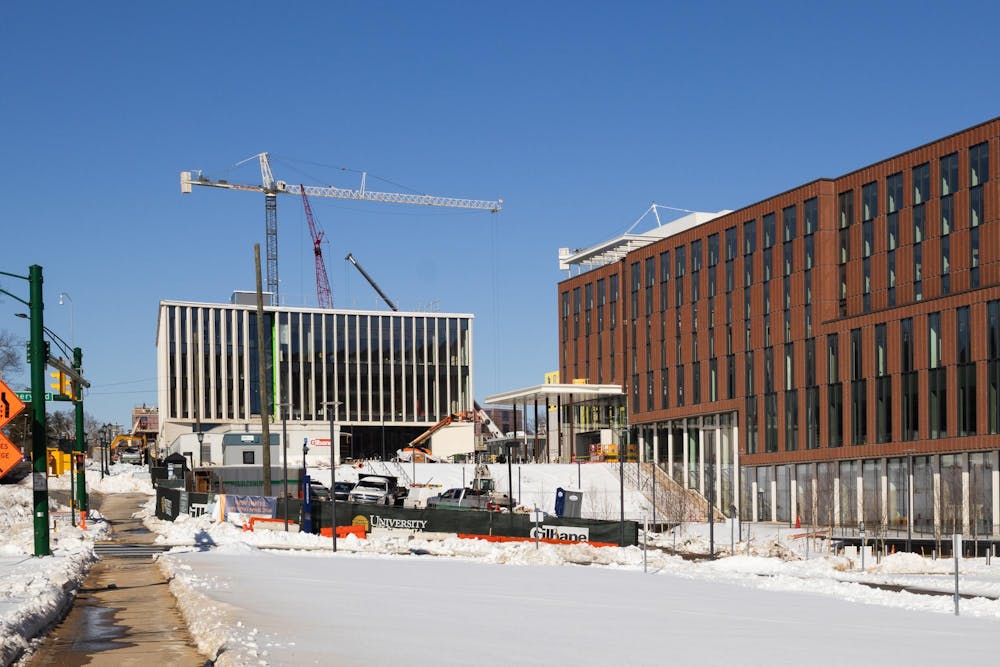
Located at the intersection of Emmet Street and Ivy Road, the University has planned a major expansion of academic buildings and student housing called the Ivy Corridor. The construction of upperclassmen student housing — two six-story buildings with a total capacity of 750-800 beds — is one of the major projects in progress on the corridor.
Planning for Ivy Corridor began in 2016 and the project as a whole is expected to be completed by 2027. According to its website, the Ivy Corridor is a hub of “creativity, democracy and discovery.” Sitting on 14.5 acres, the project, which aims to serve as an academic and cultural center, is located at the crossroads of Central Grounds, North Grounds and Athletic Grounds.
The construction of the Ivy Corridor housing was approved by the Board of Visitors Buildings and Grounds Committee in February 2025 with a $160 million budget. The Committee recognized that there was an 81 percent increase in applications for upperclassmen on-Grounds housing from the Fall of 2021 to the Fall of 2025, and the increased demand led to a shortage in on-Grounds housing.
Additionally, the student housing buildings will include dining and retail accommodations. In a statement to The Cavalier Daily, University Spokesperson Bethanie Glover said that the dining component will likely have two restaurants, a coffee shop and a convenience store. Glover also said that students helped in the development process of the designs and participated in the committee that ultimately selected the project team — Capstone Development Partners, Elkus Manfredi Architects and a joint venture between Hoar and Hourigan Construction. According to Glover, the buildings are planned to be ready for students to live in for the 2027-2028 academic year.
The initiative to develop more housing on Grounds for upperclassmen was a part of former University President Jim Ryan’s 2030 “Great and Good Plan,” which aspired to house all second-year students on Grounds by 2030. The plan was created in 2019 when the University had an on-Grounds upperclassmen housing capacity of 2,409 students, which then increased to 2,797 following the opening of Gaston and Ramazani Houses in the Fall of 2024.
When complete, the Ivy Corridor housing will increase upperclassmen housing capacity to 3,577 beds, around 400 short of a typical class, which typically hovers around 4,000 students. The University stated that the price of on-Grounds housing is not anticipated to largely increase as a result of the project.
For several students, the expansion of on-Grounds housing options may alleviate stress felt throughout the off-Grounds housing search process. For students who choose to seek off-Grounds housing, the process can begin as early as September of a student’s first year. Additionally, on-Grounds housing is often cheaper than off Grounds housing, as leases are signed for nine months instead of 12, respectively.
First-year College student Aleesha Askari said that she experienced stress during her search for second-year housing. She considered living both on- and off-Grounds, and said she hopes that new on-Grounds housing options will lessen the stress future first-year students often undergo while searching for second-year housing.
“I know everyone signs their leases really quickly,” Askari said. “Getting housing is a stressful process, so I think the fact that they’re adding more [on-Grounds] housing is good because it’ll help mitigate some of [the housing search] stress.”
Similarly, third-year College student Nithya Muthukumar also said she sees the mandate from the 2030 plan for second-years to live on Grounds as a way to lessen the stress of the housing search process. Muthukumar said she was startled in her first year by the early start to the off-Grounds housing search, and that she was relieved when she had on-Grounds housing options to fall back on.
Muthukumar also said she believes the location of Ivy Corridor is relatively far from Central Grounds, which may present a hassle for students who will live there.
“I think the location of the housing, if it's near the [School of Data Science], might be a little bit difficult for a lot of those students to get around, unless they are a data science major,” Muthukumar said.
Though student housing is a major focus of the current Ivy Corridor construction, the area will also consist of several other University buildings. Currently, the only finished building in the Ivy Corridor is the School of Data Science, which opened April 2024. The Virginia Guesthouse is planned to open in April and will serve as a Hotel and Conference Center.
Glover shared that there are also plans for the site to house the Data Science Entrepreneurship Building and the Karsh Institute of Democracy — the Institute specifically will be a building of over 65,000 square feet when the corridor project is complete. Among the other buildings are the Center for the Performing Arts, which will house the Performing Arts Center, Music Department, Dance Program and exhibits currently showcased at the Fralin and Kluge-Ruhe museums.
The companies involved in developing Ivy Corridor housing have worked with universities across the country on similar projects, and some have worked with the University specifically in the past.
Capstone Development Partners is a real estate development company based in Birmingham, Alabama that exclusively works with colleges and universities. Capstone Development Partners has worked with colleges including Johns Hopkins University and the University of Maryland, but has not worked with the University in the past.
Elkus Manfreidi Architects is an architecture firm based in Boston that has worked with the University in the past. The firm is responsible for the designs of the Gaston and Ramazani Houses and the Paul and Diane Manning Institute of Biotechnology, which will be built in the Fontaine Research Park.
Hoar and Hourigan Construction will come together in a joint venture to construct the Ivy Corridor Housing. Hourigan, a Richmond-based firm, served as the general contractor for the Contemplative Commons and serves as the construction manager for the Karsh Institute of Democracy. Hoar Construction has not worked with the University in the past.
Read More

During Black History Month, Monticello reflects on America’s founding
By Naren Senthilkumar | 6 hours agoThomas Jefferson’s Monticello commemorated Black History Month with a series of events centered around sharing the history of Monticello's enslaved community.

‘It’s never boring’: Charlottesville’s mayor reflects on his first term, plans for his second
By Cecilia Mould | YesterdayWade was reelected to the City Council by voters in November and was reappointed as mayor by fellow City Council members last month.

Meredith Collier reflects on successes and challenges during term as ISC president
By Abigail Larkin | 2 days agoCollier revamped the Panhellenic Counselor or “Pi Chi” training program, and a program called “Emerging Greek Leaders” that aims to give the newest member class of each sorority more of a voice in the ISC.