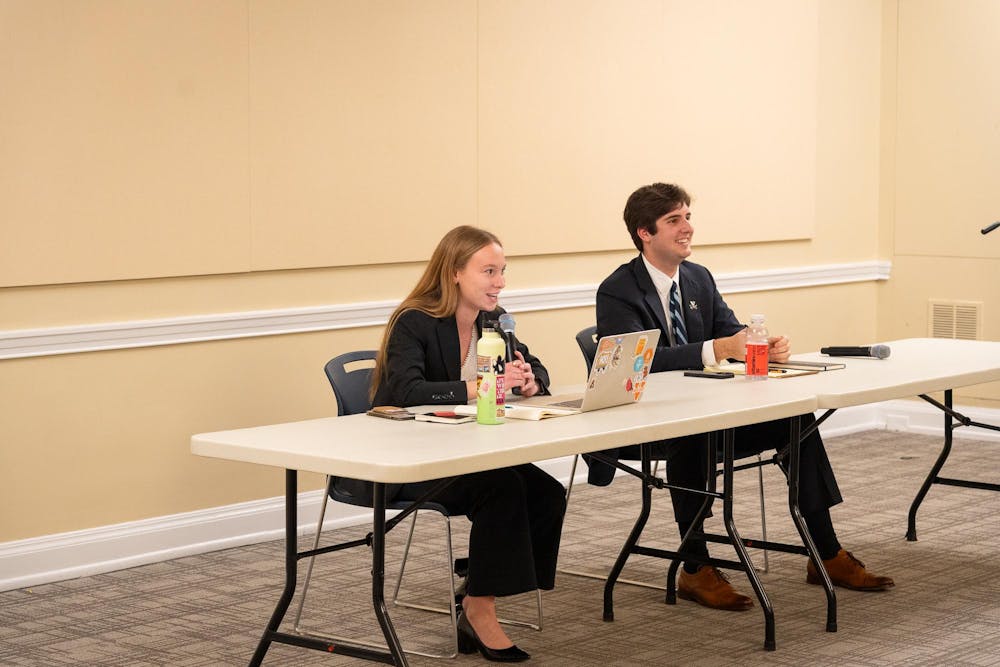
Student Council presidential candidates for the 2026 election — third-year College student Micah Andrews and third-year Commerce student Michael Mitchell — participated in a Student Council presidential debate hosted by The Cavalier Daily and the University Board of Elections Sunday. The two candidates discussed their intentions to increase access to University mental health services and better publicize the work of Student Council so that more students can utilize its resources. The debate was open to audience members and was live streamed.
In her opening speech, Andrews highlighted her accomplishments from her past three years in Student Council — she began as a member of the financial accessibility agency, then became director of that agency during her second year and became chief of Support and Access Services, which is the role she has served in for the past year.
Andrews’ campaign is titled “Our U.Va.” which she emphasized is because of her belief in providing accessible resources for all University students, noting that she comes from a hometown where attending college was once just a dream for her. She said that her goals within Student Council have been centered around providing resources for students with backgrounds like hers to succeed.
“[Our U.Va.] came about because we want to redirect the way in which we think about student self-governance and make it a ticket for everybody, so that everybody thinks that U.Va. is theirs,” Andrews said.
In addition, Andrews noted that a major reason she is running for the presidential role is to advocate for University students. She said she feels the instability over the past year — from the pressured resignation of former University President Jim Ryan to the lack of a voting student representative on the presidential search committee — speaks to why there must be a Student Council president with a strong voice to advocate for students.
“Access is not the only reason I’m running for president. It’s no secret that over the past year, we’ve seen immense instability and a lack of student voice where it matters,” Andrews said. “I think that we need somebody in the presidency who will stand as a true advocate for student voice, even when times get hard and when people aren’t listening.”
Mitchell has served within the Organizations Branch of Student Council for all three years he has been involved. He began as an Appropriations Committee member during his first year, he served as the director of the Contracted Independent Organizations Consultants Committee during his second year, and this past year, has served on the executive board of Student Council as elected vice president for organizations, after running on Clay Dickerson’s ticket — current Student Council president and fourth-year College student.
In his current role, Mitchell oversees all CIOs and said he allocates approximately $800,000 in funding. He highlighted his love for service and the three pillars of his campaign — stability, vision and justice. If elected president, Mitchell said he would establish an endowment to ensure the financial stability of Student Council and said that he will use his experience to address the most critical issues on Grounds.
“Justice is [my ticket’s] third and final pillar. That is the through line for the students — that is meant to encapsulate our mission,” Mitchell said. “We really want your voice to be heard. We want you to have a seat at the table. That is something I care so deeply about.”
When asked about the three most important issues to each candidate, Mitchell spoke about his goal to increase mental health services for University students. He said there is currently only one therapist for every school of enrollment within the University, and that there is also a lack of diverse staffing amongst the University’s Student Health and Wellness therapists. Mitchell emphasized that there are fewer male therapists than females, and both Mitchell and Andrews mentioned that the current wait time to receive an appointment with a SHW therapist is three weeks.
Mitchell also emphasized his plan to increase the Student Activities Fee — a fee each University student pays with their tuition that goes towards funding CIOs — from $58 to $62, which he said will increase CIO funding by $110,000 per year.
However, Mitchell said the issue most important to him is establishing a Student Council endowment. He noted that his plan to increase the SAF would stabilize funding for Student Council short-term, but that securing an endowment would be a long-term goal so Student Council can be successful for years to come. Specifically, Mitchell said an endowment would stabilize funding for the Support and Access Services Branch of Student Council — which provides services at low or no cost to students. SAS is currently operating off of gifts from Ryan and University President Scott Beardsley, which will deplete in fiscal year 2031.
“I think I have a really holistic understanding of the endowment. I served on the interim endowment committee … last year,” Mitchell said. “I know what needs to be done for this. The reason it hasn't been done is because it's a huge pain, but I'm really looking forward to doing it, and I'm excited to do it.”
When answering the same question about her top priorities if she were to be elected president, Andrews also highlighted the need for an endowment, again pointing out the need for stable funding for the Support and Access Services Branch beyond 2031. She also said there is a lack of transparency regarding what the Student Council does and the resources it provides. She said she wants to create a master calendar so students are aware of meeting times and can attend public comment — the section of each general body meeting in which any member of the University’s student body can discuss a question or concern they have for Student Council.
“I think a big issue is that Student Council is so large. We have so many people willing and able to help out, but we do a very bad job at telling people what we're doing, and I think that that starts with expanding our outreach,” Andrews said.
Andrews also mentioned her hope to increase the legitimacy of Student Council as a voice and advocating body for University students. She highlighted her belief that throughout the University leadership changes over the past year, Student Council could have done a better job of listening to and advocating for students.
The two presidential candidates also discussed the importance of granting voting power to the student member of the Board of Visitors — currently a non-voting position filled by fourth-year College student Gregory Perryman. Andrews and Mitchell agreed that the student representative should have the ability to vote so they can help make decisions on behalf of the student body.
The Code of Virginia states that the Board is under control of the General Assembly, so Andrews said she plans to start the process of obtaining voting power for the Board student representative by having the Legislative Affairs Branch of the Student Council continue lobbying the General Assembly. She added that Student Council can utilize ties with students at the College at Wise, who she said have already lobbied, to “further institutionalize" the lobbying.
Mitchell echoed Andrews’ thoughts, and added that voting power is important for the student representative of the Board because while Student Council is a special status organization of the University, the Organizations Branch of Student Council is actually an agency of the Board. Mitchell explained that being an agency means the Organizations Branch has a delegated responsibility to allocate funding to CIOs and having a voting student on the Board would, according to him, ensure that the operations of the Organizations Branch are defended.
“I literally wouldn’t have a job right now if it weren’t for the Board of Visitors, and that’s where, if you have a voting student member of the Board, they can help to defend that,” Mitchell said. “They can help to defend the [Organizations] Branch and that means we can keep helping students and student [organizations].”
Both candidates also responded to a total of four audience questions, which were submitted online prior to Sunday’s debate and selected by The Cavalier Daily. One question asked how the two candidates will continue advocating for the independence of higher education and voicing the concerns of the student body, given events including Ryan’s pressured resignation and the Trump administration’s offer for the University to sign the Compact for Academic Excellence in Higher Education in October. Mitchell and Andrews agreed again that the federal government has no place in making decisions for or on behalf of universities.
Andrews mentioned that when Ryan resigned in June, she took part in authoring the letter from Student Council to the Board which expressed the federal government had reached too far into University operations.
“The important right of a public institution to govern itself has been stripped and commandeered by federal forces, and the loss of President Ryan is the latest domino to fall,” the letter read.
Following the Student Council letter to the Board regarding Ryan’s resignation, Student Council ultimately voted no confidence in the Board in Aug. 2025. Student Council members said they voted because they believed the Board was not considering student voice at the beginning of the presidential search.
Mitchell said during the debate that he did not sign that vote of no confidence, and that was a decision he made on behalf of the CIOs — which he called his constituents in his role as VPO — because he did not want to harm their independence. Given CIOs are funded by the Organizations Branch, which is an agency of the Board, Mitchell said CIOs were not aware of whether their operations would be “tampered with” over the summer because of any federal overreach into the University and he felt that not signing the vote would reduce stress felt by CIOs.
“I did not sign the vote of no confidence against the Board of Visitors. This had nothing to do with my personal beliefs,” Mitchell said. “This was protecting my constituents — clubs — something that I would also do as president for the student body.”
At the conclusion of the debate, Mitchell’s closing statement included positive remarks and appreciation for his running mates — third-year College student Saehee Pérez, who is running for vice president for administration, and third-year College student Harper Tran who is running for VPO. Together, the three of them form the “Dream Ahead” ticket.
“When I was sitting in the audience [of the debate] last year … I don’t think I fully understood what it meant to be Student Council president,” Mitchell said. “[Now], it’s something that I’m willing and ready to take on, so I hope you all consider voting for the ‘Dream Ahead’ ticket later this month.”
In her closing statement, Andrews said her running mates include third-year College student Emily Frost, running for VPA, and third-year Engineering student Ben Lawrence, running for VPO. Together, they form the “Our U.Va.” ticket.
Andrews again highlighted her desire to increase accessible services for University students and to be a voice for the student body.
“I think it’s really important to have someone in the role who genuinely cares about the things that they’re bolstering, and I genuinely care about accessibility for students,” Andrews said.
Voting for Student Council executives and representatives across Student Council, the Honor Committee and the University Judiciary Committee will take place from Feb. 24-26. Students will be able to vote through an online form sent to their University inbox from the University Board of Elections.
Lauren Seeliger is a news editor of the 137th term and enjoys covering U.Va. Health and University governance. Lauren is a fourth-year Behavioral Neuroscience student from Fairfield, Connecticut.
Read More

U.Va. reports increases in rape, aggravated assault and liquor law violations in 2025
By Jaylynn Perez | 20 hours agoThe report has been published annually since 1991 under the federal Jeanne Clery Campus Safety Act.

Yael Grushka-Cockayne discusses artificial intelligence and future of business education
By Jaylynn Perez | 21 hours agoThe webinar — titled “Why Darden? Our Next Chapter” — brought together prospective, admitted and deferred students across Darden’s Master of Business Administration programs.

At rare three-way meeting, City, County and University officials discuss regional coordination
By Luca Bailey | YesterdayThe meeting also gave City, County and University officials an opportunity to discuss areas of mutual concern.