As one of the oldest public universities in the United States with a UNESCO World Heritage designation, the University has long had its page in the history books. What is often left out from its well-known past, however, is its connection to Black history — storied with deep roots in enslavement and segregation. The Virginia Guide Service has been working to change that.
Virginia Guides — previously known as the University Guide Service — has been serving the University and the greater Charlottesville community for 75 years. Virginia Guides has a focus on historical tours of the University, but also offers several specialty tours by appointment. These tailored tours include Garden tours, private admission tours and a History of African-Americans at U.Va. tour, where guides use student leadership to educate their participants about the often-downplayed stories of African Americans at the University.
Following their 2024 suspension, Virginia Guides was formally separated from the University as a Special Status Organization and became a Contracted Independent Organization. As a CIO, the Virginia Guides operate independently from the University, and the organization has shifted to primarily focus on historical tours.
In their History of African-Americans at U.Va. tour, the guides center their trips around the complicated racial legacies of slavery and discrimination at the University. According to Rose Haron, Virginia Guides co-chair and third-year College student, these tours offer their participants a unique chance to truly conceptualize the oppression that transpired during the construction of the University.
“The conditions of how oppressive the system really was sometimes gets lost. Everyone knows that slavery happened, but when you're on a tour, you're standing in the Pavilion Gardens, and you have your tour guide being like, ‘there were 15 [to] 20 people living in this space,’ and you can physically see the space,” Haron said. “I just think it adds this new context to history. And I think that everyone needs to experience that.”
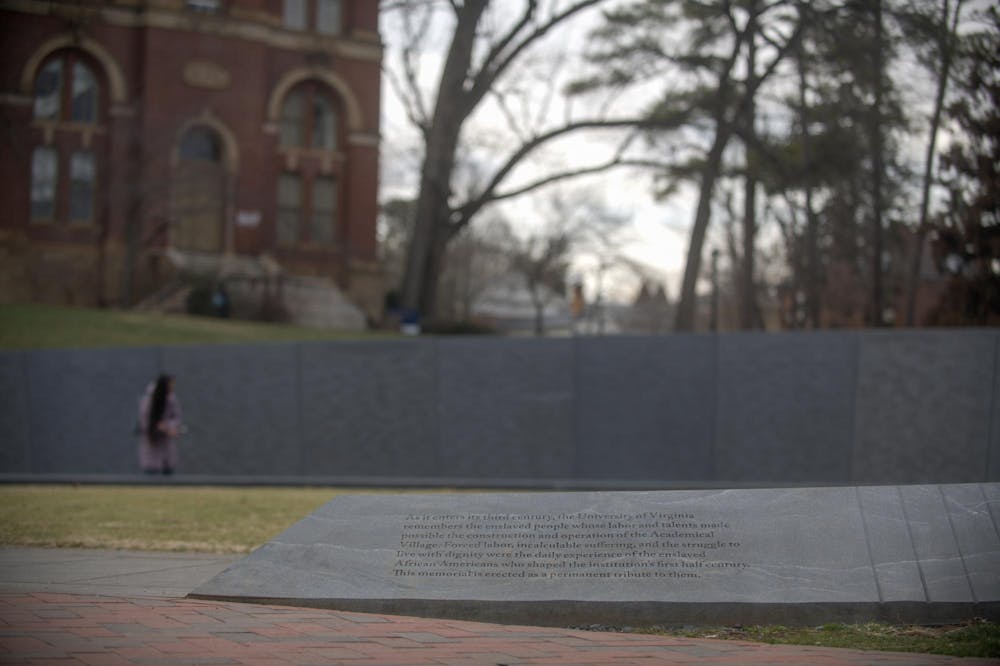
As a result, Virginia Guides has seen firsthand the impact their tours can have on community members' lives. Kendyl Pugh, Virginia Guides vice chair and third-year Batten student, recalled a time after a tour she gave on the Memorial to Enslaved Laborers, where a patron stayed behind to speak with her, sharing that she had been completely unaware of this piece of the University’s history.
“[The guest] was crying to me, and I think that for me was my moment of ‘wait — telling this history is really important,’” Pugh said.
Outside of regular tours, Virginia Guides is also working to expand its outreach into the greater Charlottesville community. Currently, they are planning a History Week to be held around Black Alumni Weekend April 10-12. According to the co-chairs, they are also working with the Descendants of Enslaved Communities at U.Va. to help develop a Memorial to Enslaved Laborers tour for the event. Additionally, they intend to host several lecture events featuring faculty and student speakers alike.
At the heart of the organization are students, who run all of the tours independently. To become a guide, students must go through a trial tour and interview, followed by a probationary semester. During this first semester, new members take weekly history classes and receive a book on the University’s history, with assigned readings to contextualize their learning and develop potential tours.
With the resources and knowledge of how to approach these topics from their training, each guide then customizes their tour to highlight different stories from the University. Many of these stories are on the lives of African Americans who helped build Grounds, allowing them to take an active part in the retelling of history. For Virginia Guides co-chair and fourth-year Architecture student Nina Accousti, the personalization of these excursions is what makes them so special. She uses her interest in architecture to influence her tour, telling stories of hidden details in the built landscape.
“All of the bricks are sculpted by hand, that means something. There [are] fingerprints still there. That's what I try to make my tour about — getting people to stop and observe the places around us and the layers,” Accousti said.
On the other hand, Natasjha Stone, Virginia Guide and fourth-year College student, takes a different approach in her tours. She begins each one in the Lower East Oval Room of the Rotunda, focusing on a mural painted around the time the University was founded. The painting depicts an enslaved Black woman, lodged in a corner while holding a white baby, amidst a crowd of white male students. For Stone, this is how she likes to introduce this history — hidden within the University, yet a pillar of its foundation — just like the woman in the painting.
Stone concludes her tour at the Memorial to Enslaved Laborers while discussing her current day-to-day experiences at the University as a Black woman. She tells her tour participants about some of the difficulties that come with attending a predominantly white institution, but also reminds them that her presence at the University is the result of years of struggle by Black students before her.
“History is living. I consider my history to also be a very living thing,” Stone said. “I don't practice [my last stop] beforehand. It's just whatever comes to mind … I would say that the Black student experience here, for me, is a little tough … Everything going on [with the] current administration and DEI kind of honing in on a lot of things, stripping a lot of things that take away the Black identity here is hard to grapple with.”
Stone is not alone in this sentiment. In recent years, the University has experienced systemic changes — such as the Board of Visitors’ 2025 decision to dissolve the Office of Diversity, Equity and Inclusion, which sparked backlash from the student body.
Stone said she is particularly disheartened by the changes made to the Office of African-American Affairs, where the weekly community-building events for Black students on Grounds were changed from ‘Black Fridays’ to ‘Bridge Fridays,’ thus removing the emphasis on uplifting Black students on Grounds.
These changes at the University are mirroring broader trends in American politics at large. In recent weeks, the Trump administration has removed informational signs discussing America’s history of slavery from Independence National Historical Park. Natalie Major, guide and third-year College student, calls special attention to this parallel.
“U.Va. is, as I see it, a microcosm of the macrocosm that is America. I feel like a lot of things that happen here are a reflection of what's happening in our country,” Major said.
On Grounds, Stone speculates that the aforementioned 2024 suspension of Virginia Guides was tied to concerns over the history that the Virginia Guides were teaching, specifically topics relating to the historical presence of enslavement, segregation and eugenics on Grounds — all of which portrayed the University in a negative light. Despite the dissolution, many guides like Stone realized just how important it was to continue these tours.
“I was so angry at one point, of them taking away this history. I was just like, ‘I'm going to do more of this. I'm going to tell this truth. I'm going to just unleash all my rage and truth into these historical tours in the best way possible,’” Stone said. “And that's what I did, and I fell in love with it.”
Other guides, like Major, echo Stone’s sentiment. As she sees it, the education Virginia Guides provides is the most important tool one can have when it comes to fighting systemic issues like racism.
“Education is deeply important on an individual and a grander scale of organizing,” Major said. “I believe that in giving tours, and formally giving these tours, and taking time to learn this history, you're definitely participating in student activism.”
It is through the actions of dedicated students like these that African American history is shared on Grounds. For Virginia Guides, to ignore the impact of this history is to ignore the very foundations of the University — as these things are inherently intertwined.
“At every single [University] ceremony, we talk about its founding, but we don't talk about the entirety of its founding, and that is intrinsic to the history of African Americans,” Pugh said. “You can't talk about U.Va. without talking about African Americans here, because they've always been here. It's just a part of telling a full history.”
Read More

After 100 years, the Jefferson School continues to empower and unify the City community
By Sadie Adams | 2 days agoAs the building celebrates 100 years in the Charlottesville community, it invites the community to further engage with events and opportunities at the City Center.

A superb summer side: Peach and tomato towers
By Abby Snowdon | 4 days agoWith peach and tomato season at its apex, there isn’t a better time to savor the flavors of Virginia’s summer harvest.

Lemon berry cookies for a pop of flavor on a summer day
By Claire McGinn | August 2, 2026Though this treat will be a hit no matter the time of year, it’s especially perfect in the warm months when blueberries and raspberries are conveniently in season.