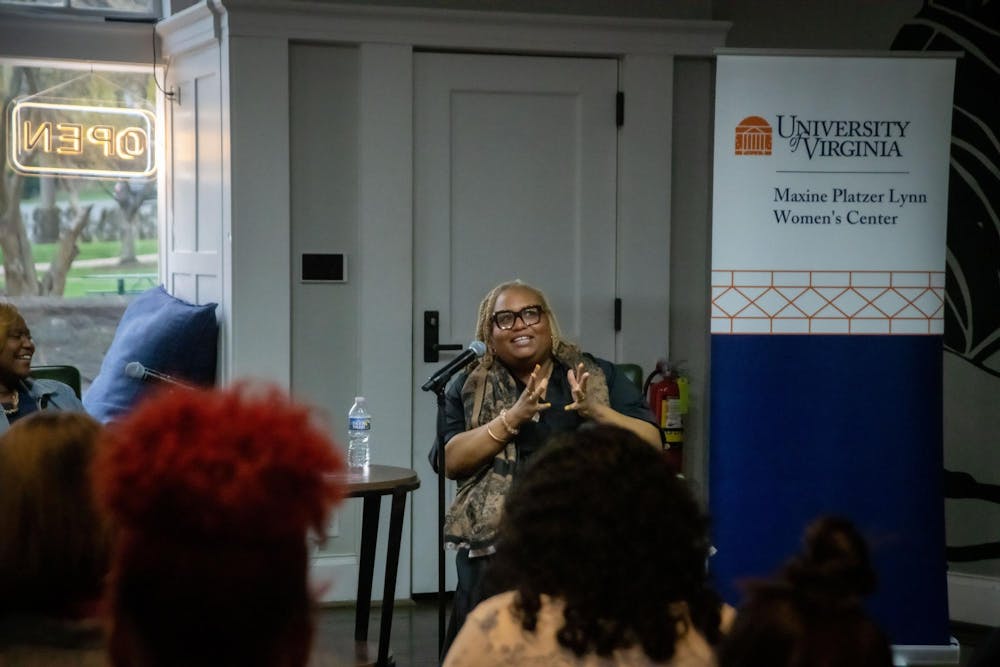
Susana Morris, author and associate professor of literature, media and communication at Georgia Institute of Technology University, visited Grounds Wednesday for a discussion on worldbuilding — critically engaging with the present and past to “responsibly” set expectations for the future. The discussion was inspired by Morris’ new book, “Positive Obsession,” about the life and contributions of author Octavia Butler.
The event was hosted by the University’s Maxine Platzer Lynn Women’s Center — an organization on Grounds that works on social justice issues to advocate for marginalized students, faculty, staff and Charlottesville community members — the University’s Department of Women, Gender and Sexuality and the College. It functioned as the keynote event of the Center’s celebration of Women’s History Month and the conversation was moderated by director of the Center Chanel Craft Tanner.
Wednesday's conversation was inspired by the work of Butler — a Nebula and Hugo award-winning science fiction author and, according to Tanner, the first black woman to consistently write books in the genre. Her works include “Parable of the Sower” — a 1993 novel about a young black woman rebelling against an autocrat in Los Angeles, Calif. in 2024. In this novel, the town is under pressure from climate change and in the sequel published in 1998, a Christian populist presidential candidate is elected on the slogan “Help us to make America great again.”
The discussion began with Morris arguing that while some believe there is a predictive element to Butler’s work on account of possible parallels between “Parable of the Sower” and the present day, she does not support heralding Butler as a “prophet.” Morris explained how she disagrees with the notion that science fiction is meant to predict the future, emphasizing how Butler’s work better demonstrates a strong understanding of history and a grasp of the issues of her time.
According to Morris, she believes “Parable of the Sower” was a “cautionary tale” based on Butler’s understanding of the rise of other conservative movements and her criticisms of President Ronald Reagan — who said “Let’s Make America Great Again” and served as the inspiration for the “villains” in her works.
“The language of [calling her an oracle] just sort of elevates her to a pedestal,” Morris said. “It’s not that she thought [her novel’s plot] had to happen. She’s writing to let us know this [all] could happen … that there is a particular kind of fuel for this particular future.”
In keeping with the idea that Butler was not a “prophet,” Morris reminded members of the audience that much of her understanding of real-world political dynamics came from hours of research. She called on audience members to follow Butler’s example and critically engage with the world around them.
“[Butler] understood … the larger makeup of the world,” Morris said. “We don’t have to be Octavia Butler, but we can research our world … you can’t be passive receivers of the world.”
In response to Morris' calls to avoid ignorance of societal issues, Tanner asked Morris to reflect on another Butler novel, “Kindred” — in which a young black woman is transported from 1976 California to an antebellum Maryland slave plantation and returns permanently scarred. She asked Morris, in light of the novel’s plot, whether she believes history is “a resource,” “a requirement” or “a risk,” and whether the past is necessary to “build” the future.
Morris responded that history often repeats itself and is important to learn in order to better predict the future. She also explained that she believes historical knowledge can be used to learn from the mistakes of others and to understand good strategies of influencing change that have fallen out of use. Pointing to recent book bans in predominantly Republican-led school districts nationwide, Morris said she believes those who call for bans want others to be restricted from “less desirable parts” of history.
The bans include books about African American history such as “Kindred” by Butler, “Black Reconstruction in America” by W.E.B. Du Bois in Lee County, Fla. and “Portraits of African American Heroes” by Tonya Bolden in St. John’s County, Fla.
Morris expressed concern, however, with allowing possibly hateful symbols from the past to continue to influence society and the psyche of marginalized communities. She pointed to the examples of “controlling images” and longstanding tropes about black women in media — according to work done by the Annenberg Charlotta Bass Journalism and Justice Lab at the University of Southern California, these tropes can include systematically portraying black women as “asexual, maternal [and] … in opposition to Western beauty standards.”
Morris emphasized history must be understood while these outdated portrayals and ways of thinking are abandoned.
The two shifted to discussing individual “world building” and the essential role of community, even when it can be difficult to maintain and a source of conflict. She said that it is important to set boundaries with community members who hold different values, but to consider these people “work friends,” anyway.
“Conflict doesn’t mean you have to immediately leave, break up [or] don’t talk to … said person,” Morris said. “If you really want to be [a] community, that means you’re not always going to be agreeing with one another.”
Morris also fielded questions from University students, many of whom asked her to elaborate on earlier comments that Butler would be concerned about society’s reliance on artificial intelligence and the environmental impact of data centers. Students asked how AI can further impact worldbuilding and the capacity to think critically. Morris responded that she believes AI is a tool which can be used to further any individual’s goals — good or bad — arguing that it inputs information from society and this is how white supremacist culture or rape culture can permeate into how it operates.
One of the biggest concerns Morris expressed with AI programs like ChatGPT, however, is that they do not scrutinize the user’s thinking process and instead reaffirm their beliefs. She cautioned about the environmental impacts of developing generative AI which requires increased electricity demand and water consumption.
Among the University students in attendance, third-year College student Amari May said she attended the discussion to hear directly from intriguing speakers, and she expressed a desire to hear Morris’ views on world building as a fellow Black woman.
“I was just like, ‘okay, we might … not necessarily [have] similar experiences, but [maybe] similar points of view,” May said. “So I kind of just wanted to come and check it out.”

Luca Bailey is a third-year Politics student from Free Union, Va. As a staffer on the news and video desks, he has covered topics ranging from the General Assembly and state elections to local politics and University governance. He is also The Cavalier Daily’s beat writer for the Charlottesville City Council.
Read More

Technology sabbatical courses expand beyond English department in third summer of the program
By Komal Reddymachu | 5 hours agoTwo years after the University began offering tech-free courses through its Summer Technology Sabbatical, the program has expanded, with courses offered this summer in psychology and engineering.
Acampora emphasizes need for human skills amid technological environment in first lecture
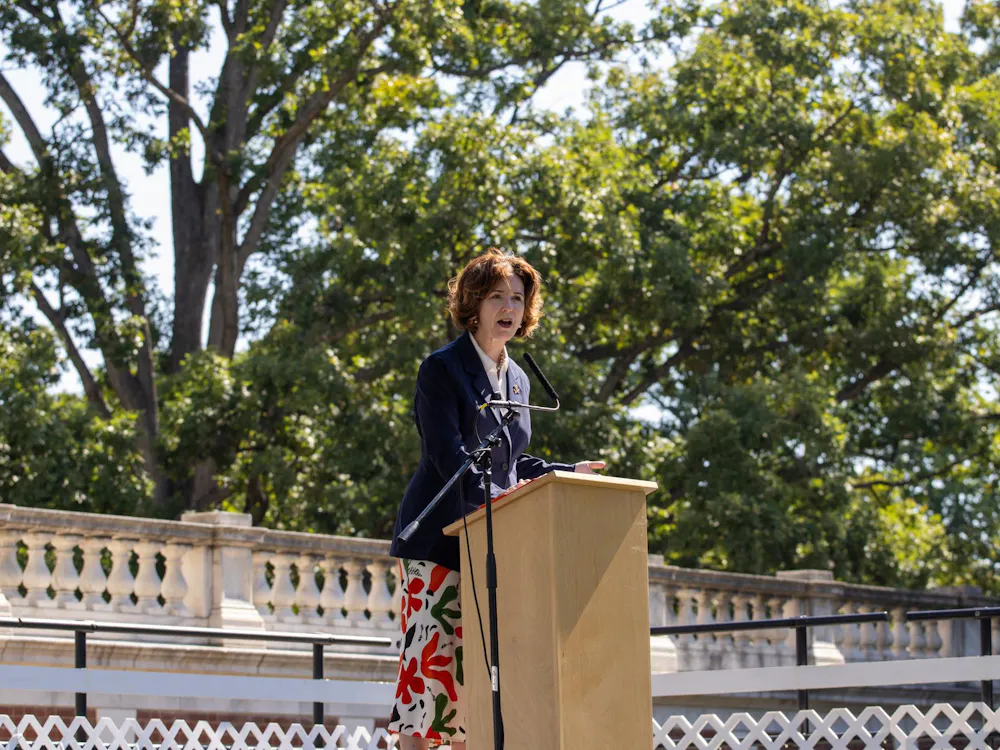
By Edward Christopher | YesterdayChrista Acampora, dean of the College and Graduate School of Arts and Sciences and professor of philosophy, delivered the First Lecture to students on the Lawn Monday morning.

City Council hears report on renewed sustainable waste disposal framework
By Luca Bailey | YesterdayResidents also appeared during public comment, petitioning Council members to reconsider plans to clear a homeless encampment along the Rivanna Trail, and to consider restoring a plaque commemorating 19th century slave auctions which took place at a historic building downtown.