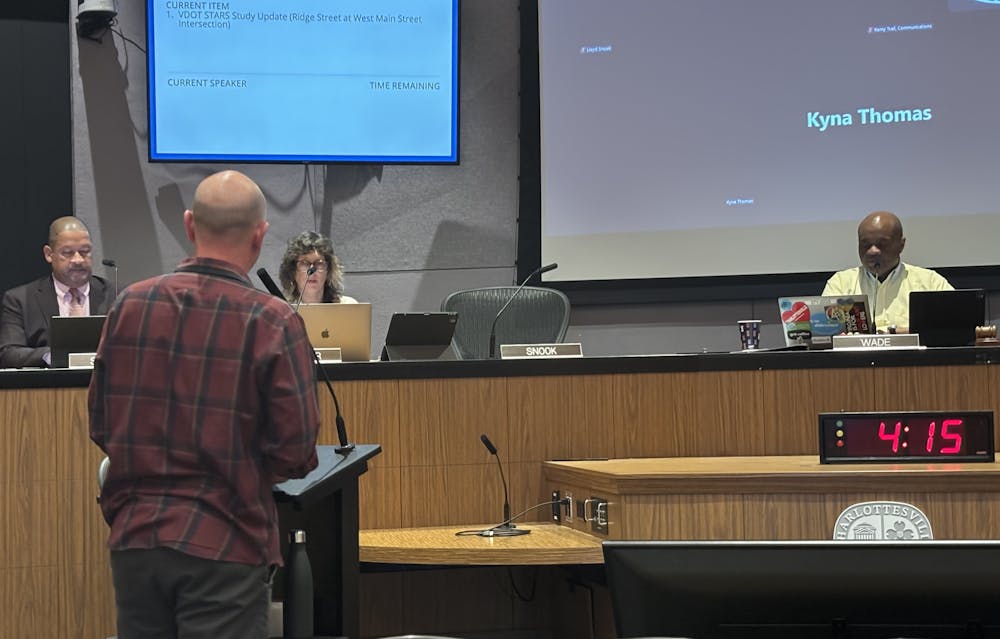
The Charlottesville City Council met for its regular biweekly meeting Monday, in which members authorized a $159,947.55 tax refund to an anonymous contracting firm that has carried out development projects around the University. Members also heard concerns from community members about the City’s zoning code.
The Council authorized the tax refund to an anonymous contracting firm that has been “working on projects around U.Va.,” according to Commissioner of the Revenue Todd D. Divers. Divers said the unnamed firm mistakenly paid taxes to the City of Charlottesville for contracting done in Albemarle County. He explained that the mistake occurred because the firm is not based in the Charlottesville area and the distinction between City and county limits were unclear to the firm’s accountants.
During the ‘Community Matters’ segment of the meeting — the public portion of each meeting in which up to 8 speakers can raise concerns to the Council — several city residents expressed concerns that the City’s zoning is not adequately tailored to protect vulnerable communities and that it could stifle development of important transportation projects. Community members near University projects, such as the residents of Westhaven, have expressed concerns with privately developed student housing projects.
Among their concerns, City residents say that LV Collective’s proposal for an apartment complex on West Main Street will block easy access and sunlight from their neighborhoods and that similar projects will lead to displacement of low-income and historically Black communities.
Emily Smith, housing attorney with the Legal Aid Justice Center, told Council members that she believes the existing Core Neighborhood Corridor Overlay — which includes Cherry and Preston Avenue and mandates developers obtain a special permit to build projects higher than seven stories — is inadequate.
Smith called the overlay “insufficiently rigorous and insufficiently applied” to protect communities facing displacement from development projects. The overlay does not include the neighborhood of Westhaven.
“Core neighborhoods are at risk of being physically loomed over, subject to faster gentrification and displacement,” Smith said. “We’d ask the Council to reanalyze these areas … and consider … enacting a stronger corridor overlay.”
Fifeville resident Frank Beckter also asked Council members for changes to the City’s zoning code. Beckter noted that the City’s website, which quotes Article 2 of its development code, claims the City has multiple zoning districts that are “tailored to the needs and character of the community.”
Beckter, however, expressed disapproval with the fact that the zoning ordinance allowed the “toxic” development of The Mark — another housing project in Fifeville which will be marketed towards students, which he claimed is not in line with the character or needs of Fifeville.
Beckter praised the Council’s support for Fifeville in other ways, such as its advocacy for the construction of a community-owned grocery store. However, he asked Council members for “consistency” — noting that projects which improve the City should not be undermined by projects which strain city residents.
5th Street resident Jim Snyder echoed sentiments of other residents raising zoning concerns, and said that zoning rules near the Charlottesville Amtrak Train Station will “box in the ability to upgrade” the station. According to Snyder, the station needs new platforms, and new lines are planned on its tracks to connect all Virginia universities by train. Snyder expressed concern that the Virginia Passenger Rail Authority — which promotes and expands accessibility to passenger trains in Virginia — was unaware of the challenges new zoning rules could pose to upgrading the station.
“This station needs to be there for the next 100 years to reduce [car] traffic,” Snyder said. “I really am concerned that [you all are] going to miss the boat here, while you allow these very big … companies to build these student housing projects … and box in the ability [to improve] that station.”
The Council also heard a proposal on new building standards for municipal buildings, received a report on the local committee organizing Virginia 250 — Virginia’s celebrations of 250 years since the signing of the Declaration of Independence — and moved a resolution to the April 6 consent agenda to establish a Charlottesville Public Art Program to maintain the City’s public arts collection.
The Council also briefly discussed a semi-annual report on the work of the Land Use and Environmental Planning Committee — an advisory committee to the University, City of Charlottesville and Albemarle County. Through “community messaging and institutional practices,” the committee coordinates land use, development plans and projects between the three entities.
However, Council member Michael Payne noted that the written report — which summarizes the committee’s work from July to December 2025 — contains no presentations given by the University. In light of this absence of contributions from the University, Payne asked City Manager Samuel Sanders whether there were any discussions of student housing or the University’s development plans at the committee’s meetings. While Sanders said that he did not have this information readily available, he said he would be able to look into it.
Payne also confirmed with members of the Council’s staff that no elected officials sit on the committee and that its meetings are not open to Council members or members of the public, claiming that this was unusual for such an important committee.
“I always like to bring [the lack of public meetings] up,” Payne said. “[That is] a fascinating situation for the main body to supposedly coordinate planning between our largest employer and landowner.”
Opting not to go into closed session, the Council publicly announced and approved the re-appointment of community activist Joy Johnson to the City’s Housing Advisory Committee. Johnson currently serves at the University’s Center for Community Partnerships — which seeks to “redress the relationship between the University and surrounding community” — and as chair of the Public Housing Association of Residents.
City Council will not hold its next regular meeting until April 6, at which point it will continue to hold biweekly meetings until mid-June.

Luca Bailey is a third-year College student majoring in politics from Free Union, Va. As a staffer on the news and video desks, he has covered topics ranging from the General Assembly and state elections to local politics and University governance. He is also The Cavalier Daily’s beat writer for the Charlottesville City Council.
Read More
Parking on Grounds — what has changed this semester?
By Charlotte Gabriel | 9 hours agoAccording to University students interviewed by The Cavalier Daily, several expressed frustration with high parking prices on Grounds, as well as the difficulty in finding available parking in general.

Student Council connects with University’s Strategic Planning Committee
By Lucia Gambacini and Reilly Auld | 10 hours agoThe Council also heard updates from Executive Board members regarding the upcoming Fall 2026 elections and new investments in free Sexually Transmitted Infection testing kits for students.
Virginia colleges workshop three-year bachelor’s degrees
By Luca Bailey | 10 hours agoIf the effort is successful, participating schools in Virginia and Ohio will join at least 70 higher education institutions across more than 26 states that have already adopted three-year programs in some capacity.