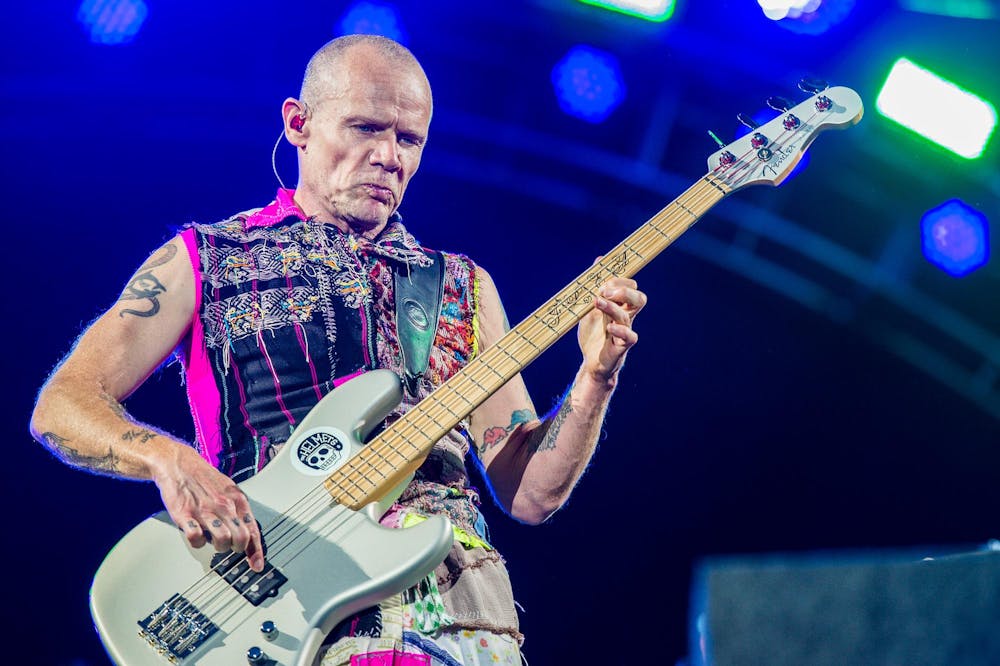
Flea, born Michael Balzary, released his first full-length solo debut outside of the rock band Red Hot Chili Peppers Friday. “Honora” is a 10-track jazz album, a twist that marks an interesting departure from his previous funk-punk style. Flea sings lead vocals, and plays bass and trumpet on “Honora” — a sonic tribute to Flea’s childhood love for jazz. The album takes a traditional jazz approach while lyrically addressing modern themes both political and personal. “Honora” is soulful and free-flowing yet sonically and thematically cohesive, exemplifying Flea’s prowess as a musician in an entirely new light.
Flea gained fame as the bassist in the iconic Red Hot Chili Peppers, attracting notoriety for his signature slap-bass technique. A Rolling Stone-lauded bassist and Rock and Roll Hall of Fame inductee, Flea’s sudden shift into uncharted jazz territory may seem unexpected — but it has been a long time coming.
Unbeknownst to many, Flea played the trumpet throughout his school and college years before he had ever touched a bass. He was inspired by the music of Dizzy Gillespie and Miles Davis, as well as his stepfather, a jazz bassist — with whom he had a tumultuous relationship — that introduced him to bebop jazz jams. This long-lasting love affair with both jazz and the trumpet makes “Honora” a true passion project for Flea, allowing him to merge his past and present into an incredibly distinct album.
Deeply personal motifs run throughout “Honora,” with inner details of Flea’s life bleeding into every element of his art. The album itself was named after his paternal great-great-grandmother, and the cover art features a photo of Flea's mother-in-law Shahin Badiyan in 1960s Iran. He brought in collaborators from all eras of his life, from former supergroup-mates Thom Yorke and Mauro Refosco percussion, to his very own daughter, photographer Clara Balzary, as his music video director.
“Honora” is produced by esteemed keyboard and saxophone player Josh Johnson, who also lent his talents to the recording, playing the saxophone on multiple tracks. Johnson’s contribution has good company, as Flea tapped his circle of influential Los Angeles hipster-jazz musicians for the project as well. Experimental guitarist Jeff Parker, Jason Isbell and the 400 Unit bassist Anna Butterss and drummer Deantoni Parks — who is known for his work with André 3000 — all feature. Indie-rock band Bright Eyes member and Chili Peppers collaborator Nate Walcott also assists on the trumpet and keyboards and longtime friends Thom Yorke and Nick Cave provide vocals on a few tracks.
The album opens with “Golden Wingship,” an otherworldly tune lasting just over one minute that immediately sets “Honora” apart from the rest of Flea’s discography. The haunting instrumental track has an entrancing feel, introducing the intensity of the first half of the album with its evocative, dissonant soundscape.
“Golden Wingship” is followed by “A Plea,” the first single released from the project. The traditional jazz instrumental in the first half builds to a subtly intense crescendo, pulling the listener deeper into the song. Flea’s vocals come in almost four minutes into the nearly eight minute track. He begins with more of a stylized chant than pure melody, the hard-hitting lyricism fueled by the repetition of the phrase “Civil War” after each line.
The song reaches an angry lyrical and sonic peak, as he desperately warns of an “army coming, blotting out the sun” and of “concentration camps.” Flea then launches into his final sermon, beckoning listeners to choose love over hate and create something beautiful out of political pain. The jazzy backdrop mellows out to its original stature, and listeners are left with a final piece of rock-and-roll wisdom — “You wanna be brave, you wanna be tough? / Peace and love is the toughest, hardest thing you can do.”
This revelation in song form is followed by the second single and third track, “Traffic Lights,” a warmer track featuring Radiohead’s Thom Yorke on co-vocals. The rhythmic and trippy nature of “Traffic Lights” is the perfect cool-down from “A Plea,” complementing the previous track with its elusive political metaphors and syncopated bassline.
“A Plea” is accessorized with an experimental music video directed by Flea’s daughter, Clara Balzary, in which Flea does an interpretive dance for the duration of the song. The music video for “Traffic Lights” is a different style completely, consisting of a childlike, watercolored animation depicting scenes of jazz players and the open road.
The third music video released for “Honora” accompanies Flea’s cover of Frank Ocean’s “Thinkin Bout You,” with a more matured, colorful and slowed-down version of the watercolor style to match the reflective arrangement of the song. Both the “Thinkin Bout You” and “Traffic Lights” videos were produced by Mexican animator nespy5euro in his signature hand-drawn style.
The album included four delightfully reimagined covers as well. “Maggot Brain” is an eerie cover of the 1971 Funkadelic track from the same-named album, exchanging the piercing electric guitar riffs for a melancholy jazz ensemble-style rhythm. “Thinkin Bout You,” is a beautifully soulful rendition of Frank Ocean’s hit song “Channel Orange,” artfully reimagined in a traditional orchestral jazz style. The song is purely instrumental, but still manages to convey much of Frank Ocean’s imagery and emotion through the music alone.
With “Honora,” Flea steps out of his comfort zone, resulting in an incredible amalgamation of genres and a new forum for creative release. His musicality, along with that of the rest of the incredible talented ensemble, is on display in a completely new form. In doing so, he answers his own call to action made on “A Plea,” to “make something beautiful,” even “if it's a little scrap of squiggly crayon on a paper.”
Read More

Hoo’s Watching: Anatomy of a teen TV show
By Caroline Lee | 19 hours ago“Crew Girl” is not reinventing the wheel, nor is it particularly interested in doing so.
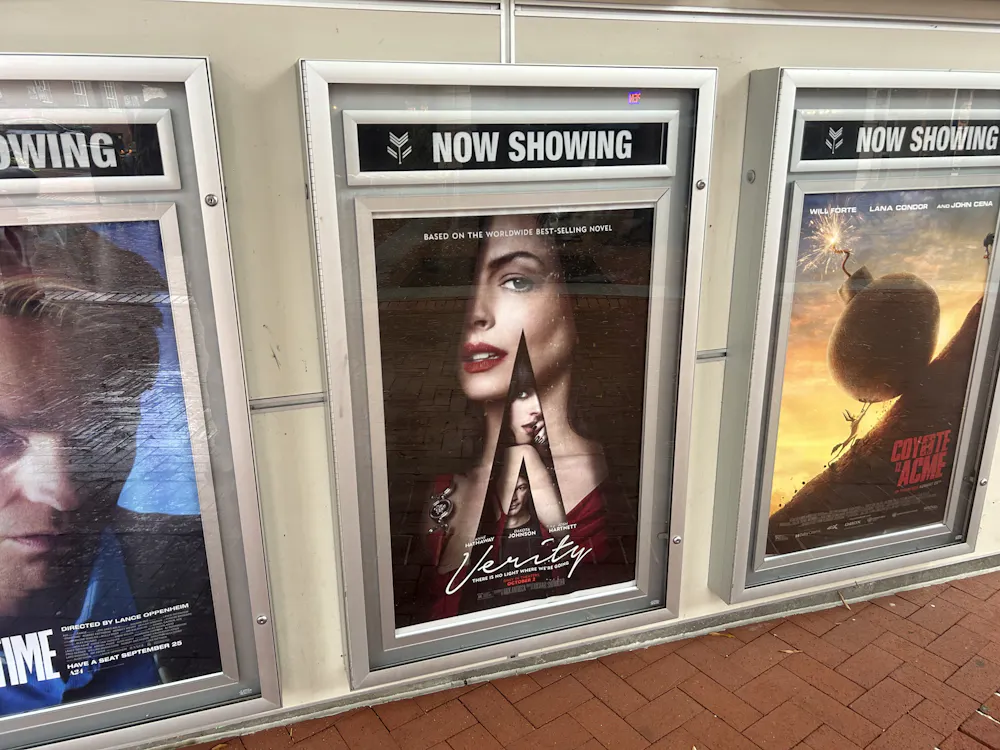
‘Verity’ falls short on its psychologically thrilling promise
By Julia Prevost | Yesterday“Verity” is entertaining in moments, particularly when its dialogue becomes so outrageous that disbelief gives way to amusement.

Virginia Film Festival unveils full lineup for 39th rendition
By Matthew Wang | 4 days agoThe Festival’s 39th rendition, which will run for five days from Oct. 21 to Oct. 25, will feature a myriad of films from Virginia and across the world, as well as live discussions and panels with celebrated filmmakers and industry professionals.