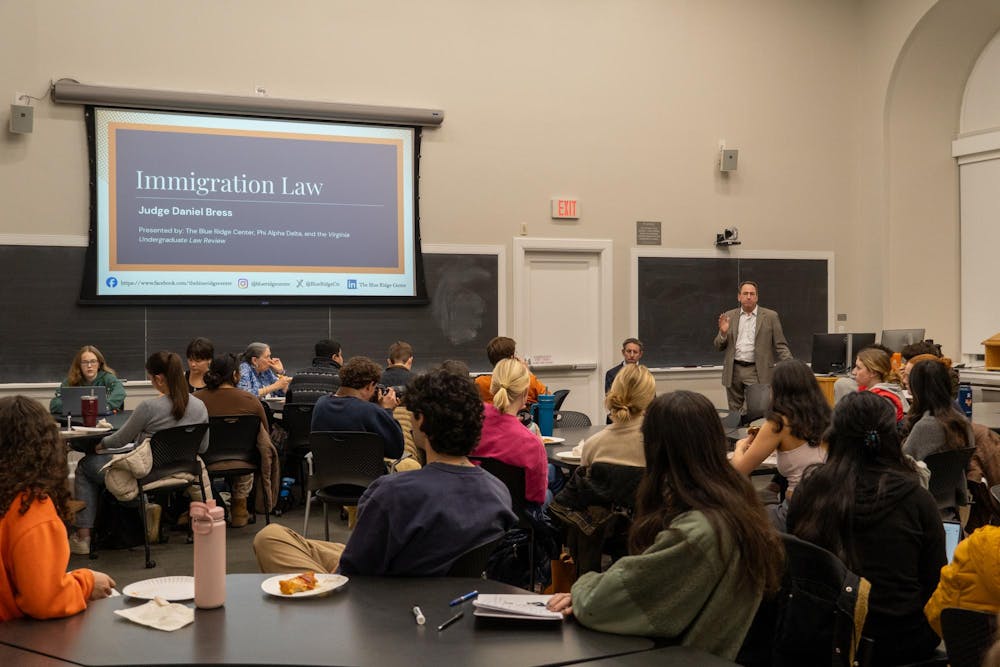
The Blue Ridge Center hosted John Cotton Richmond, former U.S. Ambassador-at-Large to Monitor and Combat Trafficking in Persons, Tuesday evening. Richmond discussed the criminalization of sex work, the effectiveness of anti-trafficking legislation and forced labor challenges in foreign countries.
The event was held in Monroe Hall and was co-sponsored by the International Justice Mission at U.Va., Phi Alpha Delta and the Second-Year Council Diversity, Equity and Inclusion Committee.
Richmond served as ambassador from 2018-2021 under President Donald Trump’s first term, and throughout the event, Richmond stressed the global rise in human trafficking victims over the last few years. He said that the excessive profit derived from the forced labor obtained from human trafficking remains the largest driver of the illegal industry — in 2022 there were an estimated 27.6 million victims of human trafficking internationally, a 10 percent increase from 2017. Further, he said this 2022 estimate would rise to 49.6 million victims if the statistic included individuals forced into marriage.
“I think it's worth understanding how much money is at stake,” Richmond said. “The latest estimate we have from the International Labor Organization came out in March of 2024 and is $236 billion in profits [from trafficking] every year, and that doesn't even include state sanctioned forced labor.”
Richmond added that despite this rise in victims, the number of identified human trafficking victims is less than 1 percent, and that this low number reflects poorly on federal leadership.
“I don't know how it works at U.Va., but I think if you get half of 1 percent right, you're probably not graduating,” Richmond said. “We’re failing victims as [a] government, as [a] culture.”
Richmond also discussed issues surrounding the criminalization of sex work and the different policy approaches aimed to tackle it both domestically and internationally. He described the importance of enforcing the “non-prosecution principle” — the practice of not prosecuting individuals selling themselves as the product in sex work, such as prostitutes.
However, Richmond noted the “non-prosecution principle” is not currently enforced. He said that those used as the product in sex work are particularly vulnerable to be exploited and controlled by a third party through their work, but that the third party workers are not the ones ultimately punished.
“You are more likely to get arrested as a trafficking victim than as a trafficker. That's true in the United States, and it's true all over the world,” Richmond said. “I think it is a shame that we carry, we should be making sure that we do not indict victims of trafficking and [not] charge them with any sort of offenses.”
At the end of Richmond’s presentation, students participated in a question and answer session during which several students asked him his thoughts on the Jeffrey Epstein files, the role of pornography in sex trafficking and why the issue of human trafficking is so pervasive in the U.S.
One student asked Richmond how the release of the Epstein case files has influenced human trafficking work. In response, Richmond said that the current handling of the Epstein case filings and the lack of convictions against those involved reflects poorly on the current Justice Department under the Trump administration. He added that he was concerned that victims were not kept private in the files.
“It [the Department of Justice] speaks through its cases [and] its filings,” Richmond said. “Do we want to have a pattern where governments and whoever's at the helm of [our] government at that time and wielding it can release a whole bunch of information about you, your loved ones, your family, outside of a court indictment?”
Madeline Magielnicki, student fellow for the Blue Ridge Center and second-year College student, asked Richmond why the “inverted equality model” — which Richmond defined as a system in which only sex workers are arrested and not the individuals managing them — was such an accepted approach for prosecuting sex crimes in the U.S., and why sex trafficking remains a pressing issue in the country.
According to Richmond, there is a widespread perspective in the U.S. that individuals involved in sex work should be seen as “damaged individuals,” and that this perspective has only perpetuated a cultural acceptance of charging potential sex trafficking victims with sex crimes, instead of those who buy or manage the selling of sex work.
“I don't think that our culture really wants to wrestle with what it would take for things to look different ... In the sex trafficking realm, as well as the forced labor realm … I don't think [the government wants] to deal with the fact that if they really started arresting buyers of commercial sex, that they're going to find some bankers and some professors and some softball coaches and a pastor or two,” Richmond said.
When the event ended, Magielnicki said that Richmond’s insight into modern human trafficking issues was a great opportunity to learn more about the topic, and engage in discussions about important issues that transcend partisanship.
“It's really fascinating. I didn't know specific terms for that [different policy approaches to human trafficking], and I definitely didn't know how much of an issue it is to get policy around it going,” Magielnicki said. “It's really nice to have very experienced people come in and talk about topics that you can't necessarily get in a classroom.”
The Blue Ridge Center will host its next event March 23 featuring Mary Kate Cary, assistant vice president and deputy chief of staff and Politics Prof., to discuss founding father Patrick Henry, the American Revolution and his quote, “give me liberty or give me death.”

Lily Kostro is a staff writer on the news desk and a third-year College student studying politics. Lily is from Beverly, Mass., and enjoys writing about events happening on Grounds.
Read More

10 years since Trump’s first election, professors reflect on a decade that reshaped U.Va.
By Komal Reddymachu | 10 hours agoSince President Donald Trump’s first election in 2016, Charlottesville has seen a white supremacist rally, the removal of its Confederate statues and federal pressure influence the University’s governing body.

Student Technology Council aims to represent students on technological issues
By Solomon Ross-Milligan | YesterdaySTC is currently a 20-member council and includes students from across schools and organizations within the University.

Woodruff and Bouie discuss freedom of the press, emphasize need for nonpartisan news
By Robert Head | YesterdayAfter an introduction by Jane Kamensky, president and chief executive officer of Monticello, Woodruff answered Bouie’s prompts on topics such as modern threats to the press, the objectivity of the press and Americans’ declining trust in news outlets.