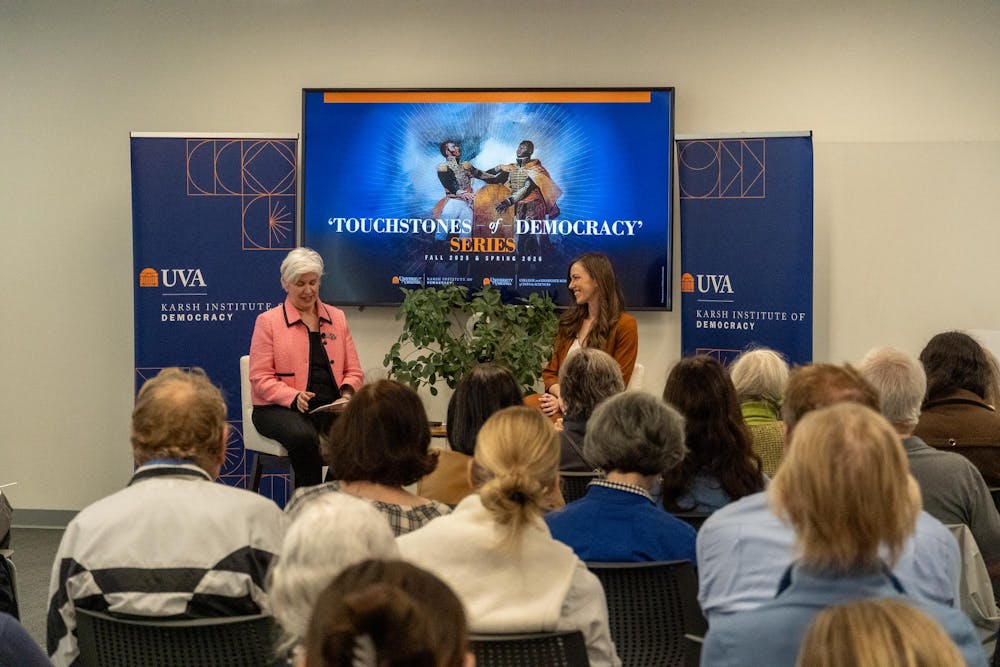
Lauren Duval, Gibson fellow at the Karsh Institute of Democracy, spoke about her book “The Home Front: Revolutionary Households, Military Occupation, and the Making of American Independence” at the most recent “Touchstones of Democracy” workshop Thursday. At the event, Duval spoke about military occupations in the household during the American Revolution, and how these experiences shaped the ideas of citizenship and political culture in the newly born United States of America.
The event was moderated by Jane Kamensky, president and CEO of Monticello and the Thomas Jefferson Foundation, as well as the author of “A Revolution in Color: The World of John Singleton Copley” and a co-editor of “The Oxford Handbook of the American Revolution.” It was hosted by the Karsh Institute, a group which focuses on strengthening democracy at the University through research, teaching and public engagement.
One topic that Duval discussed, particularly in the context of her recently published book, was the concept of the “household” and how the British occupation of the colonies during the American Revolution affected this concept.
“I [wanted] to write about the household during war, and to recognize that the household has been a really important way that historians have understood women’s lives,” Duval said. “Household and property and family [are] also really important to how men in this period think about themselves.”
She explained some of the regulations around quartering of British officers in American homes and the power dynamics which resulted — particularly in the differences between the interactions with officers and civilians along gender lines.
Duval also said that during the American Revolution, the British moved along the coast with the intent of occupying port cities. As a result, large portions of the American population were exposed to a battlefield on their doorsteps and in their homes.
According to Duval, and in English common law, an Englishman’s house was considered his castle, meaning that a man had the right to rule over his household. Because of these correlations between household power and social status, the occupation of households by the British created struggles for agency within one’s own home.
“For American men, being a head of household [was] a really important marker of manhood, of political independence [and] of social status,” Duval said. “[The households] become actual battle spaces, where the British army [was] invading and occupying houses.”
Duval also discussed how the power dynamics within each household under occupation differed along lines of gender. She shared the story of Elizabeth Drinker, a Philadelphia Quaker woman who quartered a British officer. Drinker’s story was unique, as she both lived without her husband in the house and recorded much of her daily life in a diary.
Duval said that the dynamics Drinker described in her diary show that Drinker had significant control over what the officer was doing in her household, despite being a woman. Drinker and the officer living in her household had a cordial relationship, where he respected her rules and the space of herself and her family.
However, the relationship between women and British officers was drastically different than the relationship between men and British officers. Duval said that conflicts between officers and household members expanded into a household war, and they symbolized a “real microcosm of the questions at the heart of the Revolution.” The central question, Duval said, was what rights American colonists had relative to the occupying British force.
Duval also discussed her research process, particularly in the difficulties of finding narrower frames and relevant evidence. She aimed to “get inside” the households to understand their environments.
To accomplish this, she said that she used both traditional kinds of media like letters and diaries as well as British military papers. Duval said that women wrote petitions to commanding officers, spoke in court-martials, exchanged letters with officers and more — which was extensively documented in these papers. She also cited newspapers as a valuable source, particularly in understanding dynamics within enslaved families and how they navigated the changing landscape around them.
“I wanted to be able to get inside these households, and understand what it was like to live in them [and understand] what people were seeing, thinking [and] feeling,” Duval said. “By putting those military and those civilian sources into conversation, you start to get this whole comprehensive sense of what's going on in cities.”
The Karsh Institute’s next event will be a student oratory contest held April 10.

Charlotte Gabriel is a second-year student and serves as a staff writer on the news desk. In her free time, she enjoys hiking, painting and being with her dog Buddy.
Read More

Student Council confirms rules and ethics chair, discusses graduate student input
By Lucia Gambacini | 18 hours agoThe Representative Body voted to reappoint J.D./PhD candidate Benvin Lozada for his third term as rules and ethics chair.

U.Va. Health System Board Quality Subcommittee reflects on recent accomplishments
By Michael Racz | YesterdayThe HSB Quality Subcommittee is responsible for overseeing clinical performance and performance improvement within the Health System.

Federal funding uncertainty sparks fewer admissions to University doctoral programs
By Nicolas Biernacki | 2 days agoPhil Trella, associate vice provost and director of the Office of Graduate and Postdoctoral Affairs, confirmed that preliminary data shows that, after a period of climbing Ph.D. enrollment, fewer students are applying to the University’s Ph.D. programs, and the programs themselves are becoming smaller.