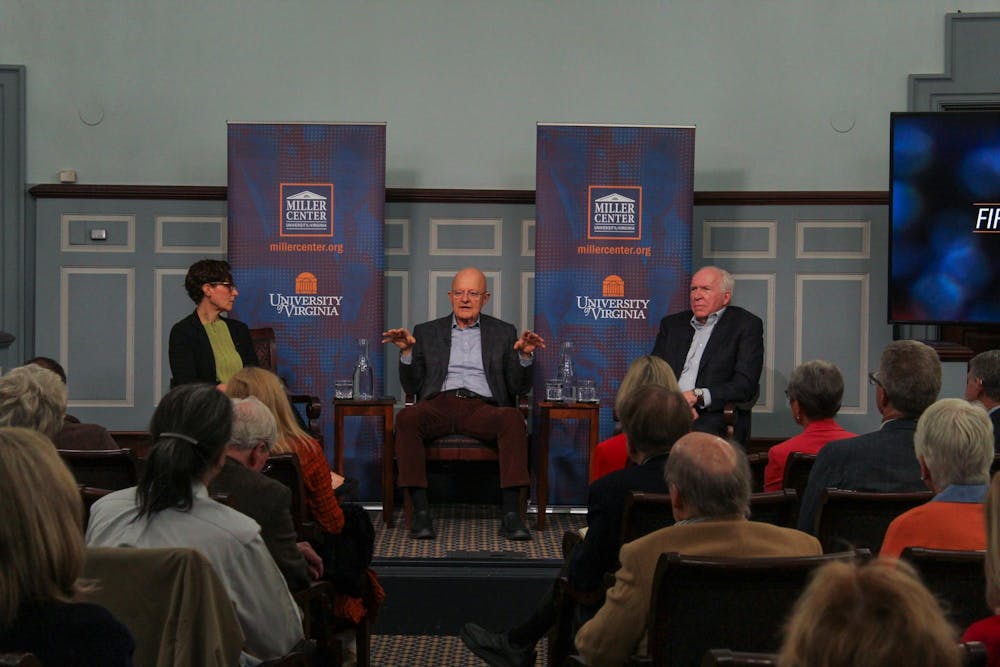
The Miller Center’s Presidential Oral History Program celebrated the start of its Barack Obama Oral History Project by hosting a two-day panel discussing how different departments handled policy challenges, events and political obstacles during the Obama administration. Panelists ranged from former cabinet members to White House staffers from both the 2009-2013 and the 2013-2017 Obama administrations.
For 50 years, the Miller Center has conducted interviews with approximately 800 individuals involved in presidential administrations for their Presidential Oral History Program. The program includes oral histories of the presidential administration from Gerald Ford to Obama, aiming to preserve the true voices of past presidents for the public to learn from. The Obama Oral History Project is a continuation of the Miller Center's dedication to creating a catalog of oral histories on presidential administrations.
John O. Brennan, former national Homeland security advisor, assistant to the president and former director of the Central Intelligence agency, along with Lt. Gen. James R. Clapper, former under secretary of defense for intelligence and former director of national intelligence, participated in Thursday's “National Security in the Era of Terrorism” panel led by Mara Rudman, former deputy assistant to the president for national security affairs. Both speakers served under both Obama administrations and worked as direct aides to the president.
To open the discussion, Brennan and Clapper gave in-depth recounts of what it was like to serve under former President Obama. Brennan and Clapper first spoke on the January 2009 transition of power between administrations during a time of less political polarization and the importance of providing both presidents with intelligence support during this time. Brennan detailed how the Bush administration was dedicated to ensuring a smooth transition between presidents and, according to Brennan, the transition was an important testament to democracy.
“Here is a Republican president who is certainly turning over the reins of power to an incoming Democratic president, and [Bush and Obama] had differences of view, quite public differences of view,” Brennan said. “There was no sense of any type of partisan bickering or effort to try to prevent the income administration from getting up to speed.”
In contrast with the successful Bush-Obama transition, Brennan spoke of unsuccessful efforts to achieve a smooth transition at the end of Obama's second term into Trump’s first term. Brennan said that after the success of the Bush to Obama transition, former President Obama aimed to ensure an even smoother transition to the following administration, but that the Trump administration was not as receptive.
Clapper also shared his experience transitioning between the Bush and Obama administrations. He was working as Under Secretary of Defense when the 2008 election occurred, and he joined the Obama administration as a holdover from the Bush Presidency. According to Clapper, there was a continuity between both administrations.
“At least in the military, when we had transitions from one party to the next, there was always a certain continuity,” Clapper said. “I thought, certainly from an intelligence standpoint, and it was the intelligence community's job, as it was during this transition, to make sure the country is safe and secure, during what, potentially, is a vulnerable time.”
Both also spoke to the importance of fostering a productive working relationship in their roles during a time when national security was at the forefront of presidential work. Clapper praised Brennan for his work as CIA director during his time as Director of National Intelligence, and he explained that there is often tension between the Director of National Intelligence and the Director of Central Intelligence. According to Clapper, Brennan worked hard to eliminate that.
Brennan and Clapper also explained the changing abilities and role of national security organizations in a time of technological advancement. Clapper said technological advancements are one of the most prevalent factors in changing the intelligence community. Today, Clapper said, the most pervasive technology facing the intelligence community is artificial intelligence, which Clapper sees as having the both the ability to help or hurt the U.S. intelligence capabilities.
“Artificial intelligence can only do what it's told,” Clapper said. “Humans have to tell artificial intelligence how to behave, and it can do so either constructively or destructively.”
Brennan expanded on the impact of technology on national security, specifying that technological advancements are profoundly affecting human espionage. Brennan cited how older tactics of espionage are obsolete in an era of retina scanners, machine-readable passports and the prevalence of closed-circuit television footage. Furthermore, enemies of the U.S. are weaponizing AI to confuse U.S. intelligence agencies, according to Brennan.
“The type of impact that technology can have that we still don't understand, both the pros and cons.” Brennan said. “Obviously, all these things have positive application, but also there are things that really will undermine our national security and prosperity.”
On the subject of AI, second-year College student Gabriel Weisdorfer said that technological advancements will play a prominent role within national security. He expressed the importance of keeping track of AI’s advancements, and how new uses may be harnessed for national security purposes.
“Continuing to watch [AI is important] and see how it's going to change intelligence, gathering, processes [and] analysis,” Weisdorfer said. “[Technology] is going to be changing so much in the next few years. So just keep an eye on [AI] and be aware of [AI].”
Ruby Budetti is a staff writer on the news desk. She also works as a staffer for The Cavalier Daily social media team. She is a second-year student on the pre-Batten track and hopes to major in Public Policy and Leadership.
Read More

No vacation from ambition
By Claire McGinn and Aditi Burra | YesterdayWhile these experiences help students advance their future goals, this culture of competition can also lead to pressure to have the “perfect” summer — defined by productivity and achievement, according to students interviewed by The Cavalier Daily.

U.Va.’s planned data center expands $30 million amid statewide debate over energy use
By Jaylynn Perez | YesterdayThe project has grown since it was initially approved by the Board of Visitors in June 2025 as a $72 million, two-story data center facility.
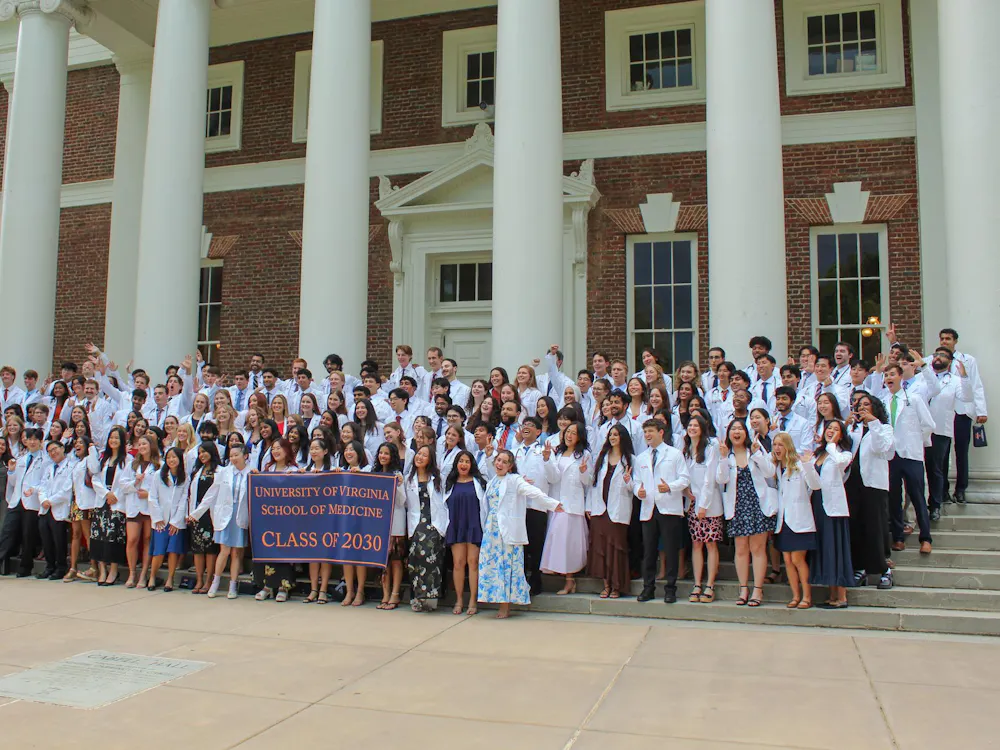
School of Medicine welcomes Class of 2030 with annual White Coat Ceremony
By Michael Racz | YesterdayThe ceremony is a longstanding tradition in medical schools across the country in which incoming first-year medical students receive their first white coat as they enter the medical profession.