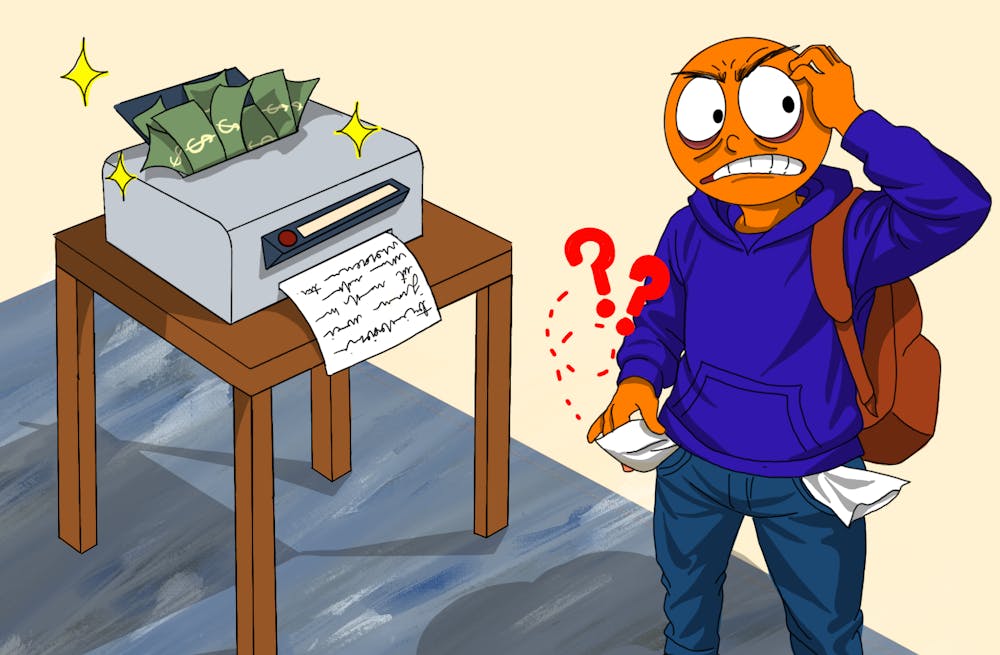
Printing is an essential part of academic life for University students, from problem sets to class readings and presentation materials for clubs. Currently, University students must pay to print through the PaperCut system that is paired with printers across Grounds. The price of a print job varies — black and white pages cost 8 cents each, and color pages cost 60 cents each. Since printing is necessary for academic life, especially amidst a push to tech-free classrooms that require students to use only physical materials, printing should be treated as a basic academic service offered free of personal charge to all University students.
In order to pay with the PaperCut system, students must preload funds through Cav Cash. The Cav Cash platform requires a $10 minimum deposit on the phone or in person, before a student can log in to print through the PaperCut account connected to their University email. An implication of this process is that, unless completing online, a student who is just 1 cent short in funds for a printing job must load at least $10 to complete the process. Since this system is also used for other expenses like on-Grounds meals, vending machines and laundry, students frequently reload money if their funds are depleted for reasons other than printing. On a surface level, these costs may seem minimal. Nevertheless, in the day-to-day life of students, this system creates logistical frictions and financial stressors that could be prevented with a free printing system that eliminates the current pay-per-use model through PaperCut. Alternatively, if the University were to preload each student with $20 of printing money, for example, it could make a serious improvement in lessening the unnecessary burden of the current printing system.
The University implicitly recognizes that printing is essential and offers some free printing options already. For example, Contracted Independent Organizations can access up to 150 black and white or 50 color pages per day in Newcomb Hall, and School of Law students receive up to 3,000 free pages per semester. Perhaps most well-known, free printing is offered at Newcomb Hall’s Multicultural Student Center during the specific hours of 10 a.m. to 3 p.m. Monday through Friday. While the MSC is helpful for providing free printing to students knowledgeable about its offerings, the constrained time periods for printing reduce the accessibility of the service for students. If a student has a midterm on a Monday, for example, there is no opportunity to print free notes over the weekend. CIO needs may exceed those of an individual, but the fact that free printing is already offered suggests that providing this service through additional avenues would further increase affordability and accessibility for students.
Further, uneven access to free printing threatens equity. Undergraduate students across all University schools are likely to need to print during their semesters. But some students are better positioned financially to access these resources than others, bringing an equity issue into an academic necessity. Several students at the University have purchased a personal printer to have at home, under the assumption that the one-time-cost of the machine and paper, plus the benefit of avoiding time lags and stress imposed by the University printing system, will pay off over time. However, this solution is not available to all students, particularly those who are financially disadvantaged. Without ensuring free printing that is advertised to all students and is accessible across all working periods, students may decrease their use of readings and materials, preventing them from interacting deeply with their coursework. The financial barrier of printing should not be a concern on students’ minds when preparing for their courses or balancing their end-of-semester budgets.
Other similar-sized public universities such as the University of Texas, University of Utah and University of Pittsburgh have initiated some form of free printing or printing subsidy, ranging as high as $63 per semester. These services have been lauded by students at their respective universities for the financial support they bring to student academic operations.
The University could follow these universities in implementing a free or subsidized printing system. Specifically, the University could ensure that students are able to access library printers with their University ID, and then load jobs directly without the need to check and manage funds. By eliminating the personal fees that PaperCut involves, printing would operate similarly to other free library services, such as using study rooms.
Ultimately, printing is a service that improves the education of all University students. A switch to free or subsidized printing can further ensure equity and accessibility for all students without large fiscal sacrifices. Expanding printing locations or adding at least $20 per student in tuition and fees to support a subsidized printing system can ensure students feel fully academically supported.
Emma Nero is an opinion columnist who writes about economics, business and housing for The Cavalier Daily. She can be reached at opinion@cavalierdaily.com.
The opinions expressed in this column are not necessarily those of The Cavalier Daily. Columns represent the views of the authors alone.
Read More

EDITORIAL: College sports need fixing
By Editorial Board | 22 hours agoCollege sports, in their current state, are fundamentally broken, and they desperately need legislative stabilization and reform.
EDITORIAL: Student self-governance deserves our confidence
By Editorial Board | 5 days agoNow, just a month into the semester, new officeholders appear to be delivering results.

YOUNIS: SJP’s criticism is not hysteria — it is a challenge to U.Va.’s standards
By Ayat Younis | September 16, 2026Any leader deserves scrutiny for their professional past, regardless of their background and especially if they have ties to brutal military-industrial complexes through the IDF.