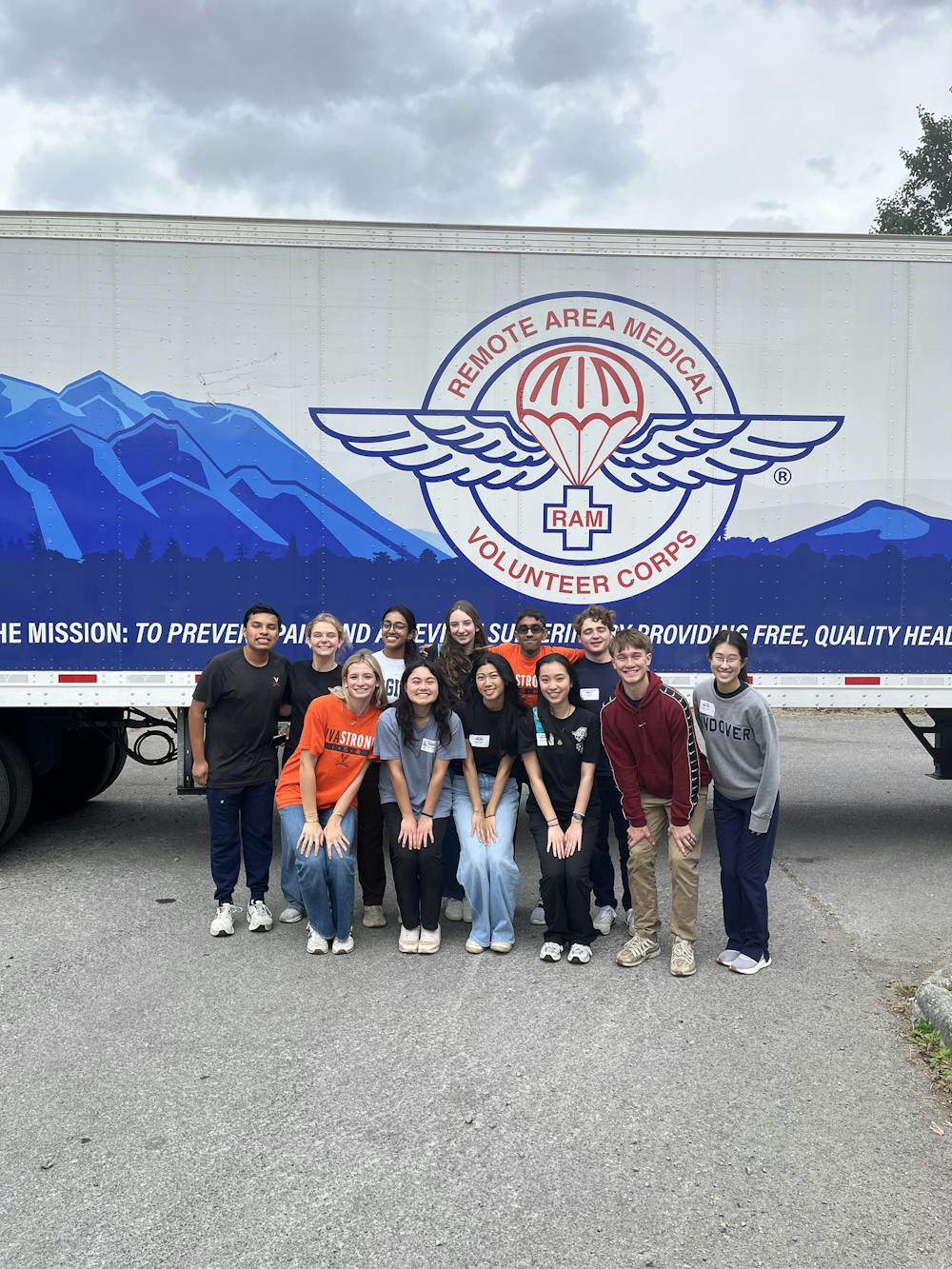
The University’s chapter of Remote Area Medical’s Fisherville Community Host Group held the Fishersville, Va. Clinic at the Augusta Expo Center Saturday and Sunday, bringing free medical, dental and vision services to the Central Virginia community. Offered on a first-come, first-serve basis, the clinic expected to host upwards of 400 patients. The clinic does not require any ID, insurance or payment for treatment. As such, it is targeted towards patients without the means for traditional medical care.
The mission behind RAM is to break down the typical barriers that some — especially those living in rural communities — face when seeking medical care. Whether a patient is self-employed, unemployed, ineligible for coverage or their existing coverage does not provide the full breadth of care they require, RAM seeks to fill those gaps.
In addition to the local Fisherville clinic, RAM members extend their outreach beyond Central Virginia, traveling to other clinics in Grundy, Va. and Newport News, Va. to provide services. Working in tandem with RAM is the Fisherville Community Host Group. The members of the Fisherville CHG were responsible for planning large portions of the weekend's clinic.
According to Tommy Williams, CHG Hospitality and Promotions lead and third-year Education student, the Fisherville clinic typically sees a majority of dental patients, as many government-backed health programs lack dental care offerings. Due to insurance, cost or other barriers, some patients go years or even decades without receiving adequate dental care. One patient from a clinic earlier this year was able to receive dental care for the first time in decades.
“Someone said they hadn't seen a dentist in over 25 years, and they looked [to be] 40 years old, so they hadn't had care since they were around 15,” Williams said.
Williams recalled that patients traveled from across Virginia — even as far as Maryland and Tennessee — to receive RAM services at the last clinic in the area. In order to receive care, attendees start lining up hours before, sometimes overnight. According to Lilia Kim, RAM fundraising chair, CHG Finance Team co-lead and second-year College student, if patients arrive later in the day, they may not receive care due to the volume of patients.
“[Patients] will wait overnight. They'll come at midnight, and they'll wait until about 6 a.m. to get free services,” Kim said.
According to Taylor Krafchick, CHG co-lead and ‘25 College alumna, the clinic has around 30 dental tents to provide service to as many patients as possible. Preparing for the volume of dental patients was a key goal for the clinic, ensuring that patients could see timely care without the bureaucracy of scheduling an appointment through a typical provider. Some dental procedures offered to patients included cleanings, extractions, fillings and even X-rays.
“Normally, when you have a cavity, you might … need a tooth extracted, the dental appointment might be three months from now,” Williams said. “It's not necessarily going to be next week. And so if you really need something that's quick, you can just show up [to RAM] and get that handled.”
In addition to alleviating the timing barrier of healthcare, RAM offers Spanish, Arabic, Pashto and American Sign Language translators for the clinic, ensuring that neither affordability nor communication prevent patients from receiving optimal care.
Several resources for this clinic come from Augusta Health, a general hospital in Fisherville. Ria Raval, co-lead and Masters in Public Health student, credited Augusta Health for assisting with this process by communicating lab results after the clinic, helping provide immunizations and allowing patients to make follow-up appointments when necessary.
Beyond medical services, patients were also offered haircuts, snacks, meals, children’s books and toys. Kim explained that while these offerings are not exclusively medical, they still make a difference in a patient’s overall health.
Since several attendees rely on RAM clinics for healthcare, CHG organized roughly 300 student and professional volunteers to handle the volume of patients. Volunteers typically assist with several tasks — preparing and assembling medical trays for procedures, cleaning and checking in with patients. To ensure that professionals can focus solely on each patient, student volunteers contribute by sterilizing the tents and equipment, checking patients in, directing parking and other organizational tasks.
While RAM was ultimately able to secure volunteer professionals across many specialties — including opticians, optometrists, ophthalmologists, audiologists and general physicians — compiling the group presented challenges. According to Natalie Ladosci, CHG co-Recruitment lead and fourth-year College student, many healthcare specialists are unable or unwilling to volunteer long hours of their off-days amidst an already demanding schedule.
“The biggest challenge that I've faced, is the realization that there are more providers out there that don't volunteer than [those that] do,” Ladosci said. “There's so many different circumstances that would lead a provider to not be able to volunteer.”
After reaching out to over 1,000 providers, Ladosci and the Recruitment Committee were able to ensure the clinic was equipped with enough providers to manage the hundreds of anticipated patients.
Looking forward, Raval said that the Fishersville CHG aspires to increase the frequency of the clinic, allowing it to become an annual staple of the area.
“One of our goals is to sign a contract right after this clinic for the year after, so we can start making Fishersville more than just a little pop up,” Raval said. “Something that's more regular. … people can kind of, kind of count on Fishersville being there in the spring every year.”
The impact that these clinics have on patients presents itself in real time. Ariel Wang, RAM chapter president and third-year College student, recalled a previous clinic in Newport News, Va., when she assisted a young woman at the vision clinic.
“I remember she put the glasses on. And she just started screaming,” Wang said. “And she was like, ‘Oh my gosh, I can see … I can see you, I can see your face,’ and it almost made me want to cry in the moment, because she didn't realize how much vision she had lost throughout the years.”
Volunteers at RAM echo countless stories that mirror this one — patients receiving an accurate prescription for the first time in decades, a 12-year-old and an 18-year-old receiving glasses for the first time and an 80-year-old finally correcting his vision.
While offering services for patients who need them, RAM programs also provide hands-on experiences for students interested in healthcare. Riley Whelan, RAM member and third-year College student, expressed that the clinic allows her to gain insight into the day-to-day of a medical career.
“I hope to pursue a career in the medical field,” Whelan said. “RAM helps you connect with peers with similar goals and see how you could potentially help those in your community in healthcare deserts in the future.”
While the event only lasts two days, Wang said organizers strive to equip patients with follow-up care and resources to continue that care beyond the event.
“We also aim to connect patients with long-term resources,” Wang said. “It's not just a one-day intervention, but we want it to be part of a broader continuum of care through the community.”
While the CHG served hundreds of patients over the course of the weekend, both CHG co-leads emphasized that volume is not the only metric of success. According to the co-leads, the clinic is successful if patients are satisfied with their level of care and feel supported throughout their healthcare journey, beyond the clinic itself.
“Serving even just one patient is so important. Any one person is just as important,” Krafchick said.
Read More

No-bake date bark brings a taste of joy to all sweet treat lovers
By Lily Notter | 1 hours agoWhether you eat these bars with friends, as a solo study snack or after family dinner, they are a delicious and nutritious addition to any day.

Delicious on a dime: Charlottesville’s best restaurant deals
By Lucy Larsen | 5 days agoFrom wraps and wings on the Corner to imported wine and tapas on the Downtown Mall, these are the perfect spots to treat both your taste buds and your wallet for under $25.

Play the organ
By Elizabeth Adams | September 25, 2026The college side quest does not need to be the multi-semester jaunt that my organ adventure has become, and it certainly doesn’t have to make sense.