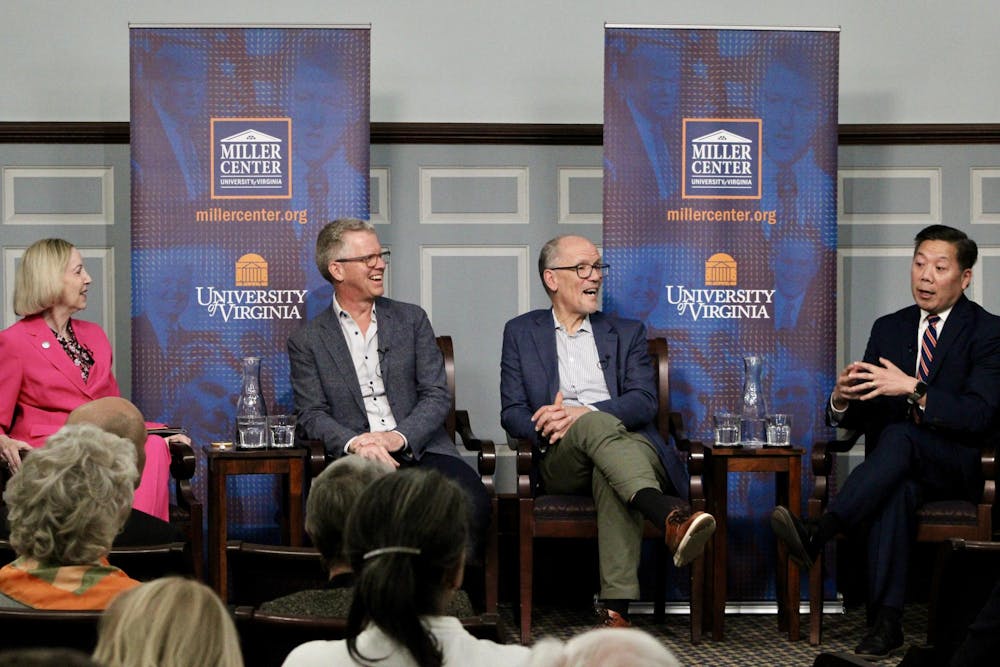
The Miller Center hosted former White House officials Wednesday to provide opening remarks for an event series to celebrate the launch of their Barack Obama Oral History Project. The panelists reflected on campaigns, presidential transitions of power and the domestic policy challenges of the Obama administration — such as the federal budget, sustainable urban planning, civil rights and healthcare.
The panel included three former Obama administration officials — Shaun Donovan, former secretary of housing and urban development and director of the office of management and budgeting, Tom Perez, former assistant attorney general for civil rights and secretary of labor, and Chris Lu, former cabinet secretary and deputy secretary of labor.
William Antholis, director and chief executive officer of the Miller Center, introduced the oral history project for the Obama administration — which he said has been in production for 10 years — and explained that the Center has been creating presidential oral history projects since the end of President Gerald Ford’s administration in 1977. Antholis said through the projects the staff at the Center have produced, they have interviewed top policymaking officials from each administration, asking them to reflect on their time working in the White House.
Antholis emphasized the dual mission of the oral history projects in cataloging history while also creating a guide for the future federal policymakers.
The panelists began their reflections by discussing their first interactions with Obama. Lu spoke about meeting the former president when they were classmates at Harvard Law School and recalled marveling at his intelligence and maturity.
“When Barack Obama spoke in law school, people listened because he had something to say. I always say he was a fully formed human being,” Lu said.
Perez then expressed his belief that Obama was unique in his power to inspire community organizing, which was key to his electoral success.
Donovan recalled initially having doubts about Obama’s lack of experience during the campaign, but he described a pivotal moment for him was when he recognized the excitement of his nine-year old son that Obama was running for president. According to Donovan, young people’s excitement in politics is powerful, and young people were drawn to Obama’s promise of hope and change.
All three panelists applauded the bipartisan efforts between the outgoing George W. Bush and incoming Obama administrations to address the 2008 financial crisis. Donovan explained that after Obama became the Democratic nominee, he was invited to meetings with the Bush administration and Obama’s Republican opponent in the race, former Senator of Arizona John McCain (R), to ensure as smooth a transition as possible during such a fragile time for the economy. Lu echoed Donovan’s sentiments on the efforts from both Obama’s and Bush’s teams to create a calm transition.
“Instruction came from President Bush that this was going to be the best transition in U.S. history,” Lu said. “We've had some very, very bumpy transitions for the last couple ones, and that history of bipartisan transitions needs to continue for the sake of the country.”
Lu described his mission as cabinet secretary during the first term to pass as much legislation as possible while there was a Democratic majority in the House of Representatives. He cited big legislative successes as being the Recovery Act and the Affordable Care Act, and described his role in organizing and using the resources of every cabinet member to acquire as many votes as possible in the House.
Perez spoke about his pride to champion LGBTQ rights during his time at the Department of Justice, describing the challenging debates within the Department that ultimately led to a decision to stop defending the Defense of Marriage Act — a 1996 law passed by Congress defining marriage as between one man and one woman — in the Supreme Court.
The panelists also spoke about regrets that they had from their time working in the administration. Lu expressed that the administration could have taken more advantage of the Democratic congressional majority in the first term, and created more structural changes on issues such as gun control and immigration. He specifically said he regretted that they could not pass more gun control legislation after the Sandy Hook shooting.
“That's about as emotional a time as I think I've ever seen Barack Obama, when we could not make meaningful progress on gun control after Sandy Hook,” Lu said.
Perez expressed his regret regarding unmet immigration reform goals, specifically citing a planned 2014 vote on a comprehensive immigration package that failed to occur after former Virginia Representative Eric Cantor (R) lost his primary race — a vote they thought they needed to pass the package.
“I think we had a laudable but ill-advised desire to get everything perfect. … The number one thing I would tell anyone coming in, [is] understand that time is precious, and don't let the perfect be the enemy of the okay,” Perez said.
Jerry McCormick Ray, an audience member and former senior scientist in the Department of Environmental Sciences at the University, said that she was impressed with the Obama administration, and has been disappointed with the state of politics recently.
“[Obama] was amazing. I was so excited. I thought … America's really finally going to grow up, but … now what we're faced with is just horrifying,” McCormick Ray said. “I'd like to see more of the people [from Obama’s administration] rise up against our leadership.”
In an interview with The Cavalier Daily, Perez spoke about his interest in being a part of the oral history project in particular as it serves as a guide for the future. He also described the importance of doing the oral history project interviews as a lesson in humility and a reflective exercise for himself and others to look critically at their past work.
“I think if we don't understand the lessons of history, we are doomed to repeat the mistakes of history,” Perez said. “It doesn't have to be this way, I don't want people to abandon the desire to forge bipartisan solutions.”

Abigail Larkin is a staff writer on the news desk. She is a third-year student in the Batten School of Public Policy, majoring in public policy and foreign affairs. Abigail is from Norfolk, Va., and she enjoys writing about state and national politics.
Read More

U.Va. Health first in Virginia to use a temporary heart pump in a pediatric patient
By Isabela Delgado | 7 hours agoAccording to the National Institutes of Health, the Impella device is a miniature catheter-based device, in which a long tube is “placed in the left ventricle across the aortic valve" to pump blood and maintain a systemic circulation.

Student Council considers reduced 2026-27 academic year budget
By Lucia Gambacini | YesterdayRepresentatives ultimately adopted an amendment to the proposed budget, but tabled consideration of the legislation to this Tuesday’s meeting.

Students pay University Mandatory Fees — what do they cover?
By Isabela Delgado | 3 days agoThe amount a student pays in fees is dependent on several factors, such as a students’ residence in- or out-of-state and their school of enrollment.