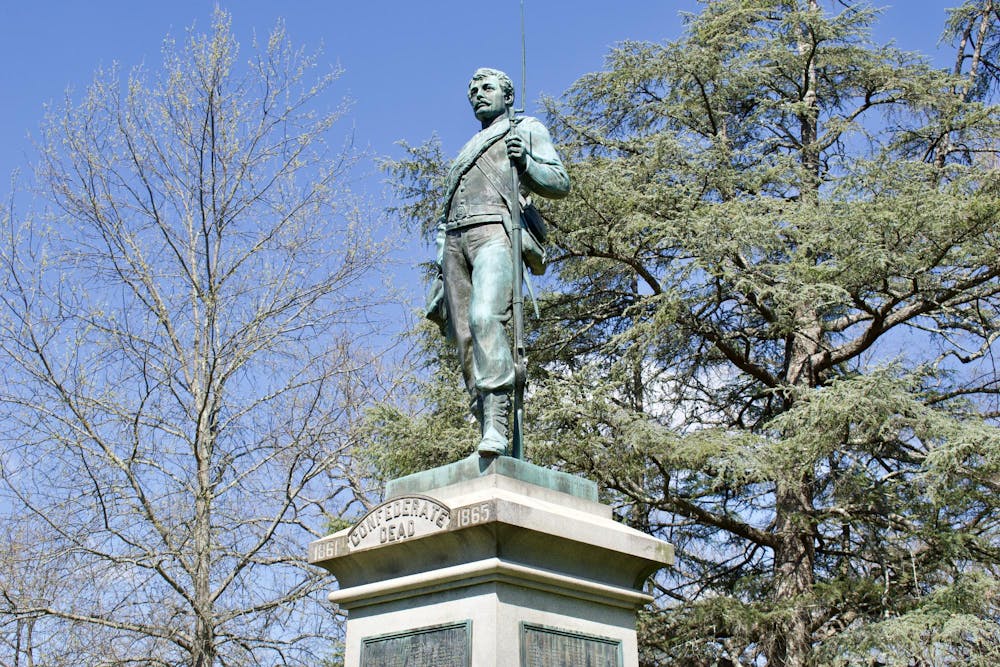
Tucked away near first-year dorms lies the University Cemetery. Buried there are hundreds of distinguished members of the University community — from University presidents to long-time staff members — but also over 1,000 Confederate soldiers who died in Charlottesville hospitals during the Civil War. Overlooking the Confederate section, in one of the highest points in the entire cemetery, hulks a defiant, smug and greenish-blue soldier — a Confederate statue erected in 1893. As the University continues to reckon with its history of racism, slavery and exclusion, there cannot be room for such a symbol on Grounds. These past injustices can only be made right by responsibly reckoning with their history — beginning with the removal of this monument.
During and leading up to the Civil War, the University was a hotbed of secessionism and proslavery attitudes. In 1861, a Confederate flag flew over the Rotunda and students burned effigies of Union generals on the Lawn. When the war broke out, 536 of 604 total students began to serve in the Confederate military, with many alumni serving as powerful Confederate leaders. Despite what some revisionists say, the South inarguably started the Civil War to defend slavery. Students and alumni — having extensively witnessed the horrors of slavery firsthand — chose to take up arms to uphold white supremacy and a slave society. This chapter of history is one that modern community members should be horrified by.
Having a Confederate monument on Grounds is not a responsible way to deal with this history. Monuments do not just neutrally represent the past. Instead, they speak an ideological message about it, shaping public perception and attitudes about events or people. Most Confederate monuments, in particular, are a far post-Civil War attempt to rewrite history in favor of the Confederates through the promotion of the Lost Cause myth — the postwar romanticization and sanitization of the Antebellum South and Confederacy by Southern sympathizers. The statue on Grounds is no exception — commissioned by the local Ladies’ Confederate Memorial Association chapter, the Confederate soldier statue bears the inscription, “Fate denied them victory but crowned them with glorious immortality.” This monument is not teaching anyone about history — the statue is not even depicting any particular soldier — but rather is a trite corruption of it.
Because the University likely knows that there would be widespread controversy if attention was brought to the monument, there is very little University-published information or discourse about the statue — most students probably do not know it even exists. But keeping it under wraps only does a disservice to us all. The University’s past full-throated support of the Confederacy cannot be swept under the rug, but instead it should be taught as an example. If the University wanted to actually teach the history of its involvement in the Civil War, it would take down the monument to replace it with an informational plaque. A plaque that accurately tells the history of the University’s involvement in the Civil War would be a positive step towards recognizing and learning from our history.
When monument removal is debated, especially at a place like the University, those who stand against removal often bring up the Founding Fathers as an example of why taking down monuments of problematic figures is a slippery slope — if the Confederate statue is pulled down, should not Thomas Jefferson’s too? However, this is a false equivalence. Jefferson was a slave owner — and an especially bad one at that — but slavery did not define his relationship to the University or the United States. He founded the University himself and played a key role in founding the United States on his own lofty, progressive ideals — he iconically declared, “all men are created equal.” Though they were ideals which he fell short of during his own life, they were truly held beliefs nonetheless. In stark contrast, the Confederacy was founded on an ideology of illiberal white supremacy that is incompatible with Jefferson’s life mission. In the simplest possible terms, the Confederacy was founded to undermine what Jefferson spent his life building, and hence, there is no place for a symbol of reverence for it at the University.
To give credit to University leaders, much has been done in recent decades to bring some semblance of justice to the University’s checkered racial past. For instance, the 2013 President’s Commission on Slavery and the University revolutionized the way the enslaved at the University are understood and recognized, spawning the Memorial to Enslaved Laborers and the Universities Studying Slavery consortium. Additionally, other dedications to problematic figures have been removed or changed, such as the renaming of the Alderman Library and the removal of the Frank Hume inscription on the “Whispering Wall” memorial. However, this progress is not adequate — in order to truly move forward, the racist parts of the University’s legacy must be progressively dealt with, deeply examining all representations of it on Grounds.
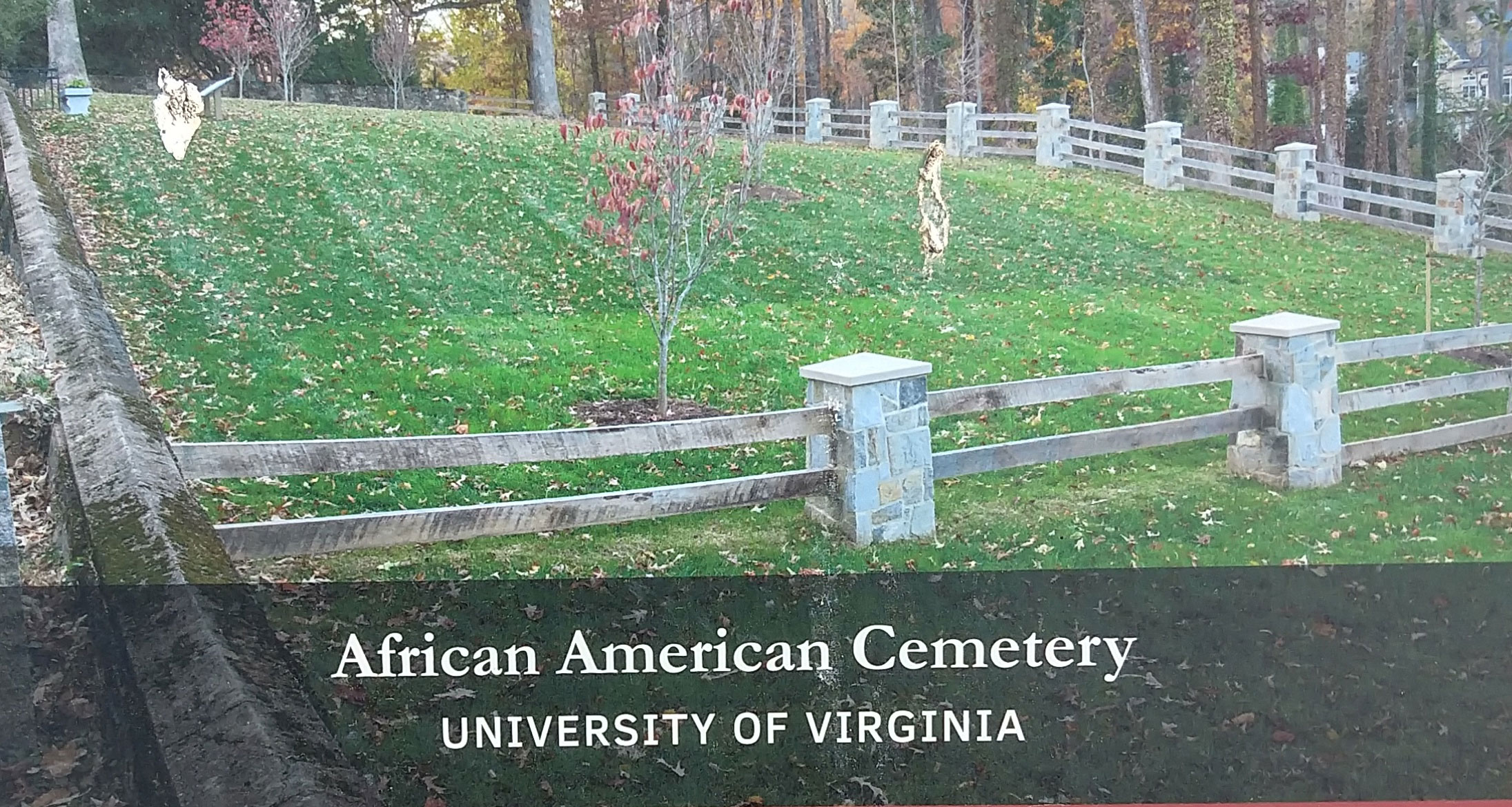
There is a third section of the University Cemetery, in addition to the University community and Confederate areas. This section is even more hidden than the rest of the cemetery — it is all the way in the back, on a downward slope, possessing neither names nor inscriptions. It is the slave burial grounds, where at least 67 enslaved people and possibly post-Emancipation African Americans who labored at the University are buried. It was entirely forgotten until unexpectedly discovered in 2012. There are now a handful of trees, benches and a plaque adorning the quiet spot, but it is still quite bare and unassuming. This juxtaposition — the front-facing, grand monument honoring those who gave their life for the enslavement of the people who are shoved to the back of the cemetery in unmarked graves — perfectly encapsulates the history of racial injustice that still stains the University. Doing away with the Confederate statue is a necessary step in removing that stain.
Beckett Anderson is an opinion columnist who writes about politics for The Cavalier Daily. He can be reached at opinion@cavalierdaily.com.
The opinions expressed in this column are not necessarily those of The Cavalier Daily. Columns represent the views of the authors alone.
Read More

EDITORIAL: U.Va.’s chance to resolve institutional distrust
By Editorial Board | 2 days agoAffordability, AI use and free speech — these are all issues critical to ensuring that our University is accessible to all and that its culture is rigorous, rational and accepting.

HAWKINS: SJP’s animosity toward Darden’s new dean is patently absurd
By Joshua Hawkins | 4 days agoNo, Grushka-Cockayne should not be forced to resign before Darden even opens its doors for the fall, and SJP should seriously reconsider suggesting such a dramatic step.

ELJAZZAR: The University’s growing lobbying budget should worry you
By Farah Eljazzar | 6 days agoA public research university having to negotiate for its independence is, on its face, an indictment of the system it operates within.