
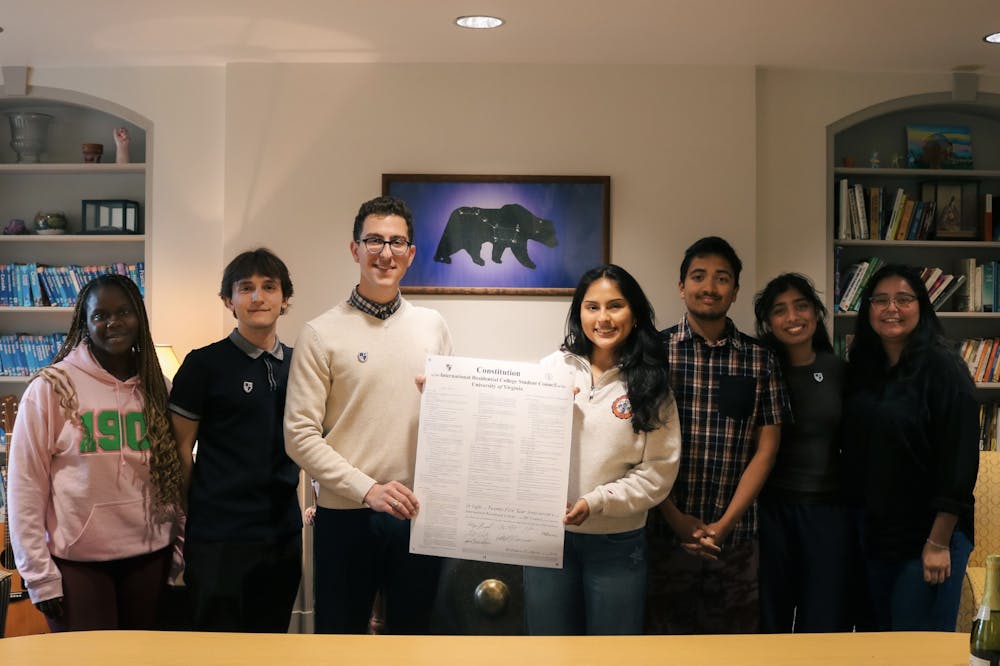
The International Residential College Council voted March 22 to adopt a new constitution, effective immediately, as the IRC approaches its 25th anniversary this fall. According to Philippe Hempel, IRC minister of community operations and third-year Architecture student, he began redrafting the Council’s constitution over winter break when Council members realized the previous constitution did not provide clear guidance to navigate it through challenges in the fall 2025 semester. Notably, in the fall, two IRC faculty members stepped out of their positions and two Council members resigned.
What is the IRC and the IRC Council?
The IRC is one of three residential colleges at the University — along with Brown College and Hereford College — and focuses on “academic excellence” and “global consciousness,” according to the IRC website. Residential colleges are on-Grounds, living learning communities to which students of all years can apply to reside, and according to Hempel, the IRC houses 308 residents across four residential buildings.
The IRC Council is the main student governing body of the IRC and follows a parliamentary structure, which Hempel said is aligned with the “international” aspect of the community. There are typically nine students on the Council — two first-year council representatives, two ministers of external relations, one minister of administration, one minister of community operations, two ministers of the interior and one prime minister. Together, the elected group of residents handles and plans student affairs for IRC members, Hempel said.
Why did the constitution need to be redrafted?
Though Hempel said the IRC has had some form of student governance documents since the IRC’s founding in 2001, he noted the previous constitution was serving as both the Council’s constitution and bylaws, which was not efficient.
“A constitution is supposed to establish governing structures in the foundation of governance, whereas bylaws are supposed to operationalize the constitution,” Hempel said. “You should be able to make quick adjustments [to bylaws] when needed, whereas with the constitution … you want to make sure that [the foundations] can’t be easily changed.”
Hempel further explained that the shortcomings of the previous constitution were made clear in the midst of two key changes to the IRC in the fall 2025 semester, during which the constitution did not provide proper guidance to Council members.
First, a newly amended on-Grounds housing policy was implemented for the 2026-27 academic year housing application, which grants priority to rising second-year students in applying for on-Grounds housing. Before this amendment, upperclassmen living on Grounds could renew their lease for the following academic year if they wanted to remain living in their current location.
For the residential colleges — though the new policy still prioritizes returning residents over new residents — returning rising second-year students are given priority in housing assignments and previously, returning fourth-year students received the highest priority in the housing selection process.
Second, according to Hempel, the IRC has also seen two faculty changes. IRC Office Manager Jill Jones retired after handling administrative tasks at the IRC since its founding in 2001, and IRC Principal and Architecture Prof. Phoebe Crisman left the University for sabbatical, Hempel said. These changes happened at the end of the spring 2025 semester, and Hempel explained the effects of those vacancies were felt in the fall when the Council had to take on “more work.”
Within the Council itself, two members resigned in fall 2025. Both the prime minister and one of the two external relations ministers resigned during their term, and the previous constitution did not sufficiently detail how to proceed with Council operations in the case of resignations. Ministers are elected at the end of the spring semester of the previous academic year, and terms are one academic year, Hempel said.
“We didn’t have the clearest guidelines or [processes] set by the constitution for filling those vacancies,” Hempel said. “Had the constitution been [better] equipped or written, that whole process [of filling empty roles] would have been easier … faster and a lot more transparent and productive for everyone involved.”
Though the roles were eventually filled in alignment with the previous constitution, Hempel said the challenging decisions following the resignations further solidified the need to redraft the constitution.
“What [the resignations] unfortunately, inevitably did was [create] a little bit of uncertainty within our community. There were residents who … were … concerned what those resignations meant and whether the structure of the council would still be able to function,” Hempel said.
Sandra Seidel, advising dean and biology and engagements professor, replaced Crisman as IRC principal. According to Isabel Ohakamma, IRC co-minister of the interior and third-year Education student, the vacancies left behind by Jones and Crisman — and subsequent replacement of Crisman with Seidel — could have contributed to the Council members’ resignations. Specifically, Ohakamma said that those Council members might have had the intent of working under the administration prior to Seidel. Seidel did not respond to requests for comment.
The redrafting process
Hempel, who spearheaded the constitutional redrafting, said that the Council began planning for the new constitution towards the second half of the fall 2025 semester — in the midst of the key changes to the University housing policy and faculty and Council resignations.
The first redraft went through several revisions throughout the spring semester until the final draft was presented to IRC members March 9.
Residents were able to ask questions to Council members about the new constitution during listening sessions held March 10 and March 12 — an informal opportunity for IRC residents to address their concerns over the new constitution before its adoption — according to Hempel. Residents were also able to attend the Council meeting held March 15, a week before the final vote on the constitution, which Hempel said was dedicated entirely to collaborative review and edits of the document.
According to Hempel, the new constitution was effective immediately following its approval March 22 in order for the IRC Council elections to follow the rewritten framework later this semester.
Key changes to the new constitution
The new constitution is written to improve transitions between Council members at the beginning and end of terms, prioritize transparency of governing documents to IRC residents, clarify the roles of Council members and ensure longevity of the Council’s governance, according to Hempel and Andrea Palomino-Jayo, IRC prime minister and third-year College student.
Hempel said when Council members are elected and installed around the end of the academic year, they begin their duties in the summer. He noted the new constitution includes provisions on improving new Council members’ understanding of their responsibilities.
“We’re hoping that between the moment that the new Council is confirmed and the new Council takes over, there’s going to be a few weeks for them to shadow outgoing Council [members] and to be able to get a feel for the role and not just be thrown into [their new position],” Hempel said.
The new constitution also aims to clarify the responsibilities of Council members’ roles. Palomino-Jayo said the IRC previously had committees to assist Ministers in their roles, but the lack of direction within those committees may have contributed to decreased resident involvement. She explained one key change is dividing the Minister of Administration role into two — a Minister of Treasury and Minister of Records — and creating specific support roles for their responsibilities.
“[The Minister of Administration] is in charge of both minute tracking during meetings and also budget tracking, as well as making our newsletter,” Palomino-Jayo said. “I created a few very specific roles … like social media chair, alumni chair and newsletter chair to support our Minister of Administration currently.”
Palomino-Jayo said that next year, the Council hopes to have a Minister of Records and Minister of Treasury to replace the Minister of Administration role.
In terms of rewriting the constitution, Hempel said IRC residents were not heavily involved throughout the drafting process, but that the listening sessions provided residents with the opportunity to highlight issues to be addressed in the constitution prior to its adoption. Hempel said that for any future amendments to the new constitution, listening sessions are mandatory for IRC residents. He said this requirement aims to increase administrative transparency and promote engagement among residents.
Hempel emphasized his hope for the new constitution to rebuild trust between IRC residents and the Council to reengage the community.
“Hopefully, what we’re going to do through [the rewrite] is build trust again and … use this as a new opportunity to be very transparent,” Hempel said. “Our former governing documents [have] been kind of all over the place.”
Melody Yuan is a staff writer on the news desk. She is a second-year student in the College studying Economics and Statistics from Richmond, Va.
Read More

Student Council considers creating an ad hoc committee to review UBE proceedings
By Lucia Gambacini | 11 hours agoConsideration of the bill was postponed until the next general body meeting.

Health System Board Finance Working Group passes remote participation policy
By Lily Kostro | 12 hours agoThe policy states that a member of HSB may participate remotely in meetings not open to the public, provided the member notifies the rector that they are unable to attend in-person due to an emergency, personal matters or a disability.

Less than three months out — what’s on the ballot this November in Virginia?
By Abigail Larkin | 12 hours agoHere is a closer look at what is on the ballot this November in Virginia’s elections for the U.S. Senate, U.S. House of Representatives and amendments to the Virginia Constitution.


