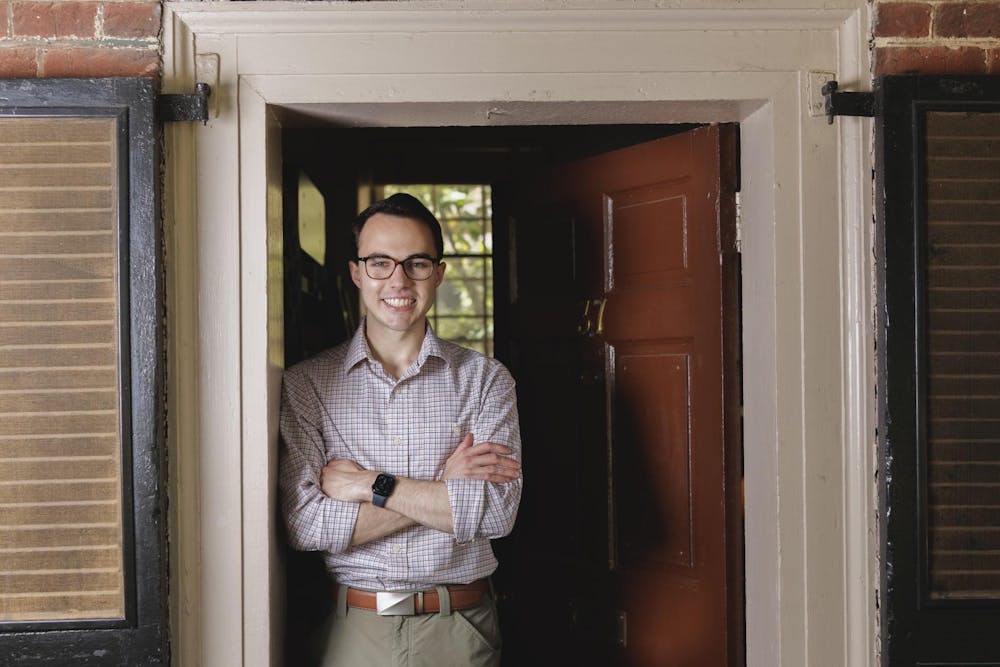
Fourth-year Engineering student Thomas Ackleson’s term as Honor Committee chair officially ended Monday. During his term, the Committee adjudicated a total of 105 cases — up from 78 cases last year. Ackleson will be succeeded by third-year College student Genny Freed, who was selected as chair March 29 by newly-elected Honor representatives at the Committee’s Graves Mountain Lodge retreat.
In an interview with The Cavalier Daily, Ackleson reflected on the highlights of his term and ambitions he has for the future of the Committee. Among these accomplishments are conducting successful spring and fall support officer recruitment cycles, improving the efficiency of the sanctioning process and increasing transparency and trust between the Committee and the University community. He also emphasized the Committee’s efforts to solidify restorative sanctions while simultaneously maintaining accountability in the multi-sanction system.
Ackleson said that one of the accomplishments he is most proud of from his term is the recruitment of a committed cohort of support officers. He said the position received 247 applicants this year — roughly double than previous years. At the beginning of his term, Ackleson said that he wanted to increase accountability among support officers and recruit a larger pool capable of meeting the Committee's needs — such as an increase in honor violation cases.
Ackleson served as a support officer — a role responsible for assisting students accused of an honor violation — before he became a Committee representative during his third year. Drawing on this experience, Ackleson said he personally took on responsibility for managing the support officer recruitment process as chair, rather than delegating the responsibility to the chair of another subcommittee.
“Usually, the chair appoints a subcommittee chair for the [support officer] selection process, and I decided to take that on as a personal project,” Ackleson said. “I'm really passionate about [it] and [it is] important to [bring] in new people from every school at the University and [make] sure that they're invested in honor.”
One thing Ackleson did during the support officer selection process was ensure the candidates were passionate about the Community of Trust. He said he planned many dinners — both during and after recruitment — where representatives would take new students out to get to know the candidates both in and out of their support officer training.
Another of Ackleson’s priorities during his term was to improve the efficiency of the sanctioning process for accused students. He said that he and the Committee have sped up the sanctioning process through bylaw alterations — such as the summer case processing amendment — and internal sanctioning procedural changes that alter how case adjudication occurs and adjust internal staffing and tracking procedures.
He also said that the Committee has been careful not to compromise the integrity of their sanctioning process in the name of efficiency and said that “it will take as long as it takes as long as we are doing it right and fairly.”
Another point of discussion during Ackleson’s interview included efforts to increase awareness of the Committee during his time as chair — he noted that he has felt community members and peers are appreciative of the work the Committee does which was a motivator for him. He also said the Committee adjudicated more honor cases this term — an increase from 78 last year to 105 this term.
Ackelson attributed the increase in honor reports to greater engagement with and trust in the honor system. He emphasized the trust in the system was lost during the single-sanction era — a period that mandated automatic expulsion for any honor offense. The current multi-sanction system, adopted in July 2023, allows for a range of consequences tailored to the specifics of each case.
Reports can be received from any member of the University community and tips can be submitted anonymously via a “Report Intake Form.”
“It speaks to [the idea that] people [are] willing to report more ... and I think that's a testament [that] there's more faith that the Honor Committee and the restorative process that we have is effective in sort of resolving that reporter's concerns,” Ackleson said.
Ackleson said that he believes the University community has begun to better understand and trust the effectiveness of the multi-sanction system. He also said that the community has begun to recognize the system’s ability to enforce both restorative sanctions and permanent sanctions — such as expulsion — when necessary.
Ackleson also discussed the honor system's role in helping the University navigate the landscape of artificial intelligence in higher education. He said that many universities are implementing blanket AI policies or utilizing AI detection software to adjudicate honor cases. He said that, instead of using the software, the University relies on its Honor Code and the Community of Trust to prevent students from cheating.
“I think that the Honor Committee and the honor system might be a unique way for U.Va. to stand out [from other universities] in that we don't need [AI detectors], just like we don't have a lockdown browser for the University,” Ackleson said. “We have an honor system that people can rely on so that students won't cheat.”
Looking ahead, Ackleson acknowledged that the next Committee will face challenges — such as the recent increase in the number of honor violation reports — but said he is hopeful they will be able to address the issue and adapt.
Ackleson shared that some of the most impactful moments during his time as chair were when students reached out to him after having gone through the sanctioning process and thanked him for how comprehensive and respectful the process was. He specifically shared one story about a student whom he advised while he was a support officer, who later came back to the Committee after going through the Informed Retraction procedures to serve with the honor system as a support officer themself.
Ackleson said he believes honor at the University has the power to foster trust amongst the University and serve as a unifying force for the community.
“The Honor Code is a really valuable asset that U.Va. has … I think it's a unifying thing … We trust each other simply because we're students here. There doesn't need to be any other reason [and] I think [there is] something really beautiful about that,” Ackleson said.
Michael Racz is a staff writer on the news desk. He is a second-year College student majoring in biology with plans to go to medical school. He enjoys writing about health topics and student self-governance.
Read More

From the Archives: Fraternity life
By Maisy Callahan and Emily Conway | YesterdayMore fraternities decide to partner with the Historic Renovation Corporation, a University-affiliated agency that provides tax credits for the restoration of historic buildings.

Center for Politics hosts Tom Perriello to discuss AI, congressional responsibilities
By Melody Yuan | 2 days agoAt the event, titled “The Deep Divide Between How the People and the Powerful Are Thinking About AI,” Perriello also referenced his Sept. 22 article “To Wary Working People, AI Preemption Is the New Nafta” in The New Republic during his discussion.

U.Va. Health’s telehealth program approaches 1 million visits
By Vrinda Vashisht | 2 days agoThe program arose from the challenge of U.Va. Health physicians traveling to communities across Virginia to treat patients who could not easily reach Charlottesville.