The Iranian war looms large in the minds of students at the University. Some have friends and family who live in fear of American, Iranian or Israeli bombs. Some wake up shocked to see gas prices higher than they were the day prior. Some are proud of the deposition of the dictator Ali Khamenei as a signal of greater American security and Iranian liberty. Some see this war as an act of blackmail to a state that has its own controversial human rights issues. Many students hold opinions on the issue, common sentiments that have produced meaningful protests in the past. Discussing throughlines with past protests can give insight into how the student body can, and should, protest actions it deems unsatisfactory in a period of economic and political turmoil. However, intentional misrememberings of history threaten the perceived legitimacy and motivation of future protests.
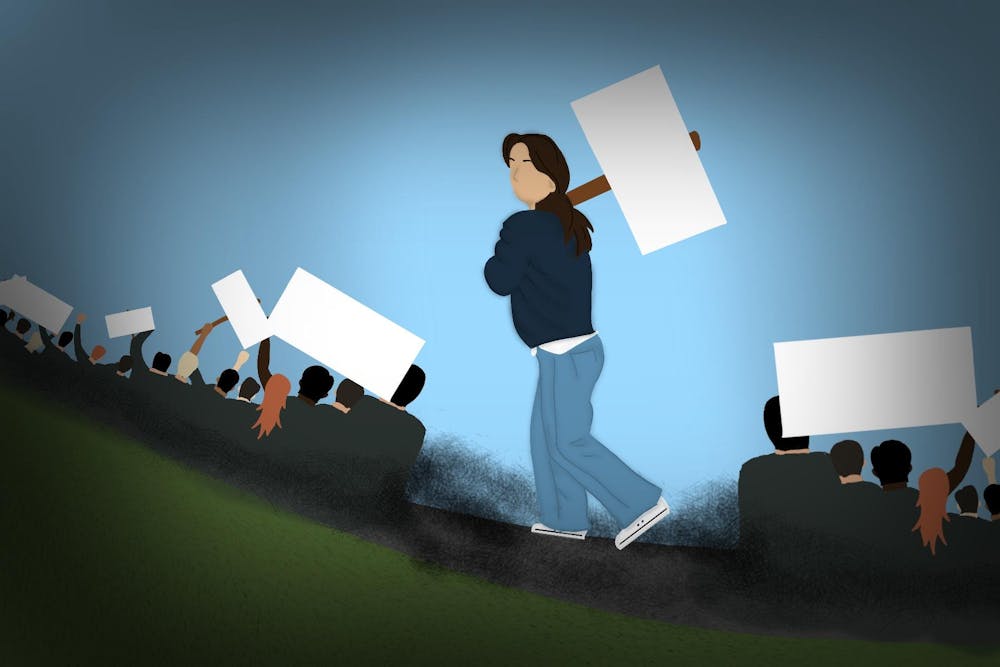
The Vietnam War and its injustices produced the first large-scale, meaningful response from the University’s student body. On April 30, 1970, President Richard Nixon announced his bombing campaign into Cambodia, a neutral country. Four days later, police responded to student protests at Kent State University with lethal force, killing four students. One would be surprised to see the University as a hotbed of activism at this moment as the first Black students attended in the early 1960s and the first undergraduate women in 1970. Despite this reputation, the week of May 6, 1970 saw crowds of 9,000 listening to fiery speeches and crowds of 2,000 marching on Maury Hall, the naval Reserve Officers' Training Corps building with the centerpiece of the protests being a brief occupation of the building. Considering the conservative nature of the University, this was an impressive display of solidarity with the larger academic community against larger political trends. Solidarity compounds, and largely due to this domestic pressure Nixon soon ended the war.
The events of the past display remarkable similarities to more recent protests, including those of May 4, 2024, whose encampment demanded the University divest from companies with ties to Israel. Both the 1970 and 2024 protests occupied physical space at the University, making visibility their primary goal. Arrests of students in both events were unpopular amongst students — one alumnus from the Vietnam protests described his work to justify to the Board of Visitors dropping charges against students. Both were dissipated by University presidents who were considered progressive in their respective times. The similarities show that student action and administrative response often does not reinvent the wheel, and it gives us a context in which to base our current situation and act prudently. Understanding actions and reactions of the past better informs what protesters choose to do today.
However, a danger presents itself to studying student action when past protests are mischaracterized to fit topical arguments. Such is the case in a recent guest column for The Cavalier Daily regarding a student endorsement of Micah Andrews for Student Council President. One segment reads, “University President Edgar Shannon famously stood with student protestors,” in reference to the aforementioned speech. This could not be further from the truth. While Shannon advocated for an end to the Vietnam War, he was certainly not on the side of protesters. Take as evidence the fact that Shannon advocated heavily for criminal reprimands for the students who were cornered into a van and arrested. Deifying administrators only leads to disappointment when they reveal true intentions and condemn future protests to misguided idealization.
Those reflecting on higher education turmoil often claim that the pro-Palestine encampments did not work. This misses the idea of a protest to begin with. The Vietnam War ended not least because of protests — domestic pressure holds power over politicians. The University’s participation in this nationwide movement was an act of solidarity rather than targeted change, and when viewed with this perspective, the encampment seems to have been a success. Check the polls — Americans’ sympathies dramatically shifted away from Israel when encampments appeared, and while perhaps not causal, awareness of the issue certainly sprang up. This is the power that student protests hold, regardless of whether one agrees with the issue at hand.
The idea behind explaining these misrememberings of history is not to critique what individuals say, but rather, the thought process they represent — protests are often defined by what people wish to believe rather than realities, which often undercuts the actual value that student protest brings. Student voice is powerful, as a shout into the void solidifies when it is joined by others. Reflecting on how past students have brought their voice to action is critical to determining the best course of action presently, and understanding past administrative responses prepares students in the same manner.
The Iranian War is a new foreign conflict but fits within the context of protests at the University in the past — a foreign war propping up a controversial nation, while citizens foot the billion-dollar bill and hundreds of people die. It should not be treated as a one-off act of intervention, but rather, a moment in a long continuum of opportunities for student voice. Student voice is greater than the sum of its parts — do not let misrememberings say otherwise.
Paul Kurtzweil is an opinion columnist who writes about economics, business and housing for The Cavalier Daily. He can be reached at opinion@cavalierdaily.com.
The opinions expressed in this column are not necessarily those of The Cavalier Daily. Columns represent the views of the authors alone.

Paul Kurtzweil is a columnist for the opinion desk. He is a fourth-year College student, majoring in economics and mathematics. Paul is from Shakopee, Minn., and he enjoys writing about resource use in Virginia, as well as the state of of public housing in Charlottesville. Outside of The Cavalier Daily, Paul is involved in Economics Club, First Year Players and University Records.
Read More

EDITORIAL: College sports need fixing
By Editorial Board | YesterdayCollege sports, in their current state, are fundamentally broken, and they desperately need legislative stabilization and reform.
EDITORIAL: Student self-governance deserves our confidence
By Editorial Board | 5 days agoNow, just a month into the semester, new officeholders appear to be delivering results.

YOUNIS: SJP’s criticism is not hysteria — it is a challenge to U.Va.’s standards
By Ayat Younis | September 16, 2026Any leader deserves scrutiny for their professional past, regardless of their background and especially if they have ties to brutal military-industrial complexes through the IDF.