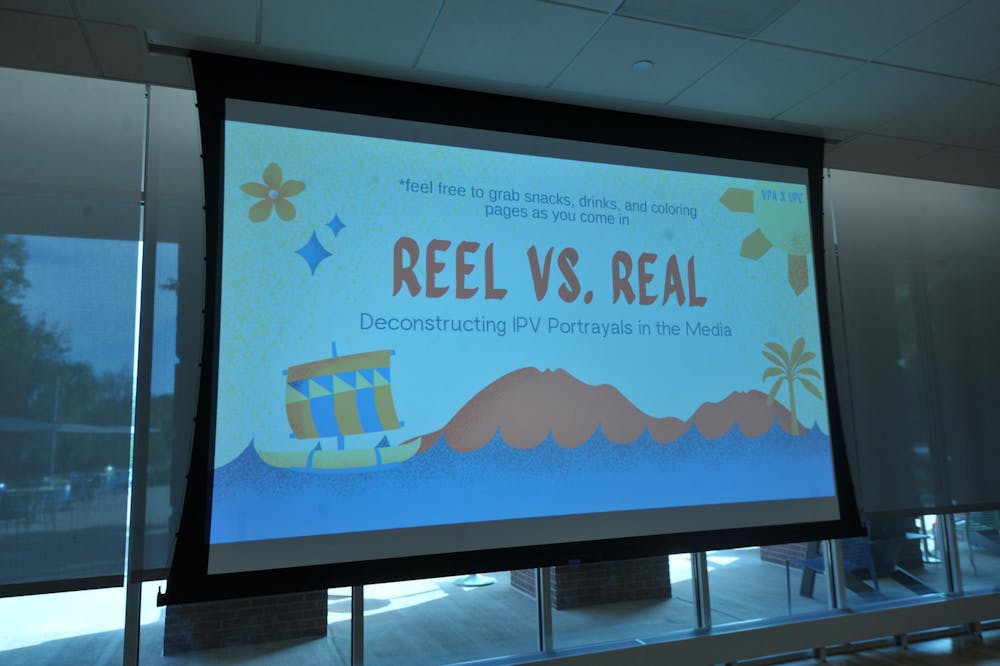
Wednesday evening, Room 101B in Student Health and Wellness was transformed into a cinema-meets-bingo night. Light refreshments, including Oreos, SkinnyPop and lemonade, filled the tables as students trickled in, taking their places at tables with bingo cards placed in front of them. As participants settled in, an episode of “Love Island” began to play.
The event was part of “Reel vs. Real: Interpersonal Violence in the Media,” a monthly series hosted by Student Health’s Violence Prevention and Advocacy team in collaboration with the University Programs Council. The program was emceed by Veronika Offor, Student Health’s healthy relationship and interpersonal violence prevention specialist.
This event was one of many University-wide initiatives that recognized Sexual Assault Awareness Month. Others include “What Were You Wearing?” an art installation that displays re-creations of the clothing survivors were wearing when they were sexually assaulted, “The Road Ahead: Understanding Title IX & Student Support,” a panel of experts from the University’s Title IX Office and many more.
Since its launch in January, on the third Wednesday of each month, “Reel vs. Real” sessions center on watching a film or TV episode and unpacking how relationship dynamics and violence appear on screen versus in real life.
Danielle D’Andrea, director of marketing and communications at Student Health, explained that the event series was created to make these conversations feel less distant and more relevant to students.
“By using familiar TV shows and films, the program creates an accessible entry point for conversations about healthy relationships, consent and prevention, while challenging some of the narratives students may have absorbed through media,” D’Andrea said in an email statement to The Cavalier Daily.
Rather than being structured like a lecture or presentation, the session felt intentionally fun and lighthearted, while still being informative. The session was built around a round of “behavioral bingo” — each bingo card listed different relationship behaviors, and participants marked squares with either red or green chips to indicate “red flags” or “green flags.” These spanned from manipulation, love bombing and monitoring location to healthier dynamics like trust, shared values and healthy conflict.
As the episode played, students marked moments where they saw those behaviors with red or green chips, aiming to complete a full line or column. When a student called bingo, one of the organizers would come over and ask them to walk through their board. Students would then explain why they placed each chip, thinking back to specific scenes or moments during the episode where those behaviors showed up.
Second-year College student Sarah Imam reflected on how she enjoyed the event’s creative format, noting that it made her more engaged with the episode and more aware of the relationship dynamics as they unfolded.
“I think the bingo was a really creative activity to have,” Imam said. “I definitely wouldn't think to have bingo when watching ‘Love Island’ … I think it really made me connect to the show more, because I was also thinking about what kinds of traits and relationship styles to look out for or understand.”
The choice of “Love Island” itself came from a mix of planning and student input. Rachel Lewis, fourth-year engineering student and member of UPC’s cinema committee, said organizers wanted to present media that was relatable to students. Compared to earlier sessions, which focused on stalking in “10 Things I Hate About You” and domestic violence in “It Ends With Us,” the reality TV aspect of “Love Island” gave viewers something that felt closer to real, observed behavior.
“I think it's a good way for students to engage with media that they're probably already watching… that kind of makes it relevant to their daily lives,” Lewis said. “You can just watch ‘Love Island’ and laugh at it. [But], you can also see how [the] behaviors that the people on ‘Love Island’ may be exhibiting could reflect — or hopefully not reflect — your real life relationships.”
Imam, who attended after seeing the event advertised on Instagram, said that familiarity of the series was what drew her in. For her, the environment of the event made it easier to engage with topics that might otherwise feel heavy.
“I do think that topics like sexual assault or unhealthy relationships can be really upsetting or triggering for a lot of people. So I think creating an environment that was very relaxed and laid back, and just a fun evening of watching ‘Love Island’ with a bunch of snacks, made it a lot more approachable,” Imam said.
D’Andrea explained a sense of nuance in current romance-centered media content, noting that while these depictions can feel relatable to younger viewers, they can also normalize problematic behaviors in relationships.
“Media often normalizes or romanticizes harmful behaviors, such as jealousy, control or persistence after rejection, framing them as signs of love or commitment,” D’Andrea said. “It can also minimize the seriousness of emotional abuse or blur the lines around consent and boundaries.”
At the end of the session, the Violence Protection and Advocacy team shared more about their services, sharing on- and off-Grounds resources with students — clearly labeling which were confidential. These resources are available for students dealing with unhealthy relationships, violence or other difficult situations, seeking to offer support and a space to talk through options.
“These events build a community around media discussion,” Lewis said. “Partnering with Student Health and Wellness’s Violence Prevention and Advocacy [helps] build up the University environment as a safe and respectful place to talk about relationship behaviors and to be open about these things so everyone can get the resources they need.”
Read More

Why I write, even as an engineer
By Aditi Burra | 52 minutes agoWriting has pushed me to think differently and connect with people in a way that engineering alone never could.

No vacation from ambition
By Claire McGinn and Aditi Burra | 2 days agoWhile these experiences help students advance their future goals, this culture of competition can also lead to pressure to have the “perfect” summer — defined by productivity and achievement, according to students interviewed by The Cavalier Daily.

The Local lives up to its name
By Abby Snowdon | 6 days agoThe Local doesn’t just use “farm to table” as a marketing slogan — it lives it in each dish it fires.