With the use of artificial intelligence on the rise at the University, there are currently no formalized, University-wide policies in place to regulate the usage of AI in educational settings or professional environments. To address this AI development, the Sloane Lab has done research to create a governing body of students who would be a voice to the University population when creating policies.
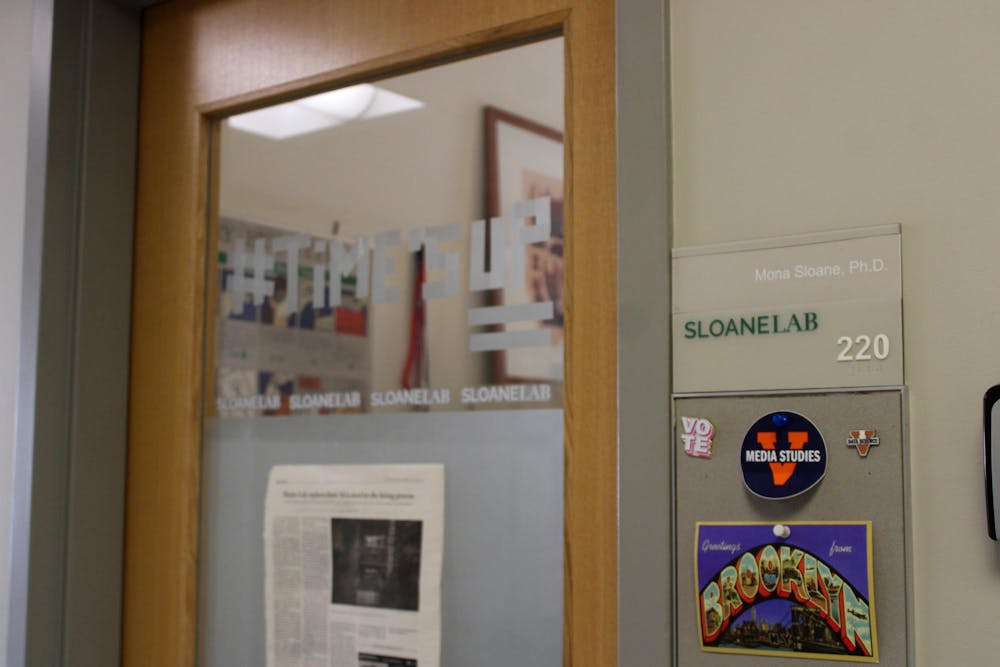
Founded by Mona Sloane, assistant professor of Data Science and Media Studies, the Sloane Lab is an interdisciplinary research group that conducts empirical research on the implications of technology for the organization of social life. Through her lab, she has launched the Student Technology Council initiative — in collaboration with the Karsh Institute of Democracy and the Digital Technology for Democracy Lab — which is meant to act as a legislative body where students can elect other students to advocate for them about technology on Grounds.
“AI is everywhere,” Sloane said. “We need to actually enact what I call generational justice in AI governance and think concretely about how we can put young people into the driver’s seat.”
The STC is currently not an official special status organization — organizations that act on behalf of the University to perform certain delegated duties — however, it is in the process of going through logistical steps to achieve the SSO status.
For STC to become an SSO, the organization must be authorized by a high-level University authority.
“We want to make sure that it's clear that this is a work in progress — the STC doesn’t exist yet,” Sloane said. “[We’re] figuring out how we can get the STC as a special status organization off the ground because that comes with certain parameters where students actually have power.”
According to Sloane, when the Biden administration issued the executive order “Safe, Secure, and Trustworthy Development and Use of Artificial Intelligence” in 2023, there was a “key group” left out — young people and students. The order directs the federal government to establish policy to ensure that AI is developed and used safely to protect national security, consumer privacy, civil rights and transparency.
With the Student Technology Council project, Sloane worked in collaboration with undergraduate research assistants to further draw on the student voice in their initiative.
Owen Kitzmann, research assistant for the Sloane Lab and fourth-year Batten and College student, highlighted the importance of student self-governance at the University and how the University may also benefit from self-governance in regard to technology policies.
“There doesn’t exist the implementation of student self-governance … with regards to technology,” Kitzmann said. “The idea is that [technology] is going to come in … and really upend higher education and so many other aspects that we don’t even know yet.”
At a presentation April 8 in Edgar Shannon Library through the Ethical Dimension of AI Literacy Series, Kitzmann presented the idea of AI as an infrastructure lacking democratic oversight. Using the example of electricity and telephones, Kitzmann explained how each of those industries need regulation to “function in society.”
“AI is more or less lacking in this oversight, and AI is more of a transformative infrastructure,” Kitzmann said. “We use electricity, we use telephones and we use AI, but AI also uses us in many ways.”
Kitzmann detailed how the STC is meant to be the “answer” to democratic oversight of AI that has been lacking. He said STC’s mission is especially important because of AI’s extensive use in day-to-day life, especially within the daily lives of students.
“We believe that AI’s infrastructure is even more pervasive at universities right now than it is in society,” Kitzmann said. “Society will get there, but at universities AI is everywhere.”
Along with Kitzmann, Celia Calhoun, research assistant for Sloane Lab and fourth-year Batten and College student, explained how the STC would be made up of a representative body with departments focusing on areas of governance, innovation, procurement, policy and engagement.
During the presentation, Calhoun outlined the importance of the student voice. According to Calhoun, there would be 12 representatives in STC — two representing each undergraduate class, two representing graduate students and two representing professional students. Additionally, there would be two ex officio representatives from the Honor Committee and Student Council — Calhoun said these organizations are “key partners” in the STC’s work.
According to Calhoun, the representative body would be responsible for drafting and amending the bylaws of the STC and writing memos on local, state and federal policy regarding new technology laws created. Calhoun said the representative body of the STC will also be working with administrators on academic and operational issues.

Isabela Delgado is a staff writer on the news desk who enjoys writing long-form pieces. Most of her work is focused on U.Va. Health and the Honor Committee, although she enjoys writing about many subjects. Outside of writing, Isabela is also a member of the photo desk. Isabela is from New Jersey and currently plans to major in government.
Read More

From the Archives: Fraternity life
By Maisy Callahan and Emily Conway | YesterdayMore fraternities decide to partner with the Historic Renovation Corporation, a University-affiliated agency that provides tax credits for the restoration of historic buildings.

Center for Politics hosts Tom Perriello to discuss AI, congressional responsibilities
By Melody Yuan | YesterdayAt the event, titled “The Deep Divide Between How the People and the Powerful Are Thinking About AI,” Perriello also referenced his Sept. 22 article “To Wary Working People, AI Preemption Is the New Nafta” in The New Republic during his discussion.

U.Va. Health’s telehealth program approaches 1 million visits
By Vrinda Vashisht | YesterdayThe program arose from the challenge of U.Va. Health physicians traveling to communities across Virginia to treat patients who could not easily reach Charlottesville.