The J. Sanford Miller Arts Scholars Program fosters a community of growth, collaboration, learning and mentorship for undergraduate students heavily involved in the arts at the University. With applications open for first and second years, students are admitted to study one of five disciplines — Studio Art, Drama, Music, Dance or Creative Writing — with increased access to grants in their fields as well. Before the end of a Miller Arts Scholar’s time at the University, they complete a final project that encompasses their journey throughout the program.
According to Mona Kasra, newly appointed director of the Miller Arts Scholars and associate drama and art professor, students are accepted into the program based on their engagement with the arts at the University alongside their academic achievements and a crafted portfolio of creative works. The 52 existing scholars, with 18 soon-to-be graduates, have each detailed their artistic involvements, past works and aspirations in profiles on the program’s website. Applications are reviewed by faculty representatives of the five disciplines, with around 50 percent of applications being chosen in the last cycle for the latest cohort selected in March.
In the program, scholars of any year are required to take two seminar classes in addition to arts-related coursework — the fall seminar CASS 1010 and the spring seminar CASS 1011. In the fall, students build their academic and skill portfolios and learn about professional development relating to the arts, while the spring course focuses on interdisciplinarity across the five program disciplines, eventually creating a final, interdisciplinary project. The project was one of Kasra’s new additions to the longstanding 15-year old program.
Kasra designed the final project alongside the co-presidents of the Miller Arts Scholars, fourth-year College student Maxwell Mitchell and fourth-year College student Jack Ireland. Kasra said she created this new assignment with the intention for students to teach each other and work together across disciplines. With each student having a different specialty, they are able to contribute in their own unique ways and embrace their respective talents and passions.
"I really wanted everyone to, now that they understood where they come from and how their works are very different from each other, to join together and create something together, or find an artistic avenue for the various disciplines they bring in,” Kasra said.
Scholars — working in groups of three composed of students from differing disciplines — were encouraged to create anything ranging from physical works to art exhibitions, performances and films. Elizabeth Moore, Miller Arts dance Scholar and fourth-year College student, worked with students involved in music and drama for her project, creating a video inspired by one of the music student’s original songs.
“Since I'm a dancer and I'm working with a musician and [a drama student], we were inspired by a song that a musician wrote, and some of those themes are looking back on a past relationship and moving forward from that,” Moore said. “The original lyrics to the song, we translated into a monologue, so that's what’s being read by the drama student, and I have choreographed to the song, and then we put them all together in a video.”
Autumn Hong, Miller Arts music Scholar and fourth-year College student, specializes in conducting. Hong’s group consisted of herself and two drama students, the trio creating a short film entitled “Girl Dinner.”
“It's about what women are consuming on social media. It's a commentary about how the internet exacerbates a lot of women's issues,” Hong said. “There's a lot of different commentaries, like ones about how we see women in their bodies … and it's about how, as women, we often perpetuate these things by both consuming this content and creating this content and pushing it on to other women.”
Hong’s group decided to include both heavy themes and comical elements in their piece, relating to audiences by filming in the style of TikTok videos. Hong, with experience conducting, composed the score for the film, using music as a means of plot movement.
“The score really helps to tie it together,” Hong said. “So that the audience can really see the progression and how the plot moves forward.”
The project’s interdisciplinary and collaborative focus also posed a handful of challenges for students. Hong said it was difficult to be vulnerable with her creative process, as she prefers to share with others only the final outcomes of her work. In regards to the initiative’s logistics, Moore said her group dealt with scheduling conflicts and needed to stay mindful of shooting time-sensitive film sequences.
After months of preparation, groups presented their projects to the class, with the final scholars completing their presentations the week of April 26. Students received feedback during their presentations, giving them the opportunity to edit their pieces and apply their peers’ suggestions before their final submissions.
“It's always cool to be able to show something you've put a lot of time into … and we got some really cool feedback,” Moore said. “We had a few questions about video editing and putting in sounds.”
Along with receiving constructive criticism from peers, Hong said she also appreciated being able to recognize everyone’s hard work throughout the semester. The groups began their projects in February, and the work throughout these three-month processes inspired pride among students about their combined knowledge and creativity.
“They were just super … receptive to it,” Hong said. “As much as I love getting feedback and critique from my fellow students, it is also very awesome to be able to show off our accomplishments and celebrate them together.”
Miller Arts Scholars also find opportunities for collaboration after becoming leaders within the group. This year, the executive board was composed of Hong, Moore, Ireland and Mitchell, with Mitchell acting as the teaching assistant for the seminar in the spring semester. Kasra said the board prioritized fostering interdisciplinary relationships within the Miller Arts program, hoping to create a warm, open environment.
“[Mitchell and Ireland] really wanted the program to be a lot more nourishing and also for people to be connected,” Kasra said. “One of their ideas was to do monthly art chats, we call it ‘MAS Art Chats,' and they would have bagels, and anybody could stop by, talk about projects [and] talk about anything.”
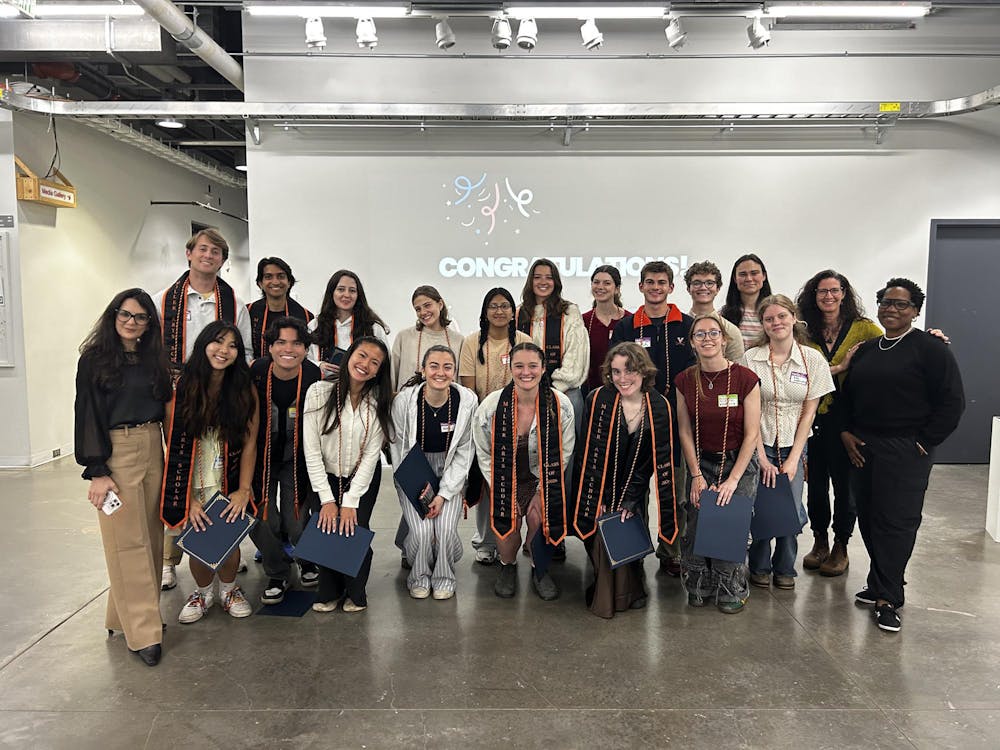
The 18 graduating scholars received their stoles and certificates as recognition for their completion of the program April 29, and also had the opportunity to present creative work that the Miller Arts program helped to fund. Moore said her experience as a scholar added creative expression and community to her time at the University.
“There's so many people who I've met who are involved in the other arts, and I would have just never met them,” Moore said. “We all share a passion for art, but they're completely different forms … and everyone's so enthusiastic to collaborate and work with you.”
With the completion of these final projects and with Final Exercises approaching, Kasra said she hopes that scholars — especially graduating fourth-years — are able to take what they have learned and maintain their presence in the arts even if they are not physically present at the University.
“I really hope they stay connected to each other, to their own cohort, that they grew as part of their education here,” Kasra said. “I really hope they will give back as they go do fabulous work themselves, whether they become producers or artists and actors and all sorts of great musicians.”
Read More

A&E Book Club: Three multigenerational novels explore universal themes
By Amelia Lucien | 3 days agoHere are three novels by authors from three different countries that offer vibrant reflections on life through vastly different narratives.

Hoo's up to bat: The anatomy of a baseball walk-up song
By Alena Touve | 3 days agoPlayers will wind up to energetic anthems, throw pitches to soothing rhythms and hopefully end the year on a high note during their final home game Tuesday.
Soulja Boy turns Charlottesville's swag on
By Victor-Jenay Cortijo Lopez | May 8, 2026As parties wind down, students are left looking for ways to spend their downtime beyond studying. Iconic rapper Soulja Boy filled that gap Tuesday night at a sold-out show at the Jefferson Theater, delivering a magnetic performance.