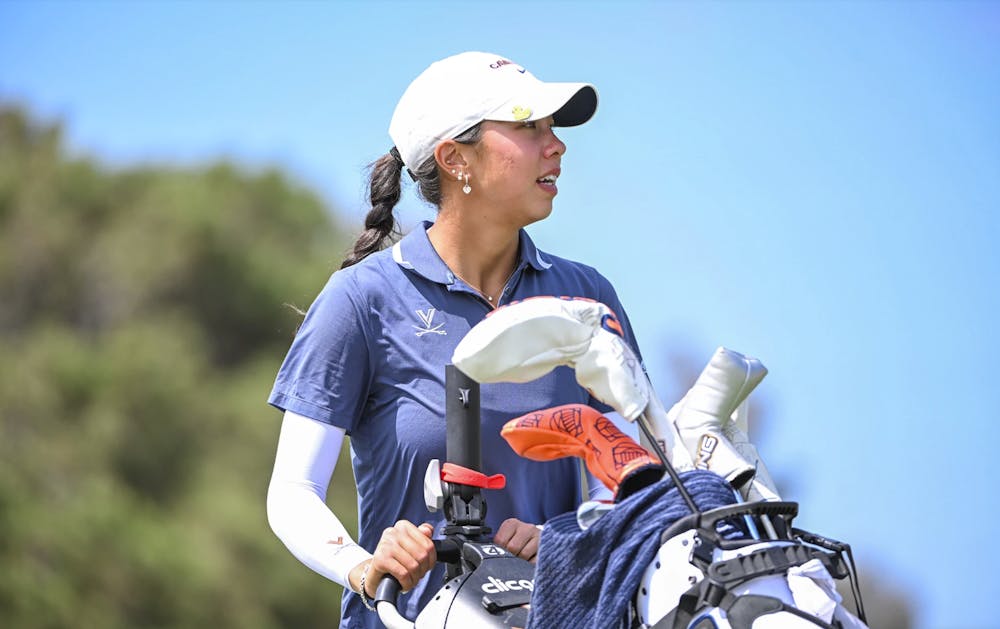
For weeks, Virginia’s five-player roster had been dancing on a tightrope. The Cavaliers squeezed past regionals by claiming the final qualifying spot in a three-team playoff, then clung to survival throughout NCAA stroke play, buried in the middle of a pack of the nation’s 30 best teams.
In the third round of stroke play, the Cavaliers finally lost their footing. They fell short of the fourth and final round of stroke play, missing match play and one final stretch of a season they fought relentlessly to extend.
The Cavaliers began their tournament May 22 at the Omni La Costa Resort & Spa in Carlsbad, Calif., playing the north course. The layout produced an average score of 73.99 across 552 total rounds.
The opening round provided struggle, but not nearly enough to cause alarm. Sophomore Kennedy Swedick led the way for Virginia, posting a strong one-under par — her best score of the tournament.
Junior Jaclyn LaHa followed closely, matching her with an even par, while freshmen Remi Bacardi and Elsie MacCleery each carded one-over. Junior Mira Berglund had a difficult day, finishing 10-over, though her score did not factor into the team total, as only the top four individual scores count.
After the first round Friday, Virginia sat tied for 11th at one-over par, still within reach of the leading pack.
But the balance the Cavaliers had managed to maintain began to slip in the second round. The one exception was LaHa, who only seemed to find her footing more firmly as the tournament progressed.
Her opening round gave way to an even stronger second, where she carded another one-under to place herself among the top 21 individuals in the field.
The rest of the squad struggled to keep pace Saturday. The lineup, besides LaHa, posted rounds over par, pulling the team down to 20th place.
LaHa kept the door open, firing a third consecutive one-under. Bacardi and MacCleery also turned in their best rounds of the tournament, posting even and one-over par respectively.
Swedick, who had stumbled in the second round, steadied herself with a three-over in the third.
The late push jumped Virginia up two positions — but the Cavaliers missed the cut by three strokes in an effort to edge their way into the top 15. Though Virginia’s season as a team ended there, LaHa, as one of the top nine individuals not on an advancing team, qualified to advance to the fourth and final round of stroke play Monday.
Her final round proved to be her most difficult, a three-over finish that dropped her three spots in the individual standings. But a bitter ending for the Cavaliers carried a silver lining, as LaHa completed her best season as a Cavalier.
She closed the season with a stroke average of 71.15, which was the lowest single-season stroke average in program history. In a tournament that ended too soon for Virginia, LaHa’s performance stood as a reminder of what this team is capable of producing.
The Cavaliers have reason to believe the best is still ahead. LaHa returns for her senior season — and she does so surrounded by youth. Bacardi and MacCleery are freshmen who now carry the experience of competing on collegiate golf’s biggest stage. Swedick also returns as an incoming upperclassmen along with Berglund, who have now competed for multiple NCAA Championships.
Virginia has already learned what it takes to qualify, survive and compete. The tightrope walk of the 2025-26 season may sting for now, but for a budding roster, it may be exactly the foundation they need to go the distance.
Read More

Heading back to Charlotte, the Cavaliers hope to do away with the memories of old
By Theo Moll | 14 hours agoBut as this team travels from Charlottesville — just as its predecessor did last December — it has an opportunity to do something special.

The Cavaliers start the fall season with a strong showing at the Kitty Harrison Invitational
By Anderson Kim | 18 hours agoVirginia women's tennis started its fall season on a high note at the Kitty Harrison Invitational.

Trial by fire greets Virginia’s young lineup in a 16th-place finish
By Joby Jung | YesterdayMen's golf has a respectable history with the Inverness Intercollegiate in the past, but 2026 did not go the same as the Cavaliers finished towards the bottom of the standings.