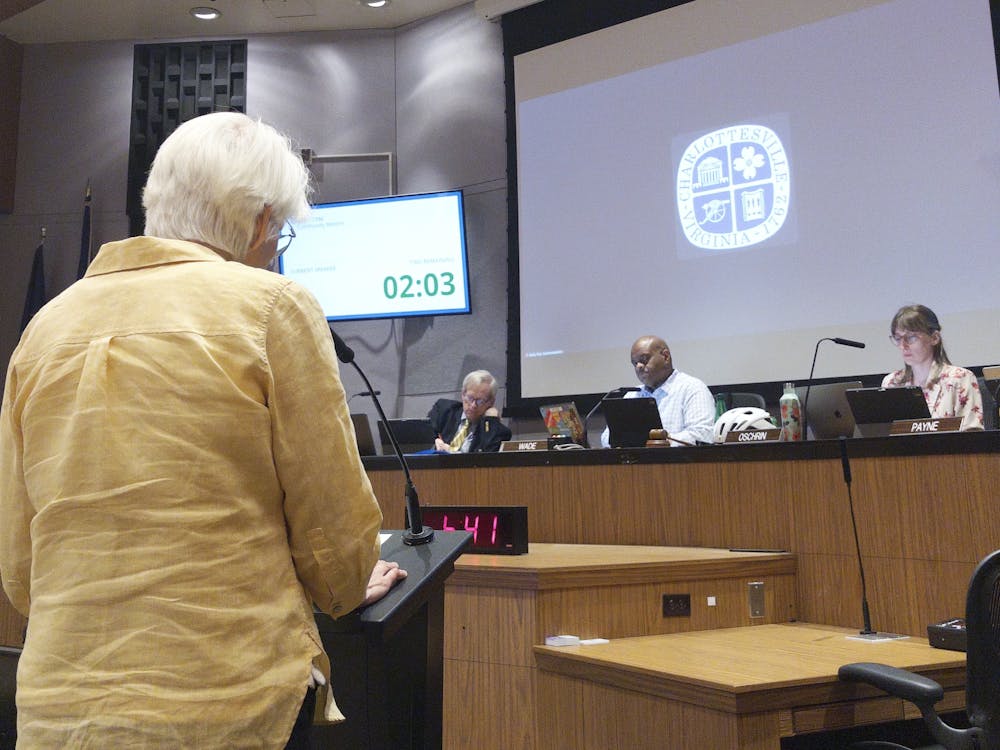
At a regular Charlottesville City Council meeting June 1, City Manager Sam Sanders presented on the concept of retrying a “participatory budgeting” policy in the City — which would set aside a portion of the City’s budget for residents to deliberate and vote on spending directly.
Participatory budgeting is described as a “democratic” form of policymaking by the Participatory Budgeting Project, which advocates for governments to implement the process. The first participatory budget was implemented in Porto Alegre, Brazil in 1989 and has since spread to 7,000 cities across the world, most of which are located in the U.S. or Canada. Charlottesville previously established a pilot program to test a $100,000 participatory budget in 2019 to engage residents and “build public trust,” according to the June 1 policy briefing summary on the issue.
Sanders explained that as part of a participatory budgeting process, citizens could choose to spend the money on any number of projects — from corridor beautification to incomplete sidewalk sections and organized City efforts to better communicate information with their communities through digital platforms.
The soonest a participatory budget could go into effect in the City would be FY2028, according to Sanders. If the City government implements the process, residents in a given area would brainstorm ideas at neighborhood meetings and online for spending their allocated funds from August to October. A proposal design team would then develop the ideas further until February, before residents vote on which final proposal they most prefer in April. Prior to the citizens’ vote, City staff would review the final proposals for logistical issues. After a winning project is selected by residents, it would further be submitted to Sanders and Council members for implementation.
The participatory budget project residents approved in 2019 was stalled and never constructed, according to Sanders and Charlottesville’s Director of Human Services Misty Graves. In light of the previous pilot’s failure due to failed follow-through efforts, Sanders stressed the importance of establishing “steering committees,” which would monitor implementation of the winning projects to ensure they actually materialize.
”The follow-through is everything,” Sanders said. “You don’t want to start a process and not finish it — which is what we did.”
Given that work sessions are an opportunity for presenters to educate Council members on issues with no binding vote, Sanders asked Council members June 1 to simply consider whether they would be interested in “embarking on this journey again.” Sanders further asked them to consider the ballpark for an initial figure to set aside for new participatory budgeting efforts.
Council members Jen Fleisher and Michael Payne expressed support for such a measure on account of the fact that the process could increase the perception among Charlottesville residents that the City government values their input.
”The problem that participatory budgeting solves is not a budget problem,” Fleisher said. “It [solves] a trust in your government problem … you are giving people direct, tangible evidence that their government is listening.”
Payne suggested replicating the pilot program from 2019, allowing a community in Charlottesville to test another $100,000 participatory budget. This would enable the City to evaluate the success of the project and ensure it can be replicated.
Mayor Juandiego Wade expressed concern that processes like participatory budgeting only represent the voices of residents who are aware and motivated to participate. Wade referenced various neighborhood associations he has been a part of where he believed poor communication left residents feeling like the process did not invite their input. Sanders responded that a lack of community engagement is always a “risk,” and warned Council members that spreading awareness about the participatory budgeting process among the public would require “special attention” as an invariable aspect of the program.
Vice Mayor Natalie Oschrin said she believes processes like participatory budgeting also demonstrate the importance of amplifying educational efforts to teach residents about City government and ensure they make informed decisions.
“Feedback from people who don’t have the full story and can’t properly weigh the tensions and trade-offs is less useful than feedback from people who have gotten an education on the topic,” Oschrin said.
Ultimately, Sanders asked Council members to confirm that they were interested in considering the idea moving forward, to which Wade responded that they were.
During “Community Matters” — the portion of meetings in which up to 16 members of the public can address the Council for three minutes each — residents continued to voice disapproval with the Council’s May 4 vote to award “The Mark at Charlottesville” a Certificate of Appropriateness for construction. Further, they criticized a similar private luxury student apartment development project — the LV Collective project near Westhaven — and the broader surge in high-density, luxury student apartments near historically Black neighborhoods.
Latricia Giles, executive director of the Charlottesville Public Housing Association of Residents, said that the Council’s support for high-density projects is resulting in a disproportionate number of these projects in communities vulnerable to displacement and gentrification. Giles said that PHAR is supportive of new housing projects in general, but decried the “uneven” growth which she said she believes is disrupting only vulnerable communities.
“If density is part of the City’s housing strategy, then it cannot keep falling on the … communities that have already experienced displacement, disinvestment and broken promises,” Giles said. “When luxury student housing, taller buildings, traffic, construction, parking pressures and rising land values keep showing up near the same communities, that is not shared growth. That is concentrated impact.”
Residents also criticized the City’s treatment of its unhoused population. Laura Sirgany, interim coordinator of the Maxine Platzer Lynn Women's Center, said that while the Council’s monthly work session May 13 included engagement with unhoused citizens, it did not lead to implementation of actionable resources. Sirgany said that the unhoused population is increasingly being targeted for surveillance by the City police department, and unhoused residents in tents are having their encampments removed and being sent out “into the elements.”
“We’ve seen this playbook happen again and again in our community. … These people, like all of us, need resources, not harassment,” Sirgany said. “This City Council would have us believe that they have no power to stand up to luxury buildings that are displacing … generations of families … but they can wield all the power in the world against someone who has to camp in a tent.”
The Council’s meeting schedule can be found on the City’s website. Its next regular, bi-weekly meeting will take place June 15.
Read More
School of Law professors weigh in on the legality of Virginia’s redistricting battle
By Naren Senthilkumar | 12 hours agoThe Cavalier Daily received written statements from two School of Law professors who offered their analysis of the ruling’s legal significance and role in the national context.

From the Archives: 1950s
By Livia Shrednick | 13 hours agoAfter a Swedish magazine wrote about Bill Bartsch, “the University’s only lonely hearts club proprietor,” he started recieving letters from girls in Sweden.

Yale report examines trust in higher education. How does U.Va. compare?
By Grace Little | 2 days agoTo restore trust in higher education, the report listed areas of recommendations pertaining to the classroom, cost, free speech and university governance that apply to higher education institutions nationwide.