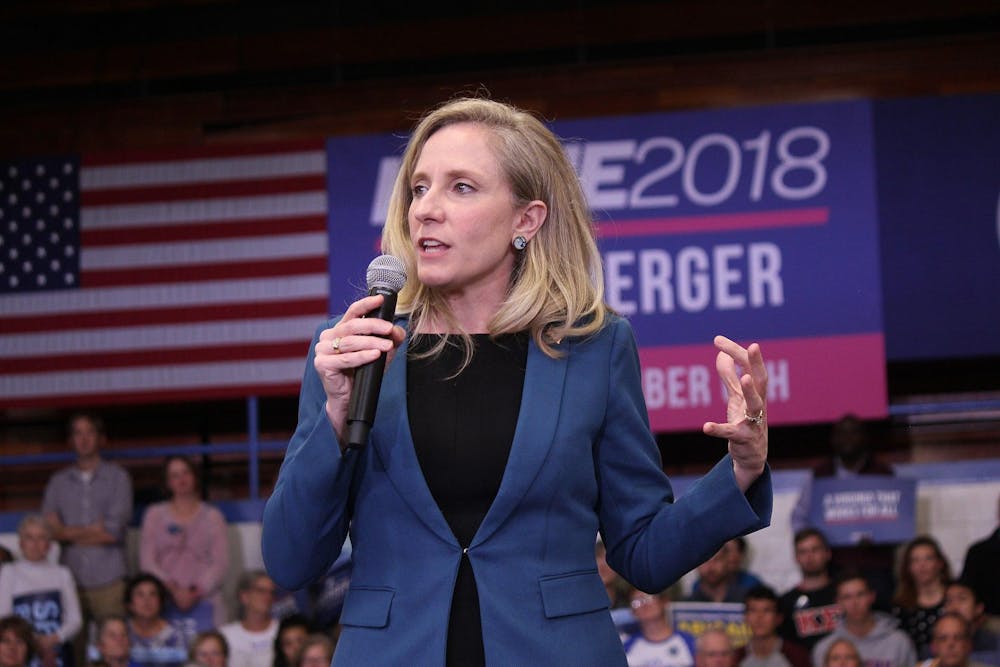
Since assuming office Jan. 17, Gov. Abigail Spanberger (D) has undertaken a broad reorganization of Virginia’s higher education system, appointing members to university governing boards at several of the Commonwealth’s flagship institutions — including the University, Virginia Tech, George Mason University and the Virginia Military Institute.
Within hours of taking office, Spanberger appointed 27 members total across the governing boards at the University, George Mason and VMI. The changes have altered the composition and leadership of governing boards previously established under former Gov. Glenn Youngkin (R). The changes — which have created Spanberger-appointed majorities on boards such as the University’s — have coincided with presidential transitions at the University and Virginia Tech.
Spanberger released a statement June 27, 2025 immediately following the resignation of former University President Jim Ryan — and prior to her election as governor — pledging to “restore a standard of leadership that puts academic excellence, Virginia’s students and the strength of Virginia’s public colleges and universities ahead of any political agenda.” The statement foreshadowed a series of appointments and leadership changes that would reshape governing boards across the Commonwealth after she took office.
Spanberger also issued Executive Order No. 6 Jan. 17 — which directed the Secretary of Education and Secretary of the Commonwealth to evaluate Virginia’s process for appointing members to public university governing boards. The order called for a report featuring recommendations regarding legislative changes to the board appointment process, including board members reappointments, term limits and the evaluation process conducted by the Virginia Commission on Higher Education Board Appointments.
In that order, Spanberger cited what she described as challenges facing Virginia’s institutions of higher education and stated that the Commonwealth should ensure its boards are composed of individuals committed to preserving the autonomy of the state colleges and universities.
“Virginia colleges and universities have faced unprecedented challenges from shifts in federal policy to attacks on institutional autonomy and mission,” Spanberger said in Executive Order No. 6. “These pressures underscore the urgent need for the Commonwealth to reevaluate how governing boards are appointed, ensuring they are composed of individuals dedicated to upholding the quality, independence and reputation of our institutions.”
Here is a look at how the governing boards of the University, Virginia Tech, GMU and VMI have changed since Spanberger assumed office Jan. 17.
The University
Many of the changes to Virginia’s higher education system followed Ryan’s resignation in June 2025.
Ryan stepped down amidst pressure from the Justice Department — which accused the University of failing to dismantle diversity, equity and inclusion policies and warned of potential legal action. The resignation prompted criticism from Democratic elected officials, including Spanberger — who condemned the federal pressure placed on Ryan, calling it “a clear infringement upon academic freedom.”
Following Ryan’s departure, the Board of Visitors launched a presidential search process led by a 28-member search committee chaired by former Rector Rachel Sheridan and former Vice Rector Porter Wilkinson. During the search process — which occurred August to December 2025 — Spanberger urged the Board in a letter sent Nov. 12 to pause the presidential search process, arguing that the process should not proceed until Board vacancies were filled and all members of the Board could participate in selecting the University’s next president.
In her Nov. 12 letter, Spanberger further argued that the Board’s composition throughout the presidential search raised concerns under Virginia statutory requirements governing its membership, noting that only nine of the Board’s 12 members were Virginia residents. The Code of Virginia states that the Board shall consist of 17 members appointed by the governor — 12 of whom are residents of Virginia and 12 of whom are University alumni. Vacancies resulted from the Senate Privileges and Elections Committee which previously blocked eight board appointees from serving on universities’ boards across the Commonwealth last summer — including five University Board members.
On Dec. 1, nine of the University’s 14 deans similarly called for a pause in the process. Many University-affiliated groups — including the Faculty Senate, Student Council, the University chapter of the American Association of University Professors and Wahoos4UVA — also raised concerns about the presidential search and called for its delay.
While Spanberger and several University leaders argued that Board vacancies needed to be filled before a president was appointed, Virginia law does not require boards to be at full membership to take action. Instead, under the Board’s bylaws, quorum — which consists of five members for the full Board — is required for the Board to conduct official business or take any binding action.
Once quorum is met, the Board may act on most matters by a simple majority vote, unless the bylaws impose a higher threshold for specific actions such as amendments to the Board’s bylaws. The Board ultimately proceeded with the search despite calls to delay the process.
The Board voted unanimously to appoint Scott Beardsley, former dean of the Darden School of Business, as the University’s 10th president in December. Beardsley later assumed his role as president Jan. 1.
Ten of Spanberger’s 27 appointments she made on her first day in office were to the University’s Board. Her appointments were Jan. 17 — the day after several Youngkin-appointed Board members resigned Jan. 16, including Sheridan, Wilkinson and Manning. Former Board members Stephen Long and Douglas Wetmore also resigned, bringing the total number of Board resignations to five.
Spanberger’s Jan. 17 appointments to the Board included Mike Bisceglia, Rector Carlos Brown, Robert Byron, Peter Grant, Owen Griffin, Vice Rector Victoria Harker, Elizabeth Hayes, Rudene Haynes, Evans Poston and Mohsin Syed. The appointments gave Spanberger’s selections a majority on the 17-member governing body.
On June 5, she reappointed four existing members to the Board — Amanda Pillion, Mohsin Syed, Elizabeth Hayes and Owen Griffin — who will serve additional four-year terms. Youngkin previously appointed Pillion to the Board in 2022, while Syed, Hayes and Griffin were previously appointed in January 2026 to complete the terms of members who had resigned from their positions.
During the Board’s first meeting with the new appointees Feb. 20, Board members elected Brown as rector and Harker as vice rector. Brown previously served on the Board from 2021 to 2025 after his appointment by former Gov. Ralph Northam (D). Brown was elected as vice rector alongside former Rector Robert Hardie, with both Brown and Hardie concluding their terms in June 2025.
Harker previously served on the Board from 2012 to 2016 following her appointment by former Gov. Robert McDonnell (R). Brown and Harker filled the vacancies left by Sheridan and Wilkinson — whose terms had been scheduled to run through June 2027.
Within seven months of Ryan’s resignation, the University had selected a new president and replaced nearly one-third of the Board.
Virginia Tech
Virginia Tech entered a period of leadership transition April 9 when President Tim Sands announced that he would step down after more than 12 years as Virginia Tech’s president. In a letter addressed “to Hokies everywhere,” Sands said he believed the time was right to begin a transition and pledged to remain in office until a successor was selected to ensure continuity.
Although Sands described the decision as a voluntary transition, the announcement prompted speculation among higher education observers and elected officials. Sen. Tim Kaine (D-11) publicly questioned whether Sands had been pressured to leave amid concerns about political influence in leadership transitions at Virginia’s public universities. He also warned against what he characterized as efforts to politicize leadership at Virginia’s public universities.
In a statement released April 9, Kaine urged Spanberger to investigate “this latest attack on Virginia higher education” and “insulate university leadership from politically-motivated schemes.”
At the time of Sands’ announcement, the Virginia Tech Board was composed largely of Youngkin’s appointees — including former Rector John Rocovich. On April 20, Spanberger announced four appointments to Virginia Tech’s Board during its presidential search. These appointments began their terms Wednesday. According to Spanberger’s statement released April 20, Rocovich had committed to placing her appointees on the presidential search committee in advance of Wednesday, allowing them to participate in the ongoing selection process.
Virginia Tech’s Board appointees included Sharon Brickhouse Martin, vice president of health services integration at VHC Health, Christopher Ramos, senior account management at Microsoft, Jane Cady Rathbone, principal and CEO Emeritus at Hanbury Architects and Mehul Sanghani, founder and managing partner at Greycore Ventures.
“I look forward to having these highly qualified leaders included on the search committee as Virginia Tech works to identify a successor to President Sands,” Spanberger said in a statement April 20.
Spanberger later removed Rocovich from the Board May 27, citing violations of Virginia Tech Board of Visitors’ Code of Ethics — the code of conduct for state appointees that require Board members “to act in accordance with the best interest of Virginia Tech.” The letter did not provide additional details regarding Rocovich’s alleged violations.
Rocovich refused to step down following his removal, stating in a letter to the Secretary of the Commonwealth that he will serve out his term through June 30, 2027. He also disputed Spanberger’s justification for his removal, arguing that he had not been provided sufficient cause.
Spanberger subsequently appointed Edward Baine, executive vice president of utility operations and president of Dominion Energy Virginia, to complete Rocovish’s term as a Board member through June 2027. Baine previously served as a Virginia Tech Board member after being appointed by Northam in 2018 and reappointed by Youngkin in 2022. His four-year term concluded Wednesday, after which he continued serving on the Board to complete Rocovich’s term.
The Virginia Tech Board later elected Jim Miller as rector June 2, replacing Rocovich while the presidential search continues. Nine days later, Rocovich filed suit against Spanberger and Virginia Tech in Montgomery County Circuit Court June 11 and argued that his removal violated state law and sought reinstatement to the Board.
Rocovich’s lawsuit remains pending in Montgomery County Circuit Court. He is still seeking reinstatement to the Virginia Tech Board, but no hearing dates or court rulings have been issued as of late June. The Board continues under the leadership of Miller.
Virginia Tech formally launched a national search for its 17th president in May. A 21-member search committee — including all but two members of the Virginia Tech Board — was established to oversee the process. According to Cardinal News, consultants from Isaacson, Miller — the executive search firm that also assisted in the search for both Ryan and Beardsley at U.Va. — told the search committee in May that the search for Virginia Tech’s next president could take six to eight months.
The presidential search at Virginia Tech continues as Virginia Tech Board members have begun to solicit input through listening sessions with faculty, students and other stakeholders.
George Mason University
Spanberger has also reshaped governance at George Mason University, appointing 12 new members to its Board of Visitors in January. Her appointees included Anne Altman, Bruce Caswell, Shawn Chambliss-Purvis, Tom Davis, Jim Moran, Paul Misener, Trevor Montano, Delbert Parks, George Schindler, Sumeet Shrivastava, Sean Spence and Jennifer Taylor.
Spanberger’s January appointments reshaped George Mason’s Board composition and included several individuals with prior institutional leadership. Davis previously served as rector, while Altman and Chambliss-Purvis had also served on the Board in prior terms.
The appointments came amid prolonged vacancies on the Board following a series of rejected gubernatorial nominees by Senate Democrats.
Due to the General Assembly rejections, George Mason’s Board lacked the required quorum of eight visitors to conduct business from August to Jan. 17 — when Spanberger appointed 12 members. Former Rector Charles Stimson continued to hold executive committee meetings in October and December under Article IV Section 5 of the Board’s bylaws, which states “should a quorum of the Board fail to be present, the Executive Committee shall be convened.”
The Virginia Senate Privileges and Elections Committee ultimately voted down 22 of former Youngkin’s university board nominees across multiple institutions over the course of last summer — including George Mason University — which left several seats vacant. Stimson and Board Member Robert Pence also resigned Jan. 17 — the same day Spanberger took office — further increasing the number of vacancies, leaving the GMU Board with only four members.
Stimson — who Youngkin appointed to the Board in 2023 — served as a former senior legal fellow at the Heritage Foundation and drew criticism from Democratic lawmakers and faculty members who questioned his ideological alignment and raised concerns about the Board's governance direction.
In September 2025, members of the Senate Democratic Caucus publicly called for Stimson’s resignation after the Heritage Foundation published a report Sept. 2 criticizing George Mason’s diversity, equity and inclusion initiatives. Democratic leaders argued that his role at the Heritage Foundation created a conflict of interest with George Mason University and the leadership of George Mason University President Gregory Washington.
In a letter sent to Senate leaders Sept. 9, Stimson rejected the Senate’s request for his resignation, stating that he was "completely committed” to serving as rector. He argued that his work at the Heritage Foundation focused on national security and crime policy rather than higher education policy and said he had been “fully walled off” from the organization’s mention of George Mason University.
“I strongly reject the premise that any citizen of our Commonwealth should be disqualified from public service simply because some elected officials may disagree with statements or articles attributed to other private individuals who happen to work for the same employer,” Stimson wrote in his letter.
At the George Mason Board’s first meeting under its new leadership Feb. 26, Board members elected Michael Meese as rector — a Youngkin appointee who served as vice rector under Stimson — and Shrivastava as vice rector. Meese was one of the only four members remaining from the previous Board.
George Mason’s Board now consists of four Youngkin-appointed members, and 12 Spanberger-appointed members.
Virginia Military Institute
At the Virginia Military Institute, Spanberger appointed five members to the Board in January. The appointments included retired Marine Corps Col. Michael Dick, Don Hall, Lester Johnson, Northam and Allen Damon William.
The appointments came as VMI continued to operate under reforms stemming from a 2021 state-ordered investigation into its institutional culture. The investigation was initiated after reports and complaints from current and former cadets alleging repeated incidents of racism and sexism on campus, including racial slurs, harassment and concerns about the enforcement of institutional norms. The probe was commissioned by state officials — including Northam — and was conducted by Barnes & Thornburg, LLP — an Indiana-based independent business law firm — under the State Council of Higher Education for Virginia.
The resulting SCHEV report — released June 2021 — concluded that VMI had maintained and allowed a “racist and sexist culture,” finding that discriminatory behavior and harassment were not isolated incidents but reflected broader issues within the institution. The report also criticized leadership and governance structures — including the VMI Board — for failing to address or challenge these conditions over time adequately and included a series of recommended reforms.
Subsequent legislative efforts have focused on how those reforms should be evaluated and who should conduct oversight. House Bill 1377 was originally introduced Jan. 21 by the General Assembly, proposing a Virginia Military Institute Advisory Task Force to assess VMI’s response to the 2021 SCHEV report and determine whether VMI should continue as a state-sponsored institution. The report included revisions to campus policies, removal of certain Confederate symbols and leadership transitions.
Spanberger later proposed an amendment to the legislation that would place responsibility for the review to the VMI Board of Visitors rather than an independent task force. Del. Dan Helmer (D-10) originally introduced the bill and said he supported Spanberger’s amendment, stating that the Board was capable of conducting the ongoing review and reporting progress to the General Assembly. The bill eventually passed with the amendment April 22.
Del. Michael Feggans (D-97) introduced House Bill 1374 Jan. 20 — which originally proposed dissolving the Institute’s Board of Visitors and transferring oversight to the Board of Visitors of Virginia State University. Following opposition from alumni and VMI officials, lawmakers adopted a substitute which removed the governance transfer provisions and instead focused on the composition of the Board.
The revised bill would have limited the number of alumni members, increased the number of non-alumni members and required a minimum number of members with military experience, but the legislation ultimately failed in the Senate and did not pass.
As part of the changes to the VMI’s Board, Spanberger also appointed three additional members to the Board June 5 — including Daryl Deke, Yolanda Green and Elise Woodworth — and reappointed Lester Johnson.
Where do these leadership changes leave higher education in the Commonwealth?
House Bill 1385 and Senate Bill 494 would have made changes to the governance structure of Virginia’s public colleges and universities, including adjustments to the appointment and confirmation processes for Boards of Visitors across the Commonwealth’s public institutions. However, both measures were vetoed by Spanberger — who argued they would risk further politicizing of higher education governance when several boards are undergoing leadership transitions.
In her veto statement, Spanberger argued that while Virginia’s public institutions of higher education provide “world-class educations” and conduct significant research, effective governance requires stable structures capable of supporting institutional missions.
“Strengthening these institutions requires strong, effective governance across our colleges and universities,” Spanberger wrote in her veto statement. “Recent challenges have demonstrated the importance of reinforcing governance structures and processes so that our institutions remain resilient and successfully advance their missions.”
Spanberger further noted that she offered amendments to both bills that would have removed provisions she viewed as potentially politicizing, eliminated sections she said were not clearly connected to current governance challenges and clarified appointment timelines to affirm the General Assembly’s role in confirmation processes. According to Spanberger’s statement, those amendments were not adopted by lawmakers.
Spanberger added that while she vetoed the legislation in its current form, she remains committed to further pursuing reforms aimed at strengthening governance across the Commonwealth’s public higher education institutions.

Jaylynn Perez is a third-year College student from Chesapeake, Va., majoring in government and Public Policy and Leadership. She currently serves as a news senior writer and video staffer, after previously serving as senior associate editor for the news desk. She enjoys covering topics such as University governance and local politics.
Read More

Interim Dean Jeffrey Blume discusses the School of Data Science’s role in growing field
By Piper Gill | 9 hours agoBlume came to the University in 2021, bringing years of experience in biostatistics, public health and data science in higher education.

Who is Gregory Fairchild, chair of the University’s third provost search committee?
By Ruby Budetti | 9 hours agoThis is the University’s third search committee for the next permanent provost — Beardsley chaired the second committee until January, which paused its work in March.

Student Council discusses meeting procedures and increasing Student Activities Fee
By Lucia Gambacini | 9 hours agoStudent Council met for a regular general body meeting to consider legislation that would change procedures for meetings during non-academic sessions and raise the Student Activities Fee.