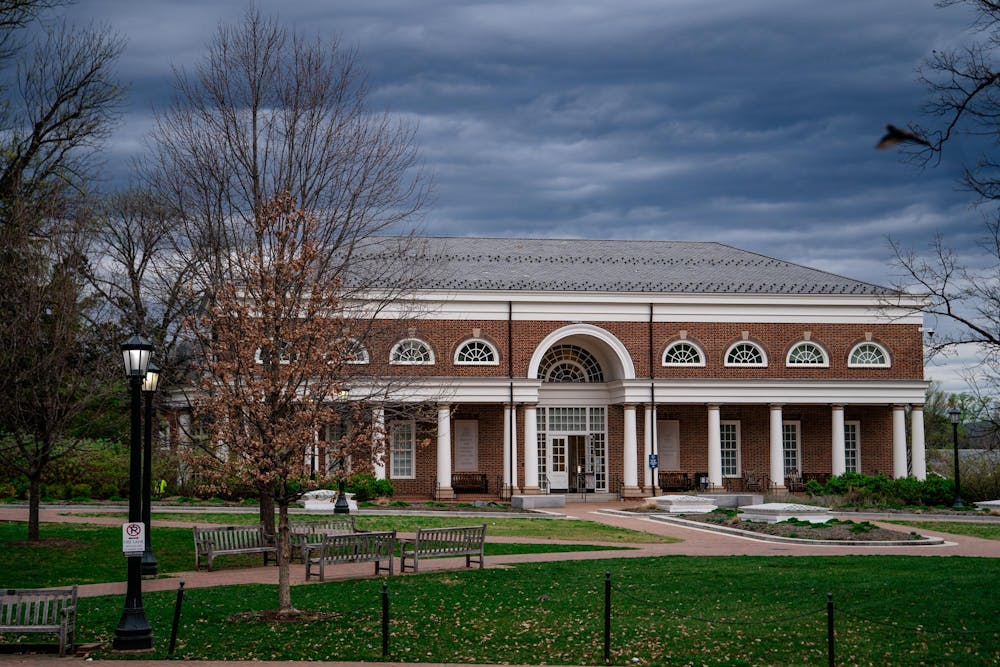
Michael Stamm, professor of history at Michigan State University, spoke at the University Wednesday about the industrial history of the printed newspaper. The lecture, hosted by the Rare Book School at the Albert and Shirley Small Special Collections Library, was the 2026 Kenneth Karmiole Endowed Lecture on the History of the Book Trades and drew on Stamm's book "Dead Tree Media: Manufacturing the Newspaper in Twentieth-Century North America."
RBS, an independent institute based at the University, hosted the talk as part of its summer lecture series, which is free and open to students, faculty, alumni and the public. The Kenneth Karmiole Endowed Lecture is an annual lecture hosted by RBS on the history of book trades, and the lectures are funded by an endowment gifted to RBS in 2020 by Karmiole.
Stamm argued that the 20th century newspaper was not only a vehicle for journalism, but also a manufactured product of industrial capitalism. Stamm said that newspapers are usually seen as a simple piece of paper, but that his work focuses instead on the physical object and the labor required to create it. To illustrate his point, he traced a supply chain that began in Canadian forests and ended with the paper on the reader's doorstep, pointing to evidence from the Chicago Tribune archives.
"Readers got their Chicago Tribune’s every day because people did physical, dangerous and occasionally fatal labor in the interest of turning trees into newspaper," Stamm said.
American publishers turned to Canada, Stamm said, after domestic mills cut through forests so quickly the publishers feared running out of paper, according to Stamm. Canada's abundant forests, cheap hydroelectric power and export-oriented economy made it the ideal source of newsprint for U.S. newspapers for the majority of the 20th century. Stamm noted that the New York Times alone required paper from millions of trees a year in the 1960s for its pages.
Wednesday’s talk highlighted lumberjacks, whose work is rarely discussed in the printing business, according to Stamm. Chicago Tribune archives highlight that in the forest, lumberjacks — the majority of them French Canadian — were handed physically demanding and sometimes fatal work, such as logging pulpwood, for the production of paper.
For the delivery of newspapers, it relied on children — delivery depended on the "legions of underage workers" whom publishers classified as not employees, but rather "merchants" to work around child labor laws that applied to factories.
"This is the hidden labor that went into producing the 20th century newspaper," Stamm said.
The newspaper was also a business ultimately built on advertising, Stamm said. He noted that the “core of the business” was to sell newspapers with many advertisements, all while keeping other expenses as low as possible — like the paper — to maximize revenue. Newspapers were ahead of other forms of media in generating advertising revenue until 1996, and papers were often sold cheap because the revenue came from advertisements.
The deforestation and dangerous labor conditions behind newspapers, Stamm said, served advertisers more than journalism. The entire industrial process, he argued, ultimately existed to sell advertisement space — enriching department stores like Macy's and Sears rather than the news.
In an interview with The Cavalier Daily following the event, Stamm said that printed newspapers have proven to be more durable than people assume, adapting to the arrival of radio, television and the internet. He said the central problem that newspapers face in the 21st century is financial rather than existential and added that fact-based reporting remains necessary whatever form the news takes.
“You still need people with a sense of news values, producing and generating and circulating the news,” Stamm said. “So I just think they remain tremendously important to democracy.”
Stamm said society consumes more news now than ever, but the money they spend flows to device manufactures and internet providers rather than the newsrooms producing the content.
"People are consuming as much news as ever," Stamm said. "They want newspapers. They just don't want to pay for it."
Stamm’s lecture was the first in RBS' book-trade series to focus on newspapers, according to Katie Hodges-Kluck, RBS assistant director of communications. Past lectures in the series have taken subjects ranging across book and print culture, from illustrated travel books to the preservation of digital text.
Stamm's telling of the newspaper’s environmental history offered the audience a new way of seeing a familiar object, according to Hodges-Kluck, and fit RBS' mission of teaching the history and making of books.
She said she hopes that attendees — including community members taking RBS’ week-long summer courses — leave recognizing the many people behind any printed object.
"[Books are] not just magically appearing in our hands," Hodges-Kluck said. “They are physical objects that have to be constructed from something, and this gives us a better perspective into thinking about ‘how are we interacting with those farther down the stream or higher up the river?’”
Jim Wallmann, a retired corporate attorney and book collector taking a RBS course, attended Wednesday’s event and said what struck him most was how Stamm connected every stage of the process of newspaper making — from a single tree to the finished paper in the reader’s hands.
Wallmann, who was a former newspaper carrier, said that the lecture did not change how he views print media, but he said its history matters as the news shifts to a more digital and streaming age. As for where that shift leads, Wallmann was uncertain.
“I’m not sure anybody can predict where it’s going to go,” Wallmann said. “We can’t long for a golden age ... but we’ll just be able to understand how news works.”
Above all, Stamm said he hoped people would come away from his lecture thinking harder about the hidden costs of what they read and hear — specifically regarding the labor involved and the environmental costs of producing new technology.
"The things that we read and the things that we listen to have consequences in communities where we don't live," Stamm said. "I want people to be aware of that … [and] think about consuming less … Do you really need a new iPhone? Do you really need all of that information right now?"
The RBS summer series will continue July 22 with a lecture by Mike Kelly, head of the archives and special collections at Amherst College, on the Indigenous history in the bibliographical record.
Vrinda Vashist is a staff writer on the news desk. She is a second-year student in the College.
Read More

U.Va. releases third compliance report to DOJ outlining changes in hiring practices
By Lauren Seeliger | YesterdayHere is a look at changes made across multiple divisions and schools since the second compliance report, as outlined in the June 30 report.

General Assembly passes 11th-hour budget — what does it mean for the University?
By Luca Bailey | 2 days agoThe General Assembly approved a two-year, $205 billion spending plan for the Commonwealth June 29.
U.Va. Health launches Heart and Vascular Institute
By Michael Racz | 3 days agoU.Va. Health launched its Heart and Vascular Institute in May in hopes of creating a heart and vascular clinical care structure across the U.Va. Health system to improve patient care and outcomes.