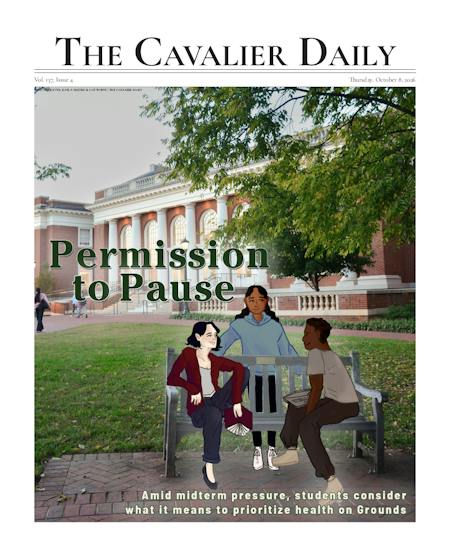
As the fall term kicks off, one can expect more than the Lawn settling back into its familiar hum or the Bodo’s Bagels line wrapping around the Corner on a Sunday morning. As students return to Grounds, shop for classes and reconnect with their peers, another task is seemingly becoming routine — applying for disability accommodations through the Student Disability Access Center.
Students are requesting disability accommodations at record rates, and the debate over what that means has never been more crucial. An article in The Atlantic claims that we are now living in an “accommodation nation,” citing top universities such as Stanford University — where 40 percent of students have accommodations — and claiming that students feel that they would be doing themselves a disservice to not gain potential testing environment advantages by applying for such accommodations. Further, the column notes accounts from professors at other prominent universities such as the University of Michigan, the University of Chicago and the University of California, Berkeley, who recount their lecture halls being empty during exams, while specialized testing centers for accommodation testing continue to fill up. The piece ignited a wider national debate, with outlets including Forbes, the Wall Street Journal and Inside Higher Ed picking up the conversation in the months that followed.
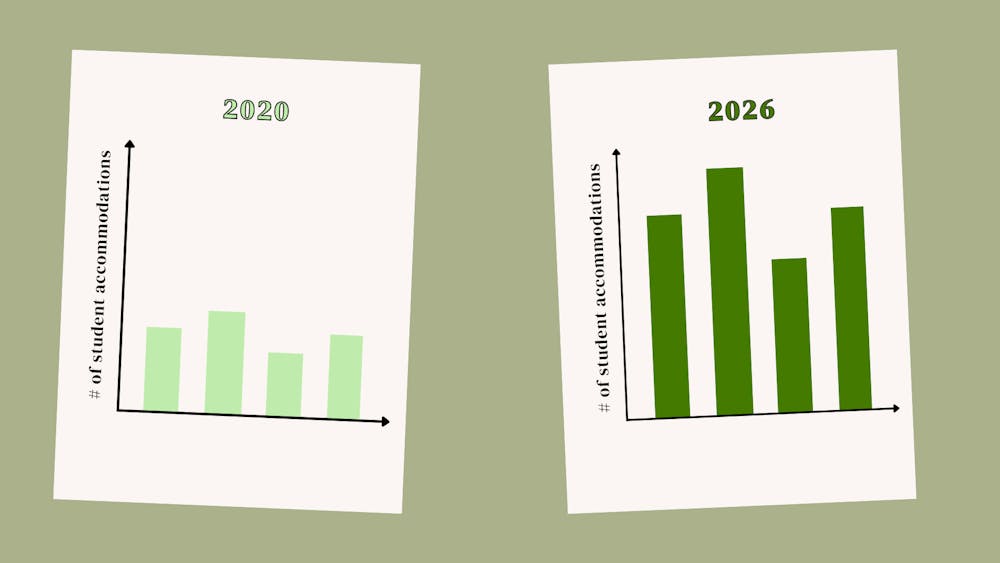
Looking at the numbers at face value, the accommodation nation argument holds — over the last decade, there has been more than a 50 percent increase in the amount of college students registering an accommodation. The percentage of undergraduates at Brown University and Harvard University with a disability registration comes in at over 20 percent. 34 percent of undergraduates at Amherst College have registered as disabled. And, over the past eight years at the University of Chicago, that figure has increased by more than a factor of three. The University is not immune to these national trends. At the University, SDAC has reported that it supports about 12 percent of the student body. Higher education's hyper-competitive culture undoubtedly medicalizes the pressure to perform — routing the stress of brutal academic environments through a medical diagnosis system and rapidly transforming the culture of accommodations from a tool of equal access into a de facto arms race simply to keep up.
However, numbers alone cannot and should not be representative of the full story. Instead, we must primarily acknowledge that the mental health crisis associated with the increase in accommodation requests is real. The argument presently points the finger at students, casting them as cheaters and liars vying to get ahead with an aim to “game the system.” However, disability service professionals have difficulty in finding evidence of students self-diagnosing, which would certainly be the main mechanism of independently "gaming" such resources that publications claim students take advantage of.
Instead, it is environments such as those similar to the University’s that create the illusion of the accommodation nation. Concerns regarding increases in academic accommodation requests should refocus away from the argument that students are falsifying diagnoses with disregard for honor and pivot towards questioning why competitive academic environments have lowered the threshold for when real, but mild symptoms feel urgent enough to formally medicalize. One hypothesis is that the root of such a surge in academic accommodations might lie in increased competition for higher grades. This creates an institutional structure in which a generation of students whose real, lived distress is being expressed through the only formal channels available to them. What an accommodation looks like today may not resemble what it looked like previously, but the conditions that produce it are no less real.
The University is notorious for the pressure cooker environment that it prompts. Competitive pre-graduate tracks, the suffocating consulting recruiting season and rumors of grade deflation trends are just some of the avenues in which students have understood that testing performance has never mattered more. Higher GPA requirements for post-graduate paths have only exacerbated the effects of the pressing mental health crises, creating a blurred line between accommodations functioning as a medical tool and a survival strategy. This is not unlike the debate surrounding the use of artificial intelligence, where students feel they cannot afford to opt out of an advantage their peers may be using. The problem, then, is not that students have gotten lazier or more dishonest. It is that we have built institutions where the stakes of academic performance are so high that students will reach for any available tool just to stay afloat.
The accommodation nation argument is not entirely false — the numbers are real. But its premise is false. This is not a nation of cheaters. Rather, it is a nation of students with a higher need for mental health attention than ever, coupled with a more competitive environment in higher education, trying to navigate within institutions that have placed exceedingly unattainable expectations for results. The question the University must start asking is not how harshly students should be scrutinized for seeking accommodations, but why so many of them feel that they have no other choice. That begins with an honest institutional conversation — one that stops pointing fingers at students and starts examining the pressures we have normalized in their name.
Farah Eljazzar is an opinion columnist who writes about identity and culture for The Cavalier Daily, and previously served as an Opinion Editor during the 136th term. She can be reached at opinion@cavalierdaily.com
Read More

WELLS: The shame is not Cornell’s alone
By Stephen Wells | 12 hours agoSo why do universities look the other way? Why do they endlessly tolerate the gross conduct of fraternities that operate in a despicable manner right under their administrations’ proverbial noses?
ADDISON: Criticism without introspection is a waste
By Lucas Addison | YesterdayThe Community of Trust must be more than a phrase we invoke to describe ourselves. It must be a standard by which we hold ourselves accountable.

HAWKINS: Florida gets education affordability right — Virginia does not
By Joshua Hawkins | 2 days agoFlorida already has better weather — we do not need to let them beat Virginia at education affordability as well.