Orientation Leaders are the first faces to welcome rising first-year students to the University — they are entrusted with duties that include being course enrollment helpers, Hoos Against Hazing ushers and Newcomb Dining Hall dining buddies.
Arguably the most public and vulnerable of the OL tasks, however, are the memorable “I Am U.Va.” speeches — delivered on stage to the entire body of orientees in a given orientation session. Many speeches provide guidance to rising first-years about how to navigate college life and find belonging based on their own personal experiences.
After receiving an abundance of information and meeting dozens of other students during their first day of orientation, another speech may seem less than appealing to orientees. However, according to students interviewed by The Cavalier Daily, after listening to OLs tell their unique stories about their time at the University, these speeches ended up being a highlight for many.
According to Funlola Fagbohun, Associate Director of the First Year Experience, the purpose of “I Am U.Va.” is to connect with incoming students at a vulnerable level.
“The goal [of ‘I Am U.Va.’] now is the same goal we had at the inception, to make students feel seen, known and valued, and to let them know that they will find their place at U.Va.,” Fagbohun said in an email statement to The Cavalier Daily.
The program began in 2017, when Fagbohun collaborated with Senior OLs to design the event as optional orientation programming. As the program grew in popularity, the speeches became part of every first-year’s orientation schedule. Although the writing, ideas and stories shared are left entirely up to each OL, Fagbohun encourages OLs to practice vulnerability through their speeches.
For Maryam Aamer, an OL and second-year College student, delivering her speech with candor helped to forge a meaningful connection between herself and incoming first-years.
“‘I Am U.Va.’ is not just a way of telling a story, but you're choosing to be vulnerable to [the rising first-years] so that they will also open up a little bit,” Aamer said. “At least for me, it's a lot easier for me to be vulnerable when I know someone else has done it first. And so, when you're vulnerable on stage, it makes it easier for [orientees] to feel like ‘okay, I'm not alone.’”
It is not just orientees who develop a sense of unity through “I Am U.Va,” OLs do, too. All OLs — between team bonding and leader trainings — are required to write an “I Am U.Va.” Based on which OLs want to share their speeches publicly, 10 of the 28 total OLs deliver them to a large group of orientees across sessions, with four OLs sharing each session. Those who do not share in front of the entire session share their speech with their smaller orientation group of around 20 orientees in small group breakouts after the event.
One OL who presented to the large session group is Katie Frick, Orientation Leader and third-year College student. While on stage, she spoke about paving her own path at the University through her involvement in organizations like the University Programs Council, and finding belonging at the University despite grappling with unexpected rejection from selective clubs during her first semester.
“My ‘I Am U.Va.’ is about being yourself and basically that students will face a lot of rejection and that there are going to be struggles,” Frick said. “But U.Va. is a really unique place because of student self-governance and the power that we have as students to get involved and be ourselves and find things that align with our interests, and by sticking true to yourself, despite the rejections and the imposter syndrome that every student will feel, they belong here.”
Other OLs also described finding belonging by pursuing their interests in college. Klyne Walker, Orientation Leader and fourth-year Education and College student, encouraged younger students to find outlets to manage anxiety and pressure.
“[I’m writing my speech about] anxious thoughts, like how I personally cope with them, and the coping mechanisms I use,” Walker said. “And [I’m] not necessarily like forcing those same [coping mechanisms] onto [orientees], but giving them ideas and letting them know that you should have ways to have outlets, especially at a high-achieving school like U.Va.”
Although each story is different, each speech ends with a word that summarizes who the speaker is, followed by the phrase “I am U.Va.”
Emerson Ritter, a first-year College student who attended Orientation Session A, believed that this concluding line communicates to her and other orientees that each speaker represents the University in their own way.
“The four [OLs] who spoke each of their stories, it was interesting how different they all were,” Ritter said. “But they were all so impactful, and it was really just cool to hear how different people got to U.Va. and how U.Va. had changed them.”
What most resonated with Ritter, however, was many speakers' messaging about exploration during their time on Grounds.
“A lot of those speeches were talking about seizing the moment and enjoying all of the opportunities that U.Va. gives you and saying ‘yes’ to things,” Ritter said. “In high school, there's one path, and you just kind of take the APs that the school offers … so going into college [where] there's so many different opportunities, I think I want to just focus on trying as many things as I can.”
For some students, however, the many opportunities at the University that orientation introduces can be nerve-wracking. Although Aamer is enjoying her experience as an OL, she said her own first-year orientation experience was stressful and overwhelming. Yet, the positive connection she made with her OL influenced her to give the University a chance.
Through her own “I Am U.Va.” speech and her role as an OL overall, Aamer hopes to make similar positive connections with students, showing them that orientation is more than just stressing about course enrollment — it is about human-to-human connection.
“I think one of the most important aspects [of the job] is just connecting to them on a human-to-human, student-to-student level,” Aamer said. “It is so overwhelming. [The University] throws so much at you during orientation … [but] when we do icebreakers, while we're walking with them, the stuff you talk about during that time, just talking to them like they're people [is what matters].”
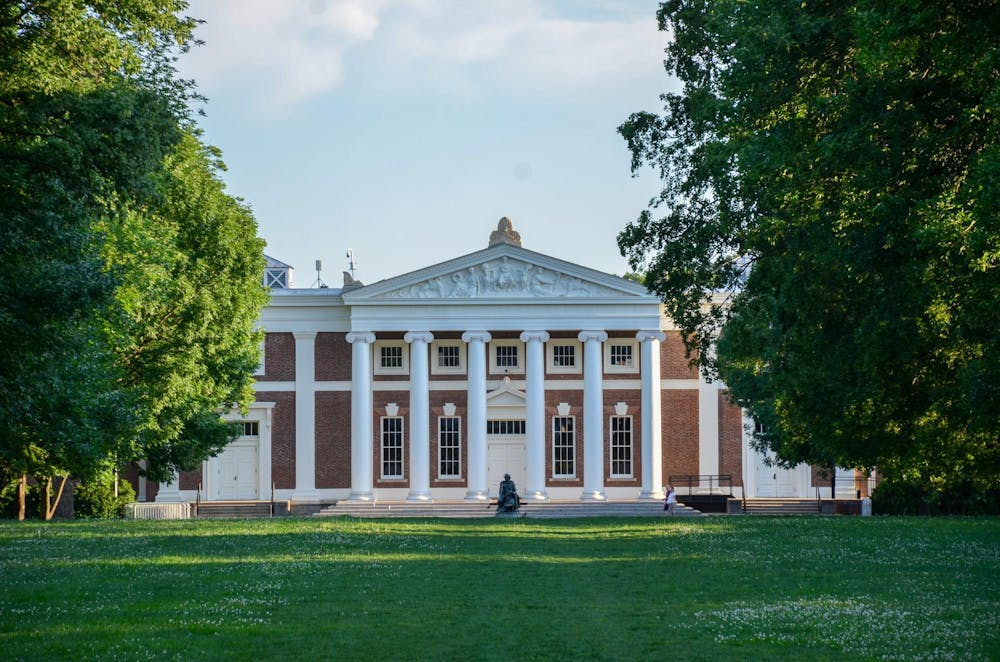
Conversations like the ones Aamer has with her orientees are built into the “I Am U.Va.” structure. After listening to “I am U.Va.,” OLs take their smaller orientation groups to debrief outside of Old Cabell Hall, where incoming students are given a chance to share about their own characteristics and journeys.
“There [are] different things we can do, but one of them is you go around a circle and you say what your ‘I Am U.Va.’ would be. Like ‘I am resilient,’ or ‘I am strong,’ and it kind of gets the students thinking about what's important to them and what journey they hope to have at U.Va.,” Frick said.
As Walker prepared for her own “I Am U.Va.” speech to share with her orientation group each session, she still vividly remembered debriefing as a group after her OL, Alayna, gave a speech three years ago at Walker’s first-year orientation.
“We were able to kind of debrief as a group after [the speeches], and it was just really touching,” Walker said. “I felt comfortable. I was like, okay, I'm in the right place, because sometimes you can have a little bit of imposter syndrome almost when you're coming into a new space.”
While all orientees at a given session attend the same speeches, the messages that resonate with each of them can be different. When asked about the biggest takeaway from his orientation experience so far, Agrim Bansal, a first-year College student at Orientation Session B, said that the “I Am U.Va.” speeches taught him about the strength of the University community.
“It was great to see everyone cheering … for everyone else,” Bansal said. “And then [the OLs are] all doing standing ovations, and everyone seems like they're friends with each other.”
Zoe Gardner, a first-year College student attending orientation Session B, said she hopes to carry the values of “I Am U.Va.” forward into her first year on Grounds by exploring her identity.
“I hope to really embrace my identity and to learn a lot about myself while I'm learning about U.Va. and about all the subjects that I'll be studying,” Gardner said. “I think that that's what college is about, learning who you are and what you want to do.”
When asked about the biggest piece of advice she would give first-years, Aamer said it was about finding belonging. For many new students, the “I Am U.Va.” speeches begin this discovery of belonging and community on Grounds.
“You will find your community,” Aamer said. “Just go out and explore, and you will find your people somewhere. And it's probably not going to be the people you meet at orientation, and probably not going to be your little friend group in the first week. But eventually, you will find the right people.”

Sadie Adams is a senior associate on the life desk. She is a second-year College student, planning on majoring in Public Policy and Leadership. Sadie is from Crozet, Va., and she enjoys writing about local restaurants and community organizations. Outside of The Cavalier Daily, Sadie is involved in the Civic Cornerstone Fellowship, Undergraduate Women and Law and is a workout coach at Formula Complete Fitness.
Read More

Feeling the burn with Pilates Reformer at North Grounds Recreation Center
By Lily Notter | 8 hours agoReformer Pilates is a full-body, low-impact workout that focuses on strength, flexibility, mindfulness and stabilization.

The world kept scrolling
By Aditi Burra | 3 days agoI began to find a sense of peace in not knowing. I felt so much more at ease with myself and my life, all because I deleted a few apps on my phone.

College Mentors for Kids instills confidence with friendship
By Claire McGinn | 4 days agoOn Grounds, this CIO brings together nearly 230 University students and 200 elementary schoolers from five Charlottesville-area schools.