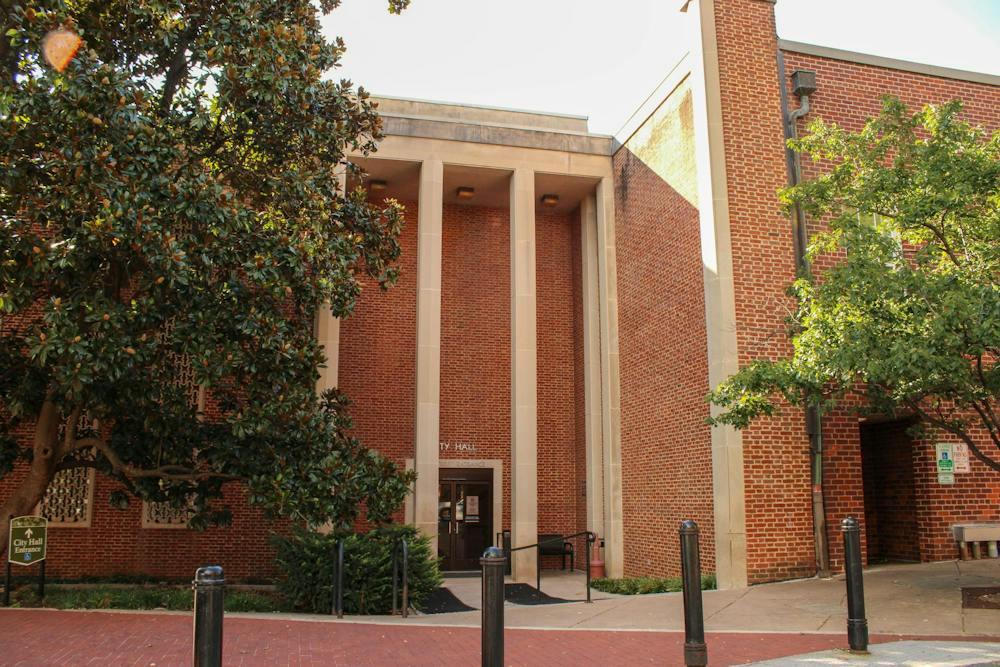
The Charlottesville City Council met for its regular, biweekly meeting Oct. 5, during which Council members received an update on the City’s efforts to better coordinate a response to emergency winter weather this year. They also heard from a Charlottesville community member who argued for the importance of large-scale development by-right, received updates on the new emergency homeless shelter at 2000 Holiday Drive and invested in several new affordable housing projects.
Earlier this year, the Charlottesville region experienced a severe winter storm that left the City buried in six inches of “snowcrete” for nearly a month. Now, with reports of a strong El Niño expected to bring above average snowfall to parts of the Commonwealth this winter, City staff have already updated their plan to manage snow and ice cleanup in the case of another winter weather event. Steven Hicks, Charlottesville’s director of public works, laid out these changes at a regular Council meeting Oct. 5.
The City’s Snow and Ice Mobility Management Program dictates how it should leverage personnel, equipment and resources in the event of a winter storm as they attempt to clear key transportation routes and restore mobility for residents. Staff update this plan and report on these changes annually. Hicks explained that this year’s emergency response will incorporate lessons learnt from the previous snowstorm.
“[The previous] storm became an important reference point as we evaluate[d] what worked, what challenged us and what we could approve for the coming winter,” Hicks said.
A key theme of this year’s updated plan, according to Hicks, is ensuring “mobility for all,” not just drivers. He noted that while the City primarily prioritized clearing streets and making room for vehicles in the past, the new mobility plan places a greater emphasis on getting available resources into secondary and residential streets as soon as primary routes are deemed “functionally open” — clear enough that full emergency vehicles can pass through. Aside from neighborhoods, the City will also prioritize faster cleanup along sidewalks, bike lanes, at school bus stops, at ramps for those with disabilities and along the Downtown Mall, among other locations.
Another goal of the plan is to be able to better verify the conditions on the streets in real time, according to Hicks. For this effort, Hicks said the City will enlist the help of “team leaders” and members of a street monitor program to monitor conditions at various locations throughout Charlottesville. The City will also utilize a new online GIS map, which it launched in September, to better plan its snow cleanup routes, according to Hicks. He further noted that the City recently purchased a new snow plow with a front-end loader — a larger, sturdier machine with a plow built for heavier pushing — set to arrive in November, which could also improve the efficiency of cleaning efforts.
Council member Lloyd Snook asked a question regarding the current 24-hour period residents have after a storm ends to clean their sidewalks before receiving a citation. Deputy City Manager James Freas reminded residents listening that after the 24-hour period ends, residents have another 24 hours before they can technically be cited, effectively bringing the window residents have to clean their sidewalks after a storm ends up to 48 hours. Further, Freas said the City has priority areas where they begin issuing citations first, which are usually the areas with the highest amounts of pedestrian traffic. For these reasons, Snook advised neighborhood officials who were supposedly emailing him last winter suggesting they would go to prison if they did not shovel their sidewalks to “chill.”
“I don't think City officials [could even] get out there and write you tickets … in those circumstances,” Snook said.
Following the snow and ice and waste collection presentations and a closed session, the Council heard remarks from two residents during “Community Matters” — the public portion in which up to 16 speakers can address the Council for three minutes each.
One individual spoke who said he was a resident of MSC Apartments — a complex in the Venable neighborhood popular with University students. He criticized several Council members, notably Council member Michael Payne, for wanting to reintroduce the “ridiculous” case-by-case approval that developers of large projects typically required from Council under the previous zoning code. Conversely, many of these large development projects are now by-right and do not require the Council’s approval.
The resident said that these Council members “want to change the zoning code for the entire City” in order to stop “a single project” — the proposed LV Collective building. He argued that this is not necessary, as the project will bring in millions in valuable tax revenue and put an otherwise empty parking lot to better use in an economically vital section of the City.
He also said that for the first time in his four years at MSC, his landlord informed him he would not raise his rent for next year, which he attributes to the added competition that new student-focused apartment complexes under construction — such as VERVE and Blume on Ivy — bring, which by-right development will continue to encourage.
“I feel like there is a perception that those of us who want more housing are somehow in bed with landlords,” he said. “This is not the case — I hate landlords. I think they are leeches on the public, and it is for precisely this reason that I want to force them into so much competition with one another that they never see a profit again.”
No speakers opposed to the construction of the LV Collective building spoke Oct. 5. However, concerned residents frequently cite blocked access to West Main Street from the 10th and Page neighborhood, blocked sunlight on account of the building’s height and the high price point of luxury student housing in particular — which they believe will drive up costs for all residents — as reasons for their opposition to the projects.
During City Manager Samuel Sanders’ subsequent remarks to the Council, Sanders asked Assistant City Manager Samuel Roman to deliver what he called a “success report” on the early operations of the emergency, low-barrier homeless shelter at 2000 Holiday Drive.
Upon making the controversial decision to clear an encampment of unhoused residents along the Rivanna Trail Sept. 1 for public safety reasons, the City opened an emergency shelter at 2000 Holiday Drive the same day in order to serve many of the encampment’s displaced residents. At a Council meeting Sept. 8, some City residents expressed concern that the facilitated transition process was carried out poorly, and alleged that the new shelter was lacking in basic safety measures, such as locks on restroom doors. City officials asserted that these recollections of events were largely unsubstantiated, and that residents at the shelter were safe, settling in and beginning to find work.
During his report Oct. 5, Roman said that an average of 70 guests are staying at the shelter per night — up from the building’s population of 57 and maximum capacity of 60 at the time of his Sept. 8 report. He also said that each night, an additional bed is kept open for overnight referrals of any new residents from emergency services.
Between Sept. 1 and Sept. 26, 14 individuals who previously resided at the shelter exited to live at a housing destination, according to Roman, while four have found gainful employment. Additionally, Roman said that there are currently two dogs at the shelter who have been accepted to live with guests, demonstrating that pets can live there without creating additional concerns.
Noting that “with each success also comes challenges,” Roman said the City has yet to completely retrofit shelter bathrooms to ensure maximum access for those with disabilities, and hopes to more fully support workforce development for its residents. Roman also added that staff with Central Arizona Shelter Services — the outside firm the City contracted to run the shelter — said the shelter would appreciate more bottled water for its residents, and that it still did not yet have a volunteer coordinator.
After Roman’s report, the Council unanimously approved several action items, including three which will provide an unspecified amount of financial support to affordable housing projects within the City, according to Cville Right Now. The first project is a partnership between the Piedmont Housing Alliance — a non-profit aimed at creating housing opportunities for low income residents — and the Park Street Christian Church to build 50 affordable units at 1200 Park Street.
The second project Council members pledged to help support financially was a planned PHA project to build a community of 66 affordable apartments and 20 affordable homes along Macaa Drive. The third project is an effort to repurpose the Holiday Inn on Emmett Street into a largely affordable multifamily housing complex. The complex will set aside 133 units for those making up to 80 percent of the Area Median Income, while 19 units will be for those at or below 60 percent AMI. 39 of these units will be sold at market rate.
The Charlottesville City Council’s full meeting schedule can be found on the City’s website, while those wishing to watch the full meeting can do so via Boxcast. The next regular, bi-weekly meeting will take place Oct. 19.

Luca Bailey is a third-year College student majoring in politics from Free Union, Va. As a staffer on the news and video desks, he has covered topics ranging from the General Assembly and state elections to local politics and University governance. He is also The Cavalier Daily’s beat writer for the Charlottesville City Council.
Read More

Jefferson Trust awards $812,064 in Fall Major Cycle Grants
By Charlotte Gabriel | 4 hours agoThe Jefferson Trust awards both Flash Grants and Major Cycle Grants on a monthly and biannual basis, respectively.
From the Archives: Fashion on Grounds
By CD Archive Staff | 4 hours agoMerchants found that many students also opt to blend traditional, preppy basics with punk elements.

UJC redesigns hearing panels in major bylaw change
By Melody Yuan | 12 hours agoAccording to Davidson, the new amendments make up the largest structural change to UJC bylaws in recent years.