This fall marks the 40th annual Writer’s Eye competition presented by the Fralin Museum of Art at the University. From Sept. 8 through Nov. 5, the museum welcomes visitors of all ages to explore its galleries and participate in a writing program inspired by selected visual art on display. Writer’s Eye fulfills the Fralin’s mission to foster curiosity by designing an accessible, inquiry-based museum experience that integrates artistic studies into classrooms and daily life.
The literary competition was introduced in 1986 by docents Carole Armstrong and Valerie Morris to bring practices of “ekphrasis” to the Charlottesville community. Ekphrastic writing, common in poetry or narratives, is used to describe or interpret a visual work of art. At the Fralin, the Writer's Eye competition invites visitors to engage deeply with artworks through the means of creative writing — allowing selected gallery pieces to inspire works of prose or poetry.
To reflect on a single Writer's Eye artwork, participants must write an original story of no more than 1,000 words or an original poem not exceeding two pages. These online submissions are due Nov. 12, and judged in elementary, middle and high school categories as well as a University student and adult division.
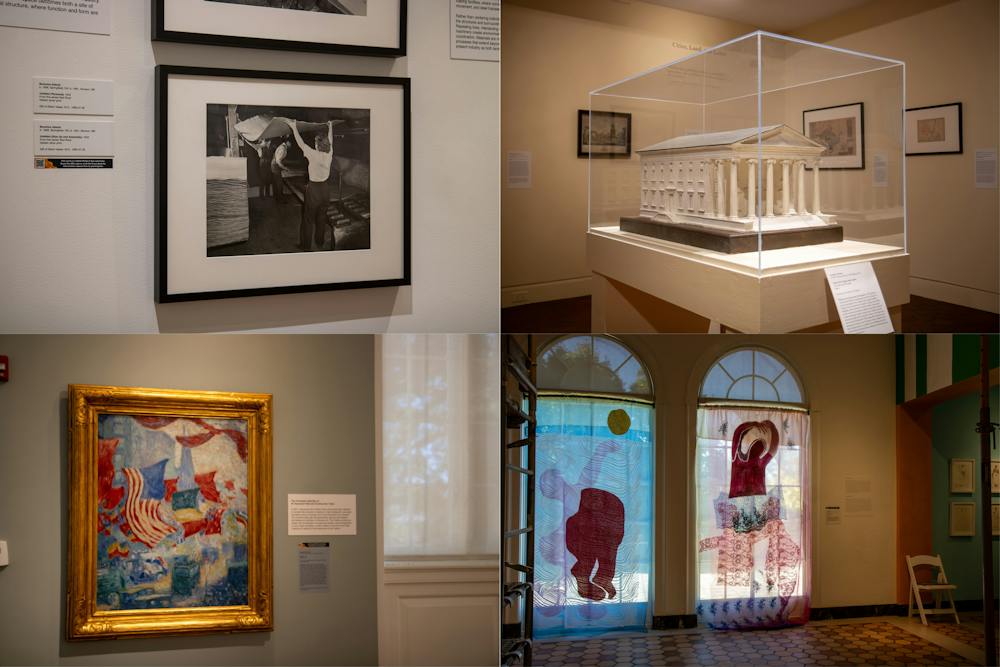
Eight Fralin artworks are carefully selected for the contest annually, including pieces from the museum’s permanent collection as well as those gifted or on loan. According to Zora Heard, manager of school and teacher programs at the Fralin and Writer's Eye lead, the selection process seeks to unite artwork that inspires thoughtful questioning in a collaborative effort among museum curators, educators and student docents.
A colorful example, “Flag Day” is a 1919 impressionist painting by Theodore Earl Butler that captures America’s patriotic spirit following World War I. Prompts developed by Writer's Eye educators are specific to each piece, here encouraging participants to consider the question — “How can flags serve as a symbol of national identity?”
Hosting a wide array of artistic mediums — spanning from sculpture to video — and a diversity of timeframes and subjects, the artworks provide museumgoers with a robust source of inspiration. Nico Ching, Writer's Eye chair and fourth-year Architecture student, spoke to the artworks’ ability to engage viewers' senses. One selected work by Sky Hopinka, an indigenous visual artist and filmmaker, holds a “vividness” that translates into ekphrasis practice, according to Ching.
“We have Sky Hopinka’s work, which is actually a video … [Writers] actually have to experience the artwork, not just visually, but also temporally,” Ching said. “They have to sit with it, and there are all these different sounds and feelings that start to arise.”
Writer’s Eye tours are free for classrooms, seeking to inspire discovery amongst visitors, encouraging them to develop artistic interpretations. Breaking from a norm of lecture or history-based tours, docents at the museum act as facilitators of active looking and discussion. School groups who arrive at the museum prepared to be quiet observers find themselves participating in vocal group dialogues — prompted to reflect on their life experiences and share perspectives on the art as part of the Writer’s Eye program. Individual museumgoers are free to view the eight works any time during the Fralin’s open hours.
Heard works throughout the year with K-12 teachers in Charlottesville or Albemarle County, helping them weave art into their curricula. Writer's Eye is an extension of Heard’s educator development work, allowing teachers to bring their students to the Fralin to see and reflect on artworks in person — with some of these local students partaking in the contest.
According to Heard, the Fralin’s commitment to art education is built on foundational research from Harvard University’s Project Zero, described in Shari Tishman and Patricia Palmer’s 2007 paper, “Works Of Art Are Good Things To Think About.” The research highlights that the active process of looking at, thinking about and discussing visual art enhances students' learning. Beyond sharpening critical thinking skills and helping students contextualize visual evidence, Heard emphasized art education as a means of community building.
“When we look at works of art together, we start to understand that, we can all look at the same thing and have completely different responses, have completely different understandings and see completely different things,” Heard said. “Having conversations around works of art helps you establish a classroom culture of perspective taking [and] introspection.”
Accessibility is also central to Writer's Eye programming and tours. For younger participants, docents balance complex artistic themes with tailored and approachable prompts. Working from an educator's perspective, Heard noted the importance of understanding an audience’s particular needs when outlining learning objectives.
“How can we explore topics like hope? How can we unpack these bigger conceptual ideas in ways that are sort of broken down and simplified, so that kids can respond?” Heard said. “Always what you'll find is that kids have really deep ideas and understandings of the world, and you just have to ask them the right questions.”
Rather than providing all the answers, docents allow audiences to build their own interpretations. Ching observes that by eliminating reliance on a single intended or true meaning, writers are empowered to go “one step further” and explore their own imaginative associations. Therefore, Writer's Eye poetry and prose emerge from unique and personal encounters with the artwork rather than existing narratives.
On a recent Writer’s Eye tour, a group of seventh grade students gathered around “Caldarostaro (Chestnut Vendor),” a sculpture by Steven Allen Linn. The piece, constructed of stone, wood and metal, depicts a man roasting chestnuts on the street. As part of the group’s discussion, the young museumgoers were asked to consider where they had encountered outdoor vendors in their own life, how they would feel in the figure's position and what they might see, hear or smell. For Ching, art’s power is derived from these personal connections between artwork and visitors.
“I think the most valuable thing that you get from these tours and from asking these questions is, ‘How does it apply to my own life?’” Ching said. “‘How does it apply to my education, the way that I imagine history and the way that we portray events?’ … It all ties back into different aspects of how we perceive the world.”
Whether joining a docent-led tour, visiting the museum independently or viewing works virtually through “Spotlight Talks” on YouTube, there are a multitude of ways to witness and interact with the Writer's Eye selected artworks. For writers ages 16 and older, Fralin educators and Writer’s Eye ekphrastic fellows host free creative writing workshops. During these 90-minute sessions, participants spend focused time sitting with and writing about a single artwork. Scheduled for Oct. 17 and Oct. 28, students are encouraged to reflect critically and make personal connections with the artwork.
Entries in elementary and middle school level categories are anonymously judged by Charlottesville community members and teachers, while adult, University and high school writers are judged by the museum's ekphrastic fellows. This year’s winners will be announced in January, with five writers in each category receiving a prize of $100 and being published in the annual Writer's Eye anthology.
Read More

On Repeat: Throwback songs for a killer fall playlist
By Madeline Unkel | 3 hours agoFrom psychedelic rock to post-punk, these four throwbacks sound as though they could have been pulled straight from a cult classic horror film, bringing that same sense of suspense to the season without relying on traditional Halloween hits.

The Hooligans break down barriers for student dancers
By Kelsey McIntyre | Yesterday“People dancing is an expression of togetherness because ... music helps bind us, and dancing is an expression of emotion and a way of communication,” Oliver said. “That's why people do it in a dance circle.”

The Virginia Dance Company trades competition for community
By Eloise Diffley | 3 days agoThe Virginia Dance Company is composed of a tight-knit group of dancers, most of whom have danced competitively and consistently throughout childhood and high school.