Study suggestions to help increase memory retention
By Kamala Ganesh | November 28, 2012With finals fast approaching, students are willing to resort to some pretty strange study techniques to cram for their upcoming exams.
With finals fast approaching, students are willing to resort to some pretty strange study techniques to cram for their upcoming exams.
After giving people a chance to simmer down and letting ridiculous proclamations of “I’m moving to Canada if [insert politician here] wins!” meet with reason, we find it possible to reflect on the polling of the election cycle and evaluate its accuracy. It may — or may not — come as some surprise that this presidential election, when all the votes were counted, President Barack Obama edged out Republican candidate Mitt Romney by 2.7 points in the popular vote.
It is a well-known fact that winter is the time for sickness. Winter means the cold, the flu and a slew of other seasonal illnesses that are accompanied with sore throats, stuffy noses and an embarrassing amount of mucus.
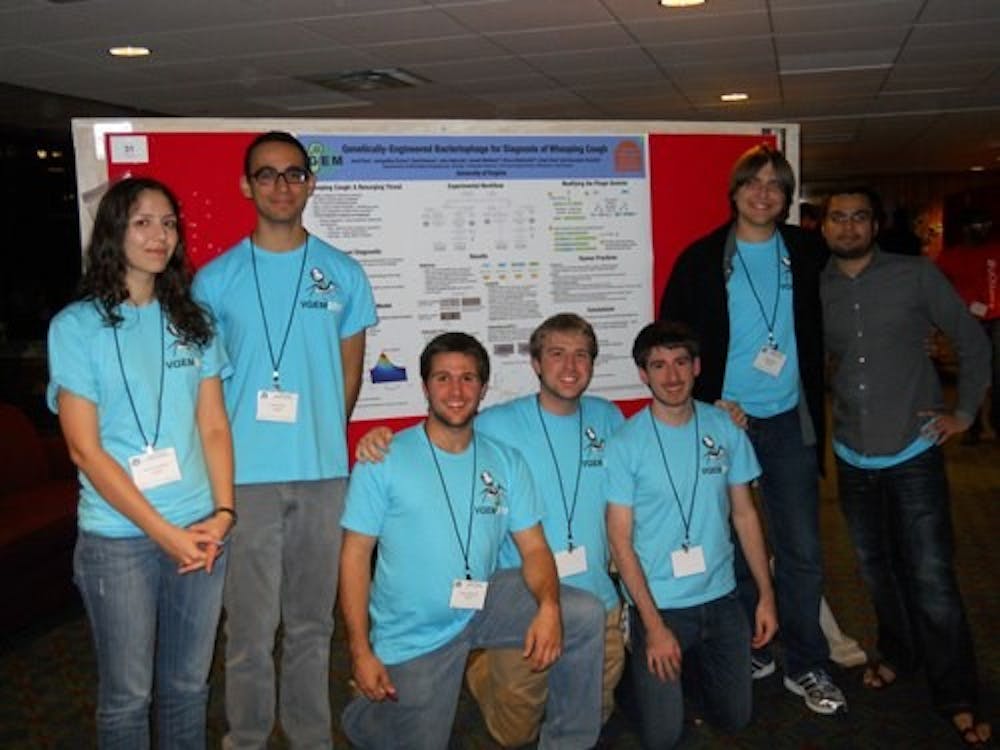
The University’s International Genetically Engineered Machine team in October earned a silver medal in a Pittsburgh science competition for a project to detect whooping cough, a respiratory disease that causes uncontrollable coughing, faster and more accurately than existing methods. At the East Regional iGem Jamboree, the team — made up of students from the College and Engineering School — presented its project to leading biological engineers.
The lines have been drawn in the sand. This week the University has waged a “Crimson War” against Virginia Tech to outraise its rivals’ blood donations.
Although Charlottesville may not have seen the worst of this year’s “superstorm,” Hurricane Sandy continues to ravage the Northeast with high winds and heavy rain.
It seems blood drive vans are always parked outside Clark Library or the Chemistry Building. Students sit in the vans for a few minutes, brave a quick needle prick and are on their way to saving a life.
A recent University study shows that anthrax, when aided by a specific type of amoeba, can thrive and multiply in soil — a trick that could prove deadly for livestock and other mammals. Bacillus anthracis, according to the Centers for Disease Control and Prevention, produces spores — small, dormant cells — that reanimate when exposed to optimal temperatures and environments, reproduce and form the disease Anthrax.
A group of University researchers has invented and produced MusicalHeart, a smartphone app that responds to the user’s heart rate, activity level and context to recommend music during a range of activities. The app uses a set of sensor-integrated headphones that measure acceleration and heart rate to gauge the listener’s activity level and then report to a remote server that recommends music to the listener to maintain a target heart rate.
A group of legal and animal control experts are planning to discuss potential revisions to animal cruelty laws at a Friday panel hosted by the University Law School. To organize Friday’s event the University’s Animal Law Program, which supports legal and scholarly research about animal abuse, , teamed up with the Virginia Animal Law Society. The panel will include Assistant Attorney General Michelle Welch and Robert C.
Many students who live on-Grounds received an ominous e-mail last week informing them that Hand, Foot and Mouth disease is on the prowl at the University.
The Charlottesville Health Department is offering free gonorrhea, chlamydia and rapid-response HIV testing in Newcomb Hall Wednesday. This clinic is the second the Health Department has hosted, offering free, confidential tests to all University students and faculty.
For years now, controversy has surrounded the emotionally-charged subject of endotracheal intubation in cats, which takes place as a routine training procedure in the Medical School.
The University Medical Center has received recognition from Becker’s Hospital Review as one of the top “100 Hospitals with Great Women’s Health Programs.” The list names hospitals across the nation that offer “outstanding programs within women’s health, including gynecology, obstetrics, reproductive medicine and other gender-specific conditions and health needs.” Becker’s Hospital Review, a bimonthly publication that provides information on health care-related legal and business news, looked at clinical accolades, quality care and women’s health proficiencies and awards to compile the list. Last month’s review cited the University’s up-and-coming research in the field of women’s health, as well as a number of accolades the University has received.
As the temperature in Charlottesville begins to drop, more health risks start to arise. Here are some of the most common health risks associated with cold weather.
The University chapter of Active Minds, a national organization that seeks to mobilize students to combat stigmas surrounding mental health issues, Thursday is hosting “Send Silence Packing,” an exhibition geared toward increasing awareness about the prevalence of suicide among college students.
This November, many students will be voting for the first time ever. Among the issues still being debated is the Affordable Care Act.
September is almost over, and finally we can pull out our boots, sweaters and scarves because fall — and with it, fall break — is right around the corner!
A little-known chemical present in most humans’ blood system could be affecting juvenile behavior, according to a University study conducted by Emilie Rissman, professor of Biochemistry and Molecular Genetics. Bisphenol A (BPA), a chemical found in many plastic products, is used to make some polymers and epoxy resins, which are then used in the lining of cans, plastic bottles and food containers.
To many Americans, the word “organic” connotes “healthy.” But recent research from Stanford University School of Medicine tells us that may not be the most accurate analogy. The study, published in the Annals of Internal Medicine, titled, “Are Organic Foods Safer or Healthier Than Conventional Alternatives?: A Systematic Review,” accumulated about 240 studies about the nutrient-related differences between organically and conventionally-grown foods.