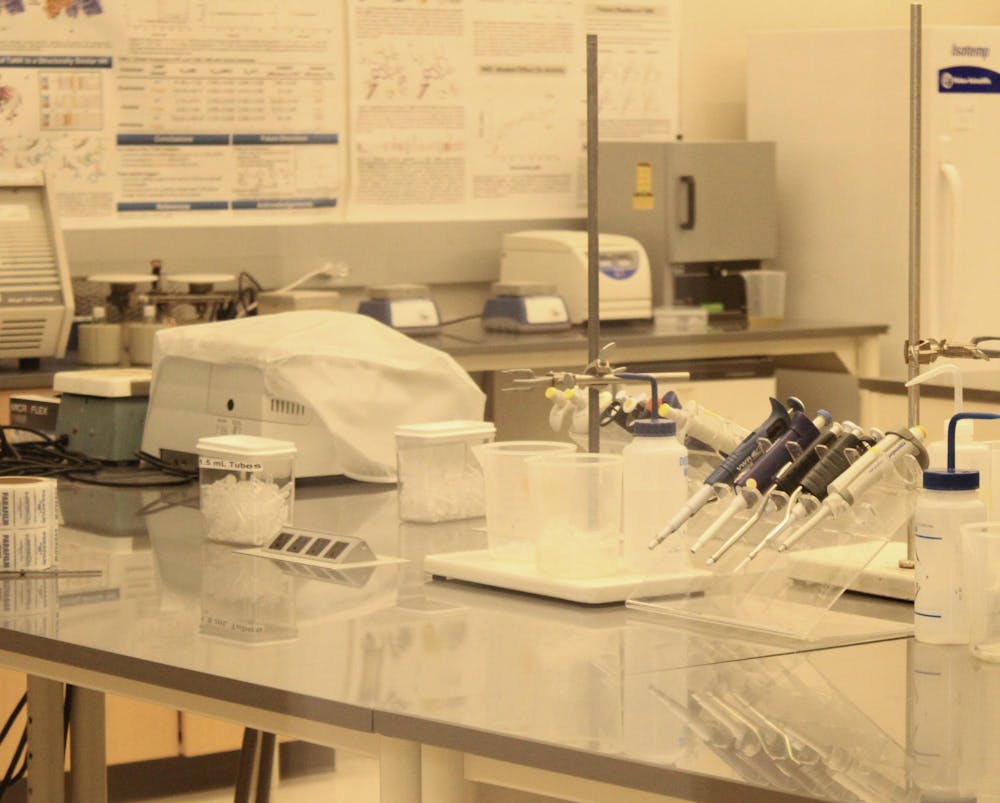
The federal government cut over $60 million in research grant funding to the University in February, while other universities faced federal funding cuts in the hundreds of millions or billions of dollars.
The fallout of these cuts to lab funding, along with ensuing cuts and reorganizations of funding institutions more broadly, has materialized in frozen grant money and unreviewed grants for many University researchers. Additionally, University researchers say there is a lack of clarity surrounding which projects merit and will receive funding.
Graduate students at the University are also impacted by these funding changes. Graduate students’ salaries are dependent on federal and internal funding sources, meaning many graduate students are pressured to pick up extra teaching assistantship work when their labs face funding uncertainties.
Asst. Psychology Prof. Aaron Reuben researches the connections between the physical environment and the brain, and he is interested in treating and preventing neuropsychiatric diseases. According to Reuben, the large-scale funding changes have burdened his lab’s work.
“[Changes to grants have] been a strain on our staff, our collaborations and, ultimately, the quality of our science,” Reuben said.
Other University researchers share Reuben’s uncertainty around funding, including Huiwang Ai, professor of Physiology & Biophysics, Chemistry and Biomedical Engineering, who specializes in protein engineering research. Ai said that many of his colleagues have had their grants unexpectedly cancelled.
More broadly, Ai noted that National Institutes of Health’s transition to a multi-year funding policy, which means the full cost of multi-year grants is provided upfront, has made it more difficult for investigators to renew existing grants or secure new ones.
Historically, the NIH used published paylines and peer-review score thresholds that reasonably indicated to researchers whether applications would receive funding. However, Ai said that the institution recently switched to no longer using published paylines nor threshold peer-review scores as the primary basis for funding decisions. According to Ai, in the past, while grant applications could still take a while before researchers heard final funding decisions, researchers could rely on this published information for funding stability.
“With NIH moving away from using published paylines or peer-review scores as the primary basis for funding decisions, this former sense of predictability is gone, adding significant uncertainty and anxiety for investigators,” Ai said.
Biology and psychology Prof. Xiaorong Liu researches retinal structures and their function, and she said her lab is funded by NIH money and has faced NIH proposal review delays. Xiaorong Liu said many proposals waiting to be reviewed by NIH are backlogged in the system due to both the government shutdown and funding cuts, meaning a proposal of hers that scored well two years ago is still pending funding.
“You [used to] have some sort of like expectation, if I score [well], it’s supposed to be funded,” Xiaorong Liu said. “Under [the] current situation, you don't know where that threshold is anymore … it’s really hard to tell … it’s more or less random in a way.”
Ai said that given this funding uncertainty, his lab has paused recruiting new postdoctoral fellow and graduate students because it is increasingly difficult to commit to long-term training without funding clarity.
Xiaorong Liu said many Universities have already cut down the number of incoming graduate students they are accepting due to funding uncertainties. According to Xiaorong Liu, her lab will most likely not recruit new students next year to save money, and she and her colleagues are careful about starting new projects.
“I have to be cautious,” Xiaorong Liu said. “I need to save money to keep the ongoing projects, and new students means new money, new resources [that] I don’t have.”
Brent Gunnoe, associate dean for graduate education in the College and chemistry professor, said that his lab relies on funding from National Science Foundation and Department of Energy grants but not on any NIH money. His work relates to renewable energy, and one of his grants exploring commercialization of a new technology to make large-scale commodity chemicals has three budget periods.
Gunnoe’s lab achieved all of the milestones to reach budget period two in May after finishing budget period one, but the lab is currently still waiting to receive the second round of funding with no insight as to when this money will come. This grant was being funded through the DOE’s Energy, Efficiency and Renewable Energy Office, which has recently been eliminated and absorbed by the Office of Critical Materials and Energy Innovation.
“This new office reflects the current administration's focus on the importance of domestic sources of critical materials, but there's also the energy innovation title,” Gunnoe said. “This could be good news for us, in the sense that this change may mean that the individuals who are involved with this program will go in and they'll start making decisions on grants.
Reuben said that his lab, similar to Gunnoe’s, has faced new NIH rules applied to grants already underway. Changes to one of his active grants have disrupted his ongoing data collection, in addition to funding uncertainty that the lab is facing in general.
“There is of course new uncertainty about pay lines and funding levels that keeps us up at night,” Reuben said.
For Xiaorong Liu’s lab, the group receives additional funding from private sources including BrightFocus and the Knight Templar Eye Foundation to supplement NIH funding. Xiaorong Liu said, however, that these funding sources are significantly smaller — an NIH grant is on the scale of millions, while a private grant is usually around $100,000 or $200,000. Xiaorong Liu said private grants provide a buffer and allow researchers to maintain current projects.
“Each [grant review] cycle, you submit different things … it’s just getting harder [to get approval],” Xiaorong Liu said. “You used to see one out of five [get approved], now it’s one out of one hundred.”
It is not just the heads of labs who feel the strain of the funding changes — Cai Liu, graduate Arts & Sciences student, said the funding situation has influenced how she and her peers view career futures in academia. Cai Liu conducts research for the Emotion and Behavior Lab. For Cai Liu, working in academia has always been a goal, but she said many other graduate students are increasingly considering careers in the private sector for more stable pay.
“As someone who has always hoped to stay in academia, this change has been discouraging,” Cai Liu said. “It’s also opened up important conversations about what sustainable research careers look like.”
Cai Liu said she should have been eligible to apply for NSF’s Graduate Research Fellowship Program — a prestigious and well-paid fellowship for graduate students nationwide. Cai Liu spent much of the past year preparing to apply, but just as she was wrapping up, NSF released new guidelines, which made second-year students ineligible.
“It was a big disappointment, and many students in my cohort were similarly affected,” Cai Liu said. “I have to admit that it felt a bit unfair, especially after all that preparation.”
In addition to federal and private foundation funding, many labs at the University rely on internal funding. According to Gunnoe, just over two years ago, the Graduate Excellence Campaign — a fundraising campaign with the College Foundation — was launched. Gunnoe said internal research funding allows graduate students and labs to remain somewhat stable amidst funding uncertainty. The money earned from this endowment supports graduate students in the Arts and Sciences, and Gunnoe said that these funds have given the University a buffer compared to other universities.
“[The campaign] is an opportunity for us to somewhat buffer ourselves from the ebb and flow of politics and federal funding, and that’s a really exciting opportunity,” Gunnoe said.
Despite other resources that allow many researchers to continue ongoing projects, Ai warned that the recent decline in research funding security could lead to a decline of national scientific prestige.
“This staged and decreasing funding environment — combined with the rising costs required to run research programs — risks diminishing the competitiveness of the U.S. scientific enterprise,” Ai said. “The United States has historically played a leading global role in research innovation, but these trends threaten to erode that position.”
According to the New York Times, NIH funding for 2025 thus far is down 13 percent, and the White House plans to shrink the agency’s budget by $18 billion, or nearly 40 percent, in 2026. The Trump administration released its proposed FY 2026 budget that would cut $5 billion from the NSF’s current $9 billion annual budget. The NIH also lost nearly 3,000 employees this year, or about 14 percent of its work force.
Reuben said that despite these federal cuts, his lab will continue to depend on national funding.
“I continue to plan to rely on NIH to fund our work and advance the health of our nation,” Reuben said.
Brendon Bordwine contributed to reporting.

Grace Little is a news editor for the 137th term. She is a third-year student from Dallas majoring in neuroscience and the interdisciplinary major in public policy, politics and media studies. She enjoys writing about the shifting landscape of higher education, and you can reach her at g.little@cavalierdaily.com.
Read More


Student discourse organizations reflect on state of free expression at the University
By Nicolas Biernacki and Austin Stegerwald | 15 hours agoThe Foundation for Individual Rights and Expression recently ranked the University No. 9 out of 261 colleges and universities in its 2027 College Free Speech Rankings.
U.Va. experts warn against emerging substances kratom, cychlorphine
By Michael Racz | YesterdayIn the wake of recent deaths at the University of Mississippi, as well as suspicions surrounding the presence of the potent synthetic opioid cychlorphine in the drug supply, University officials, medical leaders and student organizations across the country have begun urging students to exercise increased caution around controlled substances.