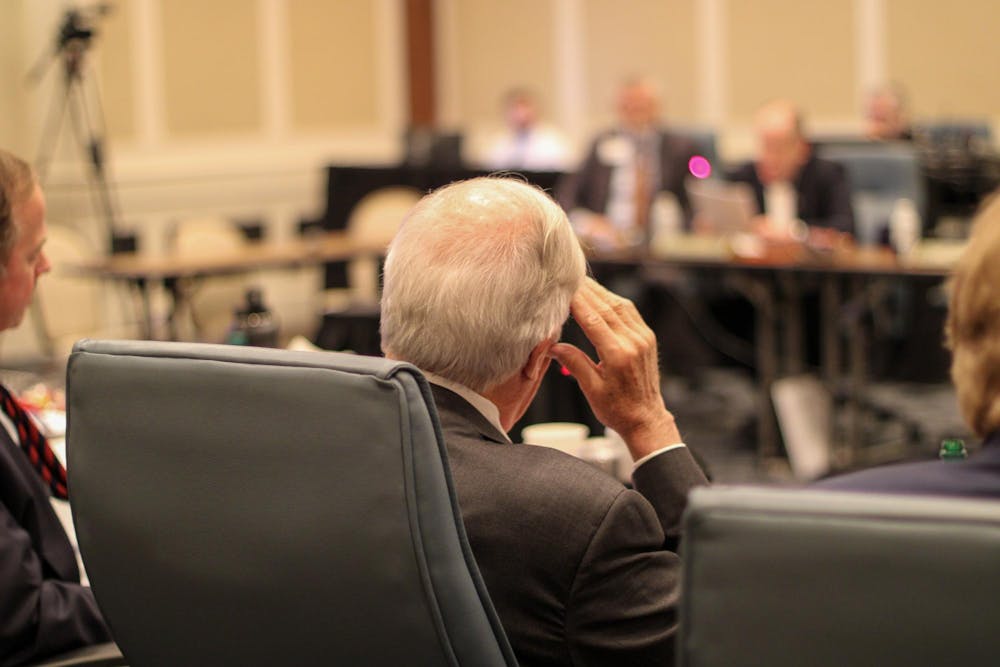
The Board of Visitors’ Audit, Compliance and Risk Committee announced Friday that the University received an unmodified, or “clean” audit opinion for fiscal year 2025, formally closing out a three-year process to resolve a material weakness in the University’s financial reporting.
A material weakness is a significant failure in internal controls that creates a reasonable possibility of a material misstatement in the financial statements.
In the University’s case, earlier audits identified issues stemming from the integration of U.Va. Community Health, including insufficient financial reporting expertise, unclear governance structures and errors in areas such as accounts payable, journal entries and cash management. Committee members and external auditors described this year’s result as a significant milestone for the University’s financial governance and future strategic flexibility.
An unmodified opinion is the highest level of assurance auditors can issue, indicating that the University’s financial statements are presented fairly in accordance with required accounting standards. According to David Rasnic, director of higher education for the Virginia Auditor of Public Accounts, the finding marks the first time since FY 2021 that the University has cleared all material weaknesses.
Representatives from the Virginia Auditor of Public Accounts reported that the University reduced its control findings — problems auditors identify in a university’s internal controls — from six in FY 2024 to two in FY 2025. Both remaining issues, one involving errors in how the University recorded expenses at the end of the fiscal year and another involving Medical Center firewall management, were categorized as “significant deficiencies” rather than material weaknesses.
The APA also noted the absence of audit disagreements, fraud indicators or significant difficulties, a contrast to prior cycles. During this period, the University faced extensive adjustments and governance concerns while integrating Community Health, the University’s acquired regional hospital network.
Augie Maurelli, University vice president for finance and chief financial officer, opened his report by outlining major changes implemented since 2022, including hiring additional financial reporting personnel, refining governance structures and stabilizing accounting practices across U.Va. Health, Community Health and the academic division.
Maurelli further showed the University improved financial statement timeliness, cleared prior audit adjustments and strengthened internal controls across multiple reporting areas.
Vice Rector Porter Wilkinson, who chairs the Committee, emphasized why these technical improvements matter beyond compliance, stressing that internal controls influence the University’s bond ratings, and therefore its borrowing costs and long-term planning capacity.
“Strong internal controls are the foundation and trust in our financial reporting and stewardship of resources. They protect the University's reputation, ensure compliance with laws and regulations and enable sound decision making,” Wilkinson said. “This success reinforces our commitment to excellence and accountability.”
According to the Committee’s open session materials and Maurelli’s presentation, the University’s net position increased by over $1 billion in FY 2025, driven largely by a 12.4 percent return from the University’s Investment Management Company. Long-term investments grew from around $11 billion to nearly $12 billion, while capital assets increased by $396 million, reflecting new construction, capitalized leases and IT system investments.
Operating revenues rose modestly in most categories, including patient services, which were up 8.7 percent to $3.5 billion, and tuition and fees, which increased 1.8 percent. Sponsored research remained stable at $534 million, though Maurelli warned the University is monitoring a slowdown in new awards.
The APA reported one significant adjustment this year, which was the capitalization of perpetual electronic library resources, including e-books and digital subscriptions, as long-term assets rather than routine expenses.
In previous years, the University recorded these resources as annual costs, but the auditor determined they should be included among the University’s assets because they provide ongoing value. Reclassifying them added a $32.4 million adjustment to the prior year’s opening balance and increased the University’s current-year net position — its overall financial standing after expenses and obligations — by $2.2 million.
Two new Governmental Accounting Standards Board requirements — national rules that public institutions must follow when preparing financial statements — related to compensated absences and risk disclosures, also took effect in FY 2025. Both had minimal financial impact, according to the APA.
While celebrating improved financial controls, Committee members urged sustained investment in financial reporting resources. Rasnic echoed that message, noting that the University’s complexity, including hospital acquisitions, new IT systems and evolving federal research regulations, requires ongoing attention.
“Stay vigilant,” Rasnic said. “U.Va. is always taking on new and complex transactions, whether it's acquiring hospitals, implementing new standards or putting in new systems, there's always something to be prepared for. You guys are in a much better position to handle that based on all the improvements that you have made since 2022.”
The Committee concluded with a closed session to discuss proprietary Medical Center financial strategies and personnel matters.
The Committee will reconvene at the next Board meeting March 5-6.
Read More
Parking on Grounds — what has changed this semester?
By Charlotte Gabriel | 12 hours agoAccording to University students interviewed by The Cavalier Daily, several expressed frustration with high parking prices on Grounds, as well as the difficulty in finding available parking in general.

Student Council connects with University’s Strategic Planning Committee
By Lucia Gambacini and Reilly Auld | 12 hours agoThe Council also heard updates from Executive Board members regarding the upcoming Fall 2026 elections and new investments in free Sexually Transmitted Infection testing kits for students.

Virginia colleges workshop three-year bachelor’s degrees
By Luca Bailey | 12 hours agoIf the effort is successful, participating schools in Virginia and Ohio will join at least 70 higher education institutions across more than 26 states that have already adopted three-year programs in some capacity.