
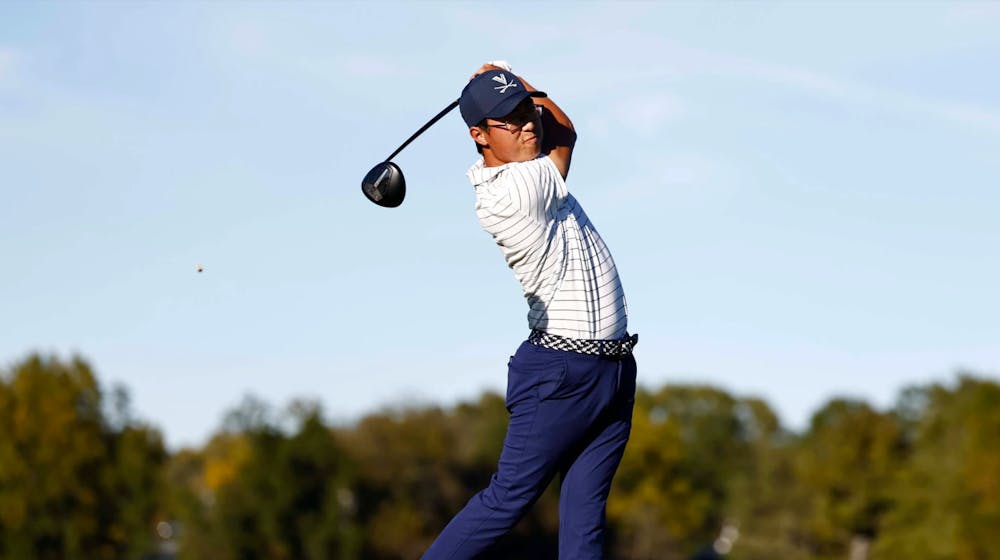
As a program coming off its first ACC title and NCAA runner-up finish, the Cavaliers’ approach to their mid-season break matters. The No. 1-ranked team has not skipped a beat this fall, finishing 10-0-1 in ACC matchups and placing no lower than second in its first three tournaments.
Much of that success has been steered by seniors Ben James and Bryan Lee, the Clippd No. 1 and No. 7-ranked men in NCAA Division I, respectively, who have provided consistency throughout the fall. Rather than viewing the break as merely downtime, the leaders treat it as an opportunity for the team to reinforce habits that will lead to success in high-stakes spring tournaments.
With tournaments winding down in October and resuming in February, the break in between creates space for players to rest, recover and train during the cold-weather months. While tournaments are on hold, NCAA rules allow collegiate coaches to schedule limited practices and workout sessions — a tool Virginia utilizes to stay sharp without the wear of match play.
“This is a down period for golf, whether you're at the professional level, college level, even junior golf level, it's just kind of the rhythm of golf,” Head Coach Bowen Sargent said. “Our guys are accustomed to this. They're used to taking this time off.”
At Virginia, this pause comes with an unusual level of separation compared to a conventional collegiate offseason for other sports because the players return home most of the break, continuing baseline training of cardio and mobility work on their own schedules.
“It's probably not like a lot of sports, where, even though you're in an offseason, you're around the guys still, and we're just not,” Sargent said.
As the team returns to Charlottesville, their day-to-day routine looks markedly different from the typical in-season schedule. Without tournaments occupying the calendar until Feb. 9, training hours replace travel and competition as the coaching staff shifts the focus toward individualized strength and durability. Whether deadlifting in the weight room, performing squat stretches to increase mobility or utilizing simulators to maintain swing consistency, players have ample time to refine their skills before the tournaments begin.
“It's a good time to just kind of focus on your body getting stronger, more flexible, all the things that are going to help you once the season starts,” Sargent said.
Further, the mid-season break offers a rare opportunity to shift focus from scoring to repetition, where feedback measures focus on technique rather than the results on a scorecard. Player-specific tweaks to the swing or repetition around the greens can be revisited deliberately, allowing players time to make refinements and assess changes before returning to competition.
Unlike in-season practices, which are designed to fine-tune form for imminent competition, the break allows mistakes to be treated as teaching moments rather than costly errors, giving players the space to experiment, refine and rebuild without the pressure of performance-ready outcomes.
“We're making swing, putting, chipping changes with guys that need to make their weaknesses a little bit stronger,” Sargent said. “I think it comes at a good time … we’ve certainly got areas that we can improve in as a team and we're working on those in preparation for the spring.”
Despite offering an opportunity for improvement, the mid-season break does not come without obstacles. Stepping away from weekly matches risks dulling the bursts of intensity that carried Virginia through the fall. The challenge lies in keeping players’ mental games as sharp as their physical ones. With a veteran-heavy roster, the break may be familiar, but it is no less challenging.
“When you're accustomed to playing every day and every week, and you take some time off, you do lose kind of your mental routine a little bit, and it always takes a round or two to kind of get back in the flow of things,” Sargent said.
Yet, every swing that’s refined and every workout that’s fulfilled during these quiet weeks can pay dividends in high-pressure moments once the spring tournaments begin. This spring, with eight tournaments packed into three months, the small details can make the difference between the Cavaliers falling short or defending the ACC crown.
Given that Virginia has made its way to the top of the national rankings, the squad is no longer chasing credibility as a powerhouse in collegiate golf — it’s chasing the title that would cement it. Opponents will measure their success against the Cavaliers, placing the weight of expectations on Sargent’s squad. Thus, Virginia’s performances under the spotlight may influence its postseason run just as much as any technical gains achieved during the break.
After a heartbreaking loss in the National Championship to end the 2024-25 season, the Cavaliers are hungry for redemption, and the standards remain high. Last season’s defeat to the 12-time NCAA national champions, No. 4 Oklahoma State, still lingers in the minds of many within the program. This is a motivating factor that drives each practice, swing and putt.
The championship standard has been set. Virginia will utilize these calm weeks to prepare for the tests ahead. The margin for error this spring is razor-thin — and the Cavaliers’ strength, precision and focus will ultimately dictate the direction of their season.
“We played a lot of good golf this fall and certainly had a competitive fall season,” Sargent said. “And we'll take the confidence from that and roll it into the spring.”
Read More

No. 11 Virginia field hockey dispatches JMU in home opener shutout
By Adair Reid | 2 hours agoVirginia field hockey handed James Madison a 7-0 defeat in its home opener Sunday, landing its first shutout of the season in a match where the Cavaliers (4-1, 0-0 ACC) maintained the possession game and showcased their offensive potential.

Virginia puts its best foot forward at season-opening home meet
By Mariam Tafwed | 15 hours agoBeyond Virginia, the meet hosted a bevy of teams, featuring Howard, Johns Hopkins, Norfolk State’s men, North Carolina, Wake Forest’s women and William & Mary. No stranger to Panorama’s charming hills and grassy course, the Cavaliers showed off their preseason preparation with a gritty and vigorous season-opener.
No. 3 Wake Forest hands No. 10 Virginia its first loss despite resilient push late
By Sofie Keppler | 15 hours agoThat single goal in the 37th minute from sophomore forward Kylie Maxwell off of a beautiful feed from graduate forward Henley Tippins, who drew multiple Virginia defenders, was enough to give No. 10 Virginia (4-1-2, 0-1-0 ACC) its first loss of 2026, 1-0.


