
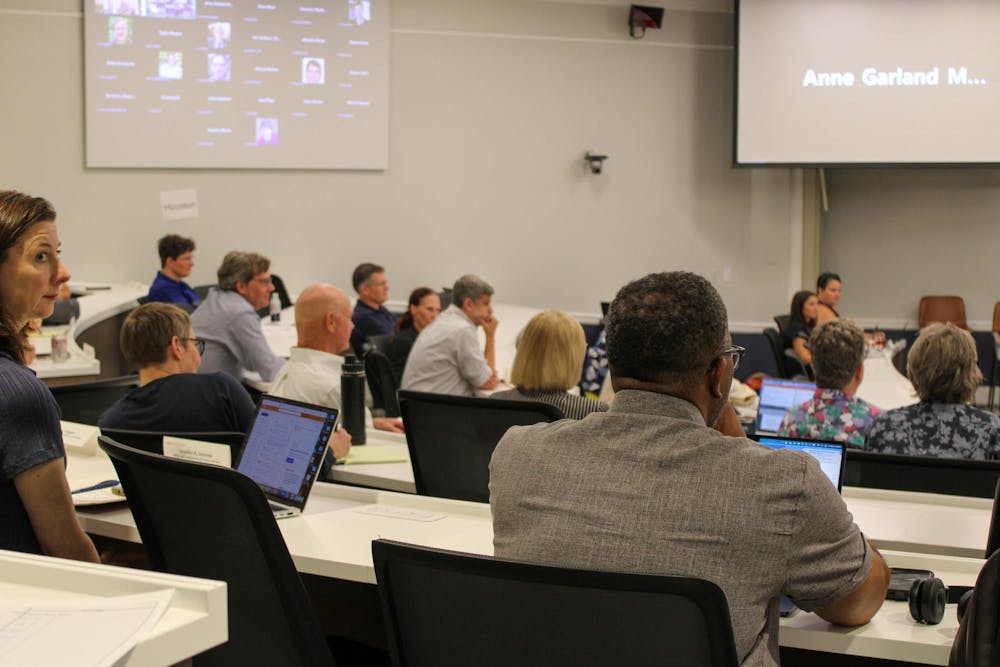
The Faculty Senate met Friday to discuss Americans with Disabilities Act compliance requirements, Senate priorities for the academic year and youth protection requirements for faculty. The Senate also heard updates from Brie Gertler, interim executive vice president and provost, regarding research and the University’s current financial model.
Barbara Zunder, chief accessibility officer and ADA coordinator for the University, provided updates on an upcoming requirement for all University online content to be accessible to individuals with disabilities. The change is motivated by a Justice Department ruling from April 2024 that requires state and local governments to ensure digital content is accessible under Title II of the Americans with Disabilities Act — the Department of Health and Human Services and Virginia General Assembly later adopted similar rulings and legislation.
Because these changes have an upcoming compliance deadline of April 24, Zunder offered guidance on how professors might make digital course materials posted to their Canvas sites — including readings and reference materials — accessible under ADA guidelines that require learning materials be accessible to students with learning disabilities. She recommended that faculty delete content they no longer use, replace outdated PDFs with direct links to journal articles and turn on automatic captions for audio or visual materials. Course materials from past classes that are archived are not required to be adapted until faculty teach the course again, Zunder added.
Zunder also emphasized that the April 24 deadline is, from her perspective, a starting point for continuous efforts towards accessibility.
“[These changes are] not a one and done, and then [you] can forget about it. This is just what life is going to be like if you work at a university or any public entity moving forward,” Zunder said. “What we want is your best faith effort. We want you to do your best work on April 24 and April 25 and April 26 and so on.”
Dave Strite, assistant vice president for support services and learning technologies, joined Zunder and discussed the potential legal risks of not adhering to the accessibility requirements. He noted that although there is no individual legal liability to faculty, the University could face enforcement actions from federal or state government or private litigation from individuals or advocacy organizations if it fails to comply. Strite also added that faculty are required to follow these digital accessibility guidelines under the University’s policy IRM-008, which explains that failure to comply with the policy could result in a faculty member’s termination or expulsion.
Zunder noted that nearly every school has appointed liaisons who are available to help faculty as they make this transition, and she encouraged faculty to reach out to their subject area librarians for help finding alternative formats — including audio and direct links to journal articles rather than using PDFs — for course materials.
During her monthly update, Gertler shared that Vice President for Research Lori McMahon has been working to establish research hubs at the University, which will connect faculty doing research on similar topics to help coordinate their work. She added that McMahon meets regularly with research leaders across the country and in Washington, D.C. to gain insight on federal agencies’ decisions regarding research funding.
In discussing finances, Gertler noted that the University functions on a responsibility-centered management model, where each school is responsible for its own budget. She said that the University is working on its second review of the model, which was first adopted in 2016 and is reviewed and revised every four to five years. Gertler said that this review has provided valuable insight into the finances of the University and has allowed deans to see how tax and tuition funds are used.
“We have begun with phase one [of the review], doing a very deep dive into how the model actually works, how funds actually flow, and it's fascinating, incredibly complex,” Gertler said. “The committee has asked a lot of really tough questions in a lot of different areas.”
Later, senators discussed their priorities as the year closes. Faculty Senate Chair Jeri Seidman shared that she has been meeting monthly with a group of faculty and University leadership across Grounds to discuss facilitating free expression in the classroom. She shared a resource with senators called the Constructive Dialogue Institute, which offers training and resources on how to lead difficult conversations.
In a presentation to the Senate, Charles Johnson, youth protection manager with the Office of Youth Protection, shared recent updates to HRM 50, the University’s youth protection policy. He shared that for any research studies involving minors — which includes individuals under 18 and not enrolled at the University — faculty should connect with the Office of Youth Protection.
Broadly, Johnson encouraged faculty to reach out to his office when they have any contact with minors, including research, internships or career guidance. He added that this includes virtual contact such as emails, and he said that the office can assist with paperwork as well as mandatory reporting procedures.
“Assume, if you're [working] with non-enrolled, non-matriculated minors ... Go ahead and reach out,” Johnson said. “... Our office was established to make the decisions for you on that front, about whether or not you're a covered program or kind of what the requirements are. So don't feel like you have to be the one to independently figure that out.”
The full Faculty Senate will hold its next meeting March 20 at 2 p.m.
Read More

University Medical Center nears top safety grade, looks to improve in November
By Michael Racz | 18 hours agoIn the spring 2026 Leapfrog Hospital Safety Grades, the University Medical Center received a “B” grade — the second-highest grade awarded by The Leapfrog Group — with a numerical score of 3.18, just 0.02 points below the threshold for an “A.”

U.Va. and United Way of Greater Charlottesville launch ‘Give Where You Live’ donation partnership
By Vrinda Vashisht | YesterdayThe program is set to run through Dec. 18, and its start date coincided with United Way’s 35th annual Laurence E. Richardson Day of Caring.

Student Council passes bill to create ad hoc committee to review UBE proceedings
By Edward Christopher and Anna Ivanov | YesterdayThe Commission will craft a report on the University Board of Elections’ current structure and governance practices, putting forth proposals for corrective action based on its findings.


