Correction: A previous version of this article incorrectly described the pathway of identical bills in the legislative process. The article also incorrectly detailed the enactment clause included in HB 1385 and SB 494. The article also incorrectly presented Gastañaga's views on the purpose of SB 494. Additionally, the article incorrectly detailed current state legislation regarding governing boards at public higher education institutions. The article has been updated to reflect these changes.
The Virginia General Assembly adjourned March 14 after advancing several pieces of legislation concerning higher education, including proposals that would reshape university governance and campus policy for the University and across the state. Proposals include changes to university governance boards, free speech on campus and federal immigration enforcement activity.
Following the session’s conclusion, Gov. Abigail Spanberger (D) has 30 days to sign, veto or recommend amendments to legislation that both the House and Senate passed, according to Virginia law. If Spanberger takes no action within the 30 days, the legislation will automatically become law and come into effect July 1.
HB 1385 and SB 494
A bill that has not been fully passed — but a conference report has been agreed upon by both the House and Senate — is House Bill 1385 and its Senate equivalent, Senate Bill 494. Del. Lily Franklin (D-41) introduced HB 1385 Jan. 21, and Sen. Creigh Deeds (D-11) and Sen. Scott Surovell (D-34) introduced the Senate bill Jan. 13.
Both “identical” bills will likely be amended then either signed or vetoed by Spanberger, according to Claire Gastañaga, former chief deputy attorney general of Virginia. In cases of similar bills, the Governor will act on each independently.
HB 1385 and SB 494 — if passed — would have significant effects on the way university governing boards will function at Virginia’s public universities. HB 1385 and SB 494 require each university’s governing board to adopt formal policies defining and implementing shared governance. These policies must clarify how authority and responsibilities are distributed among different groups within the institution, including administrators and faculty. The requirement applies to all public higher education institutions that award baccalaureate degrees.
The legislation does not require a specific model of shared governance but instead asks that institutions define their own policies.
“[The bill requires the governing board of each public institution of higher education to] adopt policies defining and implementing shared governance among the components of such institution's organizational structure,” SB 494 reads.
SB 494 was introduced in the Virginia Senate Jan. 13 after federal pressure on the University in the form of the Trump administration’s proposed “Compact for Academic Excellence in Higher Education” and the resignation of former University President Jim Ryan in June. Gastañaga said the bill reinforces that the Board of Visitors acts in the interest of the institution itself, with the aim of limiting the influence of external federal pressure.
“[The Board seems] to be acting in the interest of the federal government … It was not clear that they understood that they were supposed to advocate for U.Va. [and] that they had a duty of loyalty to the institution,” Gastañaga said.
Deeds similarly expressed that SB 494 was in response to the Board’s involvement with Ryan’s resignation and cooperation with the federal government.
“[The legislation is] pretty critical to me because I think what we saw with the last governor, unlike any governor before, [was] all partisan boards and [members] that saw their loyalty to the governor overriding their loyalty to the school and higher education,” Deeds said.
Additionally, HB 1385 and SB 494 both include an enactment clause that requires the State Council of Higher Education to study the issue of legal counsel and report back to the legislature. As they are now, the bills would not directly change the current system in which university legal counsel is appointed by the attorney general, but instead institute a review that may lead to future policy changes. However, according to Gastañaga, the bill may look very different by the time it is passed and signed off on by Spanberger.
“Between now and April, everybody will be … suggesting to the governor different amendments,” Gastañaga said. “So the bills can change pretty significantly between now and when they come back to the bodies at the reconvene session.”
The University has a shared-governance model in which organizations such as the Faculty Senate and Student Council work to advise the University President and Board, and to protect and improve the student rights at the University. Additionally, the Board has both a non-voting student representative and faculty representative.
Gastañaga explained that most boards of institutions — both nonprofit and otherwise — have, generally, three fiduciary responsibilities — a duty of loyalty to the institution, a duty of care and a duty of obedience to the law and their board’s own governing documents. According to Gastañaga, clarification as to who the Board serves is necessary in situations where there are multiple parties involved.
“[The Board has] two duties. One is first to the institution, and the second is to the people of the Commonwealth,” Gastañaga said. “You're acknowledging they're corporate entities and state agencies. So they are subject to the control of the General Assembly.”
Another provision of HB 1385 and SB 494 would extend governing Board members’ terms from four years to six years and require a minimum two-year gap before an individual can be reappointed to the same board.
SB 351
Another bill that is awaiting action by Spanberger is Senate Bill 351, which would limit certain federal immigration enforcement activities in designated “protected areas.” SB 351 passed the State Senate Feb. 3 and the House March 4, and it was introduced Jan. 13 by Sen. Saddam Salim (D-37), Sen. Jennifer Boysko (D-38), Deeds, former Sen. Adam Ebbin (D-39), Sen. Stella Pekarsky (D-36) and Sen. Mamie Locke (D-23). The bill has been sent to Spanberger to either sign, amend or veto it.
The legislation prohibits “certain federal civil immigration enforcement activities” in locations such as public schools and hospitals — including public universities — without a judicial warrant or subpoena. It also prevents state and local employees from allowing immigration enforcement activities in these spaces without authorization.
Charlottesville City Council has already condemned the actions of the U.S. Immigration and Customs Enforcement in public spaces such as schools and hospitals, and the Council recently passed a resolution that condemns ICE’s actions and states that local officials will not assess federal agents without proper legal authority.
For public colleges and universities, the bill would require institutions to notify students, faculty and staff when immigration enforcement officials are present on campus and adopt policies restricting enforcement officials’ access to nonpublic campus areas without a judicial warrant. The bill additionally restricts immigration enforcement-related activity near polling places and election-related sites and establishes new requirements for conducting civil arrests in courthouses.
“The bill requires that any judicial warrant or judicial order authorizing the civil arrest be reviewed by a designated judicial officer or attorney before a civil arrest pursuant to such warrant or order can be performed,” the bill reads. “The bill provides that any person who conducts a civil arrest, or facilitates or assists with the performance of, a civil arrest in violation of the provisions of the bill shall be punished with contempt of court.”
HB 1374
Lawmakers are also considering future changes to university governance through House Bill 1374, which was introduced in the House Jan. 20 by Del. Michael Feggans (D-97), Del. Laura Jane Cohen (D-15), Del. Atoosa Reaser (D-27) and Del. Virgil Thornton (D-86).
The legislation would revise the composition of Virginia Military Institute’s Board, if reintroduced to the State Senate floor next year. The bill passed the House this session, but it will not become law this year — it must be reintroduced next year.
Under this new legislation, VMI’s Board will remain at 17 members, with 16 appointed by the governor and the Adjutant General serving as a nonvoting member. Although the number of members remains the same, HB 1374 reduces the number of alumni allowed on the Board from 12 to eight and increases the number of nonalumni members from four to six, all of whom must be Virginia residents. The bill also requires that at least five members have prior U.S. military experience at a senior rank.
HB 1473
Other bills pertaining to higher education did not progress successfully, including House Bill 1473 — a bill pertaining to free speech — which failed to reach the House floor and did not cross to the State Senate. The bill was introduced Jan. 23 by Del. Charles Schmidt (D-77).
The House Education Committee removed the bill from further consideration in the current session and carried over the bill to the next session. The bill would have placed new limits on how Virginia’s public institutions of higher education can regulate free speech, particularly in outdoor campus spaces. The bill would have required that any restrictions on speech be content-neutral, narrowly tailored and justified by significant public interest, such as preventing substantial disruption to the educational environment.
The legislation would have prohibited schools from requiring prior approval for students to assemble outdoors, restricted “expressive activity” to “designated zones” and banned amplified sound during daytime outdoor assemblies. It also would have prevented institutions from punishing students academically — such as withholding a degree — solely for participating in protests or assemblies.
Currently, University policy allows for protests during official ceremonies in the Academical Village but places “reasonable time, place and manner restrictions” to prevent disruption. Protests are restricted to designated areas, and cannot block movement nor use sound amplification.
Additionally, HB 1473 would have limited how long universities can retain disciplinary records related to participation in assemblies, capping it at one year. Currently, student disciplinary records which reflect a finding of guilt are retained for 20 years. If a school does restrict or deem student speech unlawful, it would have had to submit a report to state lawmakers within 45 days explaining the justification and how the restriction meets the bill’s legal standards.
While the bill ultimately failed, first-year College student Katie Watson nonetheless emphasized the importance of having free speech protections for students on Grounds, noting that limited transportation options make it difficult for first-year students to leave Grounds to attend protests.
“I am very pro allowing students to express their opinions through [peaceful assembly],” Watson said. “I think that, especially in a situation where you can't get off of campus necessarily, it's an unfair burden on an individual's First Amendment rights to limit them in some of the ways that universities have historically.”
The Virginia General Assembly is scheduled to reconvene April 22 to consider Spanberger’s recommendations and vetoes regarding legislation.

Lucia Gambacini is a senior writer on the news desk covering Student Council and other topics pertaining to student life and government. She is a third-year College student from Richmond studying Political and Social Thought.
Read More
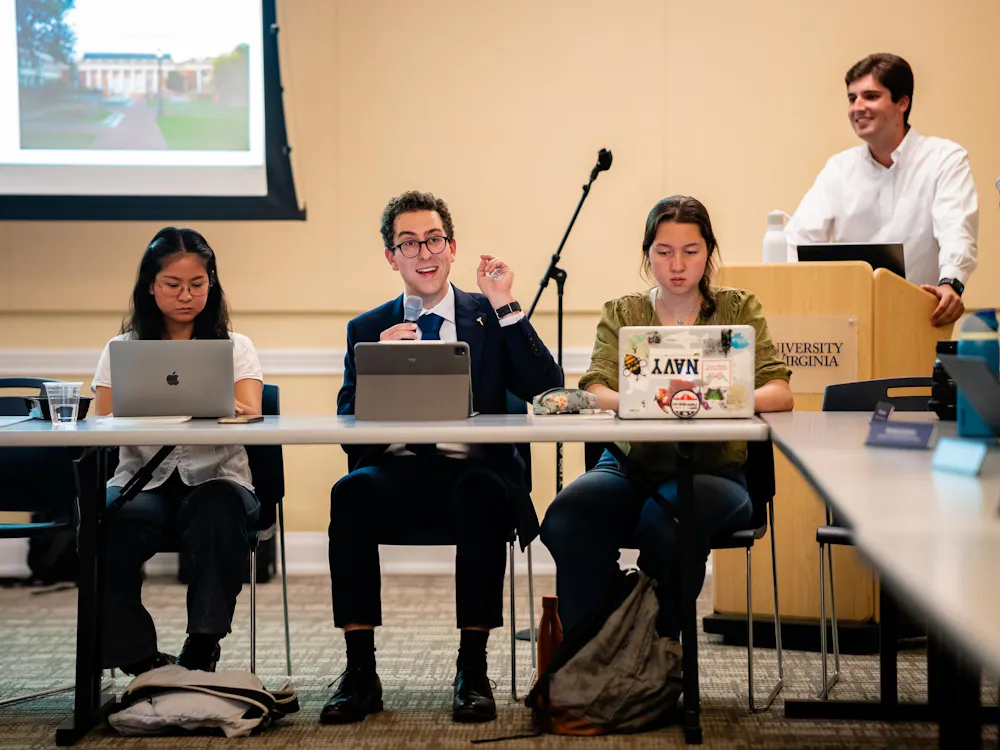
Student Council appoints members to election reform commission
By Lucia Gambacini | 3 hours agoStudent Council also announced several other cabinet appointments and discussed concerns surrounding parking on Central Grounds.

Students, professors weigh in on the importance of letter grades
By Ruby Budetti | 23 hours agoWhen thinking about letter grades for themselves, many University students and faculty said they prefer letter grading throughout all four years of college.
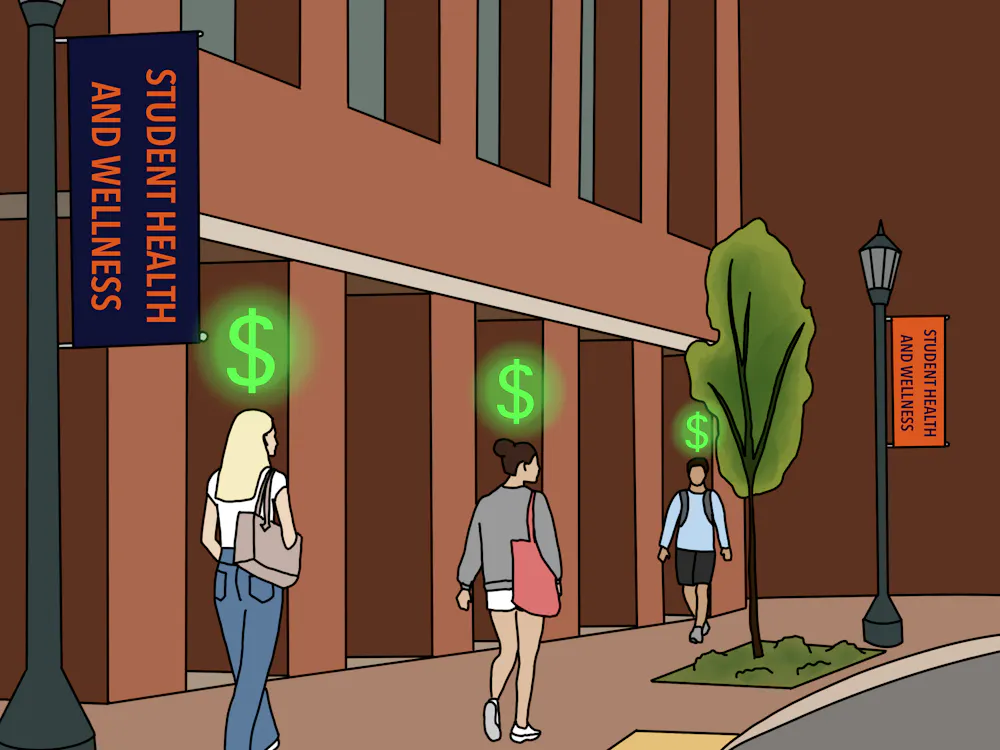
What services does the Student Health Fee provide for students?
By Melody Yuan | 23 hours agoThe University Board of Visitors approved tuition and fees for the 2026-27 academic year in April, and the Student Health fee rose from $1,147 to $1,184 per student.