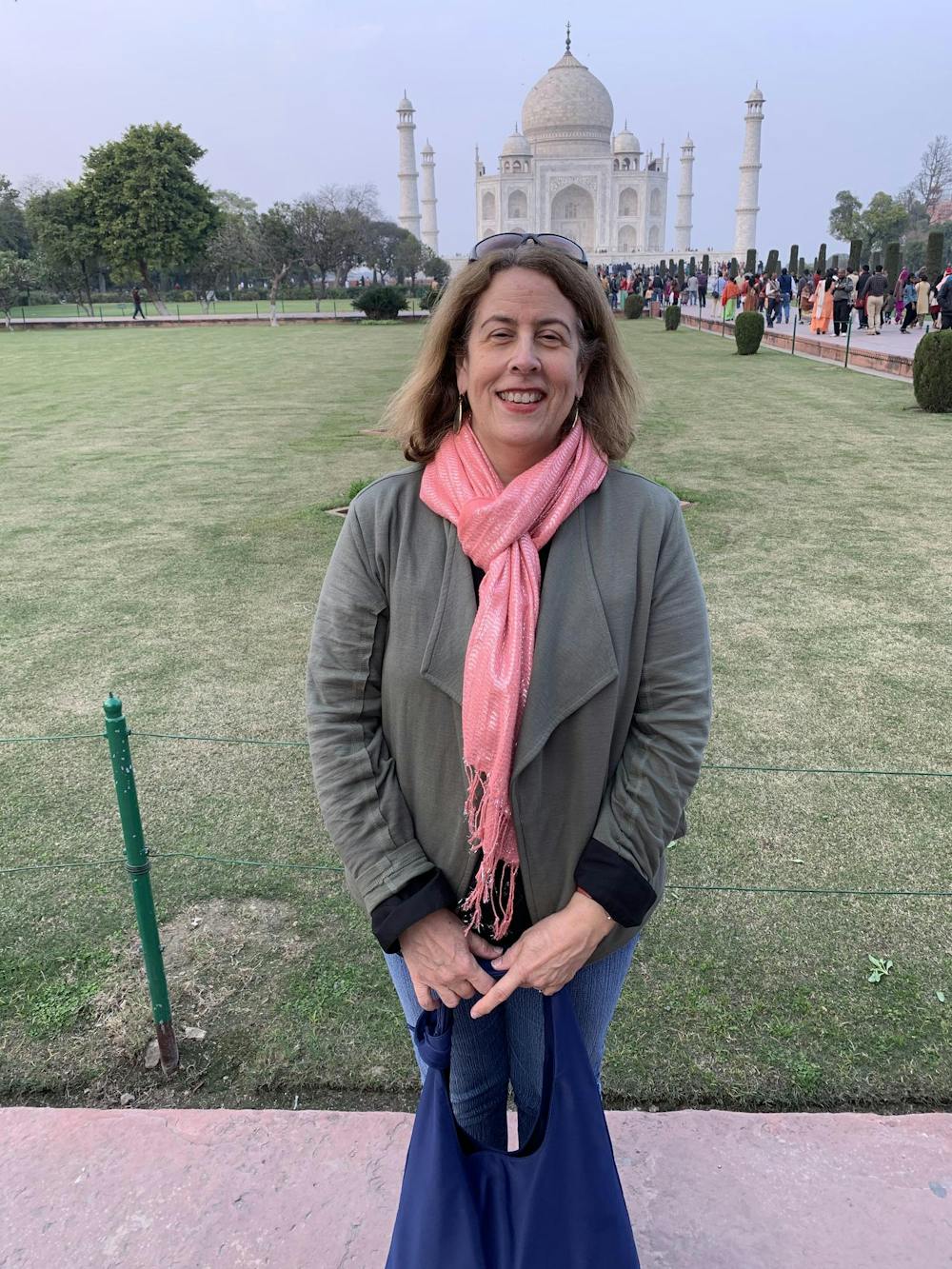
For Marjorie Leedy Green, The Cavalier Daily’s first female editor-in-chief, the central focus of her year in the role and her time at the University was not women’s newfound presence in the spaces of higher education and leadership roles within the University. Instead, her focus was The Cavalier Daily’s concern with freedom of the press under an encroaching University administration.
As Leedy Green wrote in her parting shot — an opportunity for fourth-year Cavalier Daily staffers to write a column on their time at the paper — just before her graduation, “This influence of the student media carries with it a huge responsibility, of which the students in the media are very conscious … the journalists’ concern for fairness and the care with which they treat stories are not often revealed.”
The University adopted full coeducation in 1972 — meaning students were considered for admission without regard to gender for the first time — after smaller groups of women were admitted as first-year students in 1970 and 1971. Leedy Green began her first year in 1973, studying to earn a degree in Government. At the same time, the University established its Media Board in 1976, with the purpose of supervising student-operated news organizations.
After Carl Bernstein and Bob Woodward of the Washington Post revealed the Watergate scandal in 1972, Leedy Green said she was sure she wanted to pursue a career in journalism. During the first semester of her first year, she joined the news desk, eventually becoming news editor before she ran for editor-in-chief.
“[News] was never boring,” Leedy Green said. “It just seemed to be what I was best suited for.”
On The Cavalier Daily, Leedy Green found a team that became her strongest supporters — the fast-paced and exciting nature of producing news together in the afternoons and evenings formed some of her core memories of her time at the University. This team would later encourage Leedy Green to run for the position of editor-in-chief and support her efforts to fight the Media Board’s increasing efforts to censor the paper.
Shortly after she was elected to lead the paper in the spring of 1976, the University established the Media Board which had the power to investigate complaints against student media and to take corrective action against organizations or reporters as it deemed necessary.
“[It posed] potential First Amendment violations … [and was] an immediate threat that we felt had to be dealt with,” Leedy Green said. “We were very concerned, but not shocked, about the creation of the Media Board.”
At that time, she said, the University was going through a period of intense change — women and Black students had only recently been allowed to enroll, bringing both diversity and with it, the challenge of serving a student body with a variety of backgrounds and personal views.
“I was one of the first classes of women, and that upset an awful lot of people at the University,” Leedy Green said. “With the admission of women and efforts to recruit more students of color came more student involvement in commenting on and protesting various University decisions. The University was no longer a school with young white men who tended to come from similar backgrounds.”
The Cavalier Daily, with Leedy Green as news editor and then as editor-in-chief, reported on these changes to gender and racial integration at the University, causing increasing tensions between University administration and the paper.
“It was only natural that some of [these shifts] would be reflected in what was happening with The Cavalier Daily. We were covering all of this, and we were commenting on all of this,” Leedy Green said. “It was a new world for the University administration to have students providing this kind of coverage and protesting and raising concerns.”
Leedy Green’s year as editor-in-chief marked the beginning of a period during which The Cavalier Daily’s focus was protecting its ability to report freely on University events. She and her team decided to directly oppose the Media Board’s creation, working with the American Civil Liberties Union to contest the decision on the basis of its infringement on the paper’s First Amendment rights.
After Leedy Green’s graduation, The Cavalier Daily would eventually become entirely independent from the University in 1979 — a move she had sensed might be needed for the paper to operate free from concerns over University censorship, although the paper did not have the financial resources to do so during her term.
As a student journalist, Leedy Green was experiencing firsthand what it was to be a member of one of the University’s first classes of women. Within this community, she found numerous role models — in her residence halls, courses and at the paper — who made her feel comfortable despite some pushback against women at the University.
“It felt like a moment of promise for women at the University,” Leedy Green said. “And there were a lot of women moving into student government, on the Honor Committee, on the [University] Judiciary Committee. So it really felt like we had a real fraternity of women who just were doing good things at the University.”
And although some men at the University expressed opposition to the admission of women, Leedy Green said she found at The Cavalier Daily a group of people who supported and respected her leadership, regardless of the fact that she was the first woman to hold the paper’s top leadership role.
Following her time at the University, Leedy Green began a career as a daily news reporter for the Alexandria Gazette, in her hometown of Alexandria, Va. For her, The Cavalier Daily had provided something that the University had not — a journalism education.
“The Cavalier Daily was the way we learned how to be good journalists and how to master the basics that would enable us to move on and develop as journalists,” Leedy Green said. “I will be forever grateful for that. It was just an unbeatable experience.”
While reflecting on her term, Leedy Green revisited her parting shot piece, and those of other members of her team.
“What was consistent in all of those [parting shots] was how we talked about each other and how much we valued one another and how close we were,” Leedy Green said. “And I think that really is one of the major things that I take away from [The Cavalier Daily] to this day. My best friends of many years are mostly people I met through the [paper].”
Read More

U.Va. School of Medicine names two new department chairs, explains selection process
By Michael Racz | YesterdayIn an interview with The Cavalier Daily, Colin Derdeyn, interim dean of the School of Medicine, explained the selection process of the two chairs and the new chairs’ plans for their departments.
Students react to Supreme Court decision on Temporary Protected Status holders
By Abigail Larkin | YesterdayThe Cavalier Daily reached out to University student organizations, including the International Relations Organization and Students for Equity and Reform in Virginia, to hear student perspectives on the Mullin decision.

Nursing Dean Marianne Baernholdt steps down amidst season of U.Va. Health leadership turnover
By Lauren Seeliger and Grace Little | 2 days agoBrie Gertler, interim executive vice president and provost, and Dr. Mitchell Rosner, chief executive officer of U.Va. Health and executive vice president for health affairs, wrote to the School of Nursing community Tuesday morning to announce Nursing Dean Dr. Marianne Baernholdt will be stepping down from her role.