
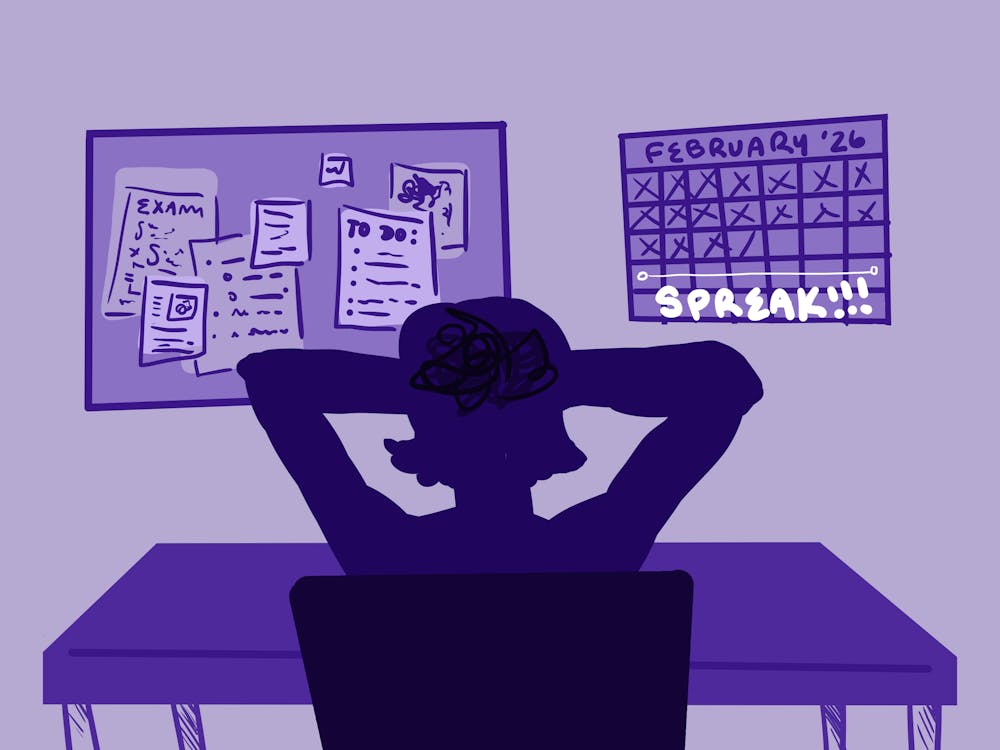
As the clutter of half-unpacked suitcases and the jetlagged yawns signal the end of break, many students are facing a familiar challenge. After several University students indulged in a week of late mornings and guilt-free scrolling online, returning to deadlines and schedules can feel like a disorienting transition.
Following a week of leisure, returning to school can feel a bit like going from zero to 100. But rather than simply being an unfortunate cornerstone of the college experience, some University students speculate that the severity of this transition reflects broader patterns of the intense academic and pre-professional culture, perpetrated by the intelligent, ambitious student body that this “public ivy” consists of.
In the weeks leading up to break, several students recount being swamped with midterms, projects and extra homework. While the workload makes for a stressful end to February, third-year College student Camyla Gonzalez explained that professors often do this to avoid assigning work during the break itself.
“I think that professors tend to slam a lot of work and exams right before break because they feel guilty giving people things to study [during] break,” Gonzalez said. “Which is fair, but also kind of sucks that all the professors are thinking the same way, because then we're slammed right before break.”
The influx of work often forces students to study into the wee hours of the morning in order to keep on top of their homework, assignments and job applications. A recent report from Handshake noted that job postings have reduced by 15 percent while job applications have increased by 30 percent. Ahuja noted how the juggling of these different aspects seem typical at the University, contributing to a “productivity culture” on Grounds.
“I think U.Va. is a very competitive school, and there's always people achieving things around me,” Ahuja said. “So I want to compete with them, and that mindset pushes me to keep working regardless of what's going [on].”
As a result, when the first day of spring break finally arrived, a tangible sense of relief was expected to spread across Grounds. However, for Gonzalez, attempts to disengage with the academic stress she has become accustomed to was easier said than done — and often led her to feelings of guilt.
“I do sometimes feel guilty that there is so much time [over break], and I'm just watching Netflix. I could be doing so much more for myself so I don't get as stressed in school and take advantage of this time to actually be proactive,” Gonzalez said.
First-year College student Radhika Bharambe described experiencing a similar tension between rest and productivity. Although she welcomed the time off, she said she often felt pressure to use it for career-related activities.
“I [felt] a little guilty because I wanted to do some more career-focused work. Not directly schoolwork, but [opportunities] for my career or U.Va. clubs,” Bharambe said.
Third-year College student Ayaan Kamal noted how the constant drive to stay productive not only influences how students spend their breaks, but also how comfortable they feel slowing down their schedule. He said that staying still during break can be difficult, as spending a semester balancing extracurriculars, homework and exams — and then suddenly having a week without any demands — is uncomfortable.
“I start to feel like I can't handle sitting at home and doing nothing all day. I don't like that feeling,” Kamal said. “Over winter break, I would go to the gym a lot. I need to find other things for me to do to keep myself occupied, otherwise I [will] go crazy.”
Ahuja spent his spring break working part-time for a company he is interning with over the summer. When asked what motivated him to spend his break working rather than resting, Ahuja noted a pressure to stay productive that is reinforced by competition from his peers.
“It's a kind of a culture of prestige and wanting to be the best. It's seeing other people do really well, and then internally that motivates me to want to do more [as well],” Ahuja said. “So in some ways, that culture is a good thing, but also it leads to a lot of stress.”
This sentiment reflects a broader culture among University students — the expectation that free time should still be purposeful or productive, rather than simply restful.
To address this culture, some students reinforced healthy habits over spring break to practice balance between productivity and rejuvenation. For Ahuja, activities involving physical movement or social interaction leave him feeling significantly more refreshed.
“Going outside and spending time in the sun and playing sports with my friends felt productive, because just being close to people, talking and laughing is not only enjoyable, but it just makes you feel good. Compared to laying in bed [which] just made me feel really guilty,” Ahuja said.
According to Bharambe, expectations of constant productivity can contribute to burnout, and prioritizing self-care can actually help students maintain focus and improve their academic performance.
“Your academics are important, [but] being happy and doing other things that you want to do [will also] help your academics, because you'll be able to manage that stress,” Bharambe said.
Read More

From soccer to startup, Emiliano Mercenari is doing it all
By Malone Morchower and Abby Snowdon | 3 days agoMercenari is a first-year College student, an attacker and midfielder for the Virginia men’s soccer team and the founder and current operator of four startups.

Conmole cooks up the perfect evening out
By Ingrid Gay | 4 days agoAs much as I loved many of the dishes we had that night, the best part of Conmole was not the flavors, it was the service.

The Ozempidemic — is social media telling the full story?
By Dana Douglas | September 9, 2026To strain the surplus of information about GLP-1 medication circulating on social media, The Cavalier Daily spoke to those on the frontlines of the phenomenon — University medical professionals and a student prescribed GLP-1 — to uncover what this development actually looks like for the future of weight management, diabetes treatment and American healthcare as a whole.


