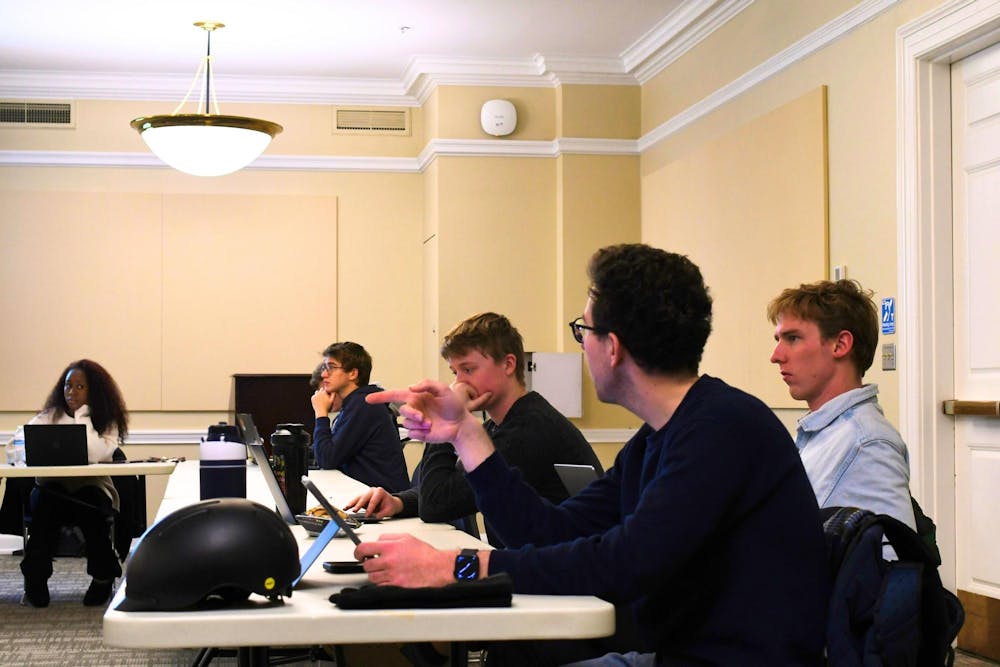
Student Council convened for their weekly general body meeting Tuesday, where they heard from the University Police Department and Office of Emergency Management regarding the University’s response to the Edgar Shannon Library active attacker threat Nov. 3.
On Nov. 3, the University received what appeared to be a credible active attacker threat that led to the University being placed under a Run-Hide-Fight order from 3:05 p.m. to 4:23 p.m. Tim Longo, associate vice president for safety and security and chief of police, noted that two calls came into the administrative line at the Emergency Communication Center. Longo said the caller explained with high specificity what was ensuing and what the suspect looked like and that the dispatcher said they could hear gunshots in the background.
Longo also shared additional details about the University’s response, saying the University and Charlottesville Police were on the scene within 90 seconds. He said he made the decision not to immediately lock all buildings on Grounds, instead shifting to access control that allowed students to enter buildings using their student ID cards. According to Longo, fully locking buildings would have prevented hundreds of students who were outside from entering nearby buildings.
“I made a conscious decision not to go to a lockdown, but go to access control so that those students who were out and about on Grounds could get into buildings and take shelter and seek safety,” Longo said.
University emergency alerts distinguish between a Run-Hide-Fight directive and a shelter-in-place instruction. Run-Hide-Fight alerts are used during active attacker situations and encourage individuals to leave the area if possible, hide in a secure location or defend themselves as a last resort. Shelter-in-place alerts instead direct individuals to enter the nearest building and remain indoors while authorities manage a nearby threat.
Longo further explained the way decisions were made during emergency situations, noting that sending an emergency alert automatically triggers an “incident assessment group” call involving roughly 40 to 50 senior University officials. When the first police units arrive on scene, they brief the group on the situation, after which University leadership begins asking questions and determining what resources are needed to resolve the incident safely. Longo emphasized that decisions are made collectively rather than by a single individual. During active incidents, text alerts are updated roughly every 15 minutes, with the language of those updates agreed upon by the group.
“These are pretty complex operations, so that when decisions are getting made, they are getting made in unified command fashion so that there is consensus, which is important when you have a situation that's this large and this chaotic,” Longo said.
Longo said that he and his office were aware that 12 to 15 universities in the U.S. had been subject to similar sorts of false threats around potential active shooters on campuses, prior to the false active attack incident.
Meghan Rapp, assistant vice president for clery compliance and youth protection, built on Longo’s explanation by sharing the legal bearings of the University's decisions. Under the Clery Act, Rapp explained, U.Va., along with all other universities in the United States, are required to alert the University community of any “ongoing or imminent serious emergency” and to maintain and publicly disclose procedures outlining how the University may respond to such situations.
Director of Emergency Management John DeSilva, who attended the meeting alongside Longo, said he and his team have since reviewed the University’s response to identify areas of improvement. DeSilva said one source of confusion for community members was the use of different “short codes” in the University’s emergency text alerts. Short codes are five or six digit phone numbers used to send text messages to large groups of recipients.
According to DeSilva, the University uses Rave Mobile Safety for the emergency notification system, the same company used by Stanford University, Massachusetts Institute of Technology and several other universities across the country. Rave Mobile Safety uses six phone numbers as ‘short codes.’ Using multiple numbers allows the system to continue delivering alerts if one number becomes unavailable or blocked by a mobile carrier.
DeSilva said some students were confused after receiving alerts from different phone numbers and worried that one of the messages could be fake or part of a scam. DeSilva said he and his team are currently looking at ways to reduce confusion in the future, including the possibility of the University purchasing its own dedicated short code for emergency alerts.
Student Council also heard an update from Kasey Michaud, chair pro tempore and Law School representative, on the newly established University-wide Food for Fines program. On March 26 and 27, students who donate $10 to the Cavalier Food Pantry receive $20 off their parking ticket and students who donate $15 or more will receive $30 off. This will apply to only level one and level two tickets — generally minor or routine violations such as permit or meter infractions — and does not apply to level three violations such as blocking fire lanes or accessible spaces. Eligible tickets must also not be overdue.
Student Council will reconvene for its penultimate general body meeting of this term Tuesday.
Read More

Five Virginia universities, including U.Va., targeted by bomb threats Friday
By Brendon Bordwine | YesterdayEvacuations and investigations were also reported at Bridgewater College, George Mason University, Randolph-Macon College and Longwood University

Bomb threat reported at Shannon Library, no bomb found
By Lauren Seeliger and Grace Little | YesterdayA University emergency alert sent Friday at 10:50 a.m. reported a bomb threat at Edgar Shannon Library, located at 160 McCormick Road. The bomb threat is clear and no bombing device was found.

Newly-appointed Rector brings four years of Board experience
By Cecilia Mould | 2 days agoTen newly-appointed members and the remaining seven selected Carlos Brown as rector Feb. 20.