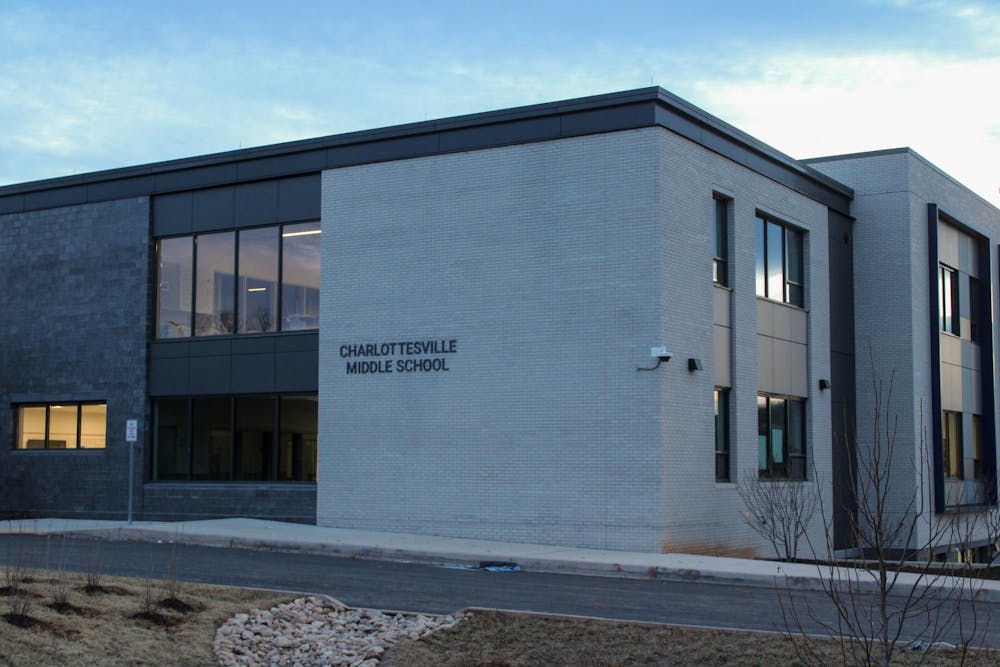
University employees, students and Charlottesville residents gathered at Charlottesville Middle School to discuss the importance of collective bargaining Feb. 21. The event was sponsored by the United Campus Workers of Virginia — a group of University students and staff which unionize public college and university workers across Virginia — and discussed the potential for collective bargaining to improve working conditions, pay and healthcare for higher education employees.
Several UCWVA members spoke at the town hall, highlighting recent legislation in the General Assembly that could expand public-sector collective bargaining rights for employees of higher education. Collective bargaining rights are the ability for employees to unionize to advocate for better wages and working conditions, and this change would allow for UCWVA to have greater bargaining power with the University, by necessitating that the University formally recognize the group and negotiate with it.
According to Assoc. Sociology Prof. Ian Mullins and member of UCWVA, collective bargaining of Virginia state employees is currently allowed in some municipalities, but is completely banned for employees of public higher education institutions. However, both chambers of the General Assembly passed different versions of a bill Feb. 17 — HB1263 in the House of Delegates and SB378 in the Senate — that would create a standardized legal framework that would grant the ability to unionize more public employees.
While both bills would expand the rights of public-sector employees to use collective action, the House version of the bill leaves out higher education employees and the Senate version does not include bargaining rights for at-home healthcare workers. Over the next several weeks, the chambers will negotiate on a final bill to send to Gov. Abigail Spanberger (D) to sign into law or veto before the end of the 2026 legislative session March 14.
Mullins said that while currently employees of the University must negotiate their contract as an individual, the ability to collectively bargain could increase their leverage in negotiations and power in dictating the terms of their employment.
Mullins emphasized UCWVA’s hope that the currently developing legislation will expand collective bargaining rights to all public employees. He said that including all public-sector job categories would strengthen the solidarity of the group and its effectiveness as a bargaining body, as opposed to the current situation where certain groups are banned. He noted that includes higher education workers, and those in municipalities that do not currently recognize collective bargaining rights.
“With the ways that the laws are currently structured … [excluding certain public-sector employees] pits people against each other, because there's some people that are actively involved and invested in [unionizing] being successful, and others who it just doesn't apply to,” Mullins said.
UCWVA describes themselves as a “wall-to-wall” union, meaning any person who receives a paycheck from the University is eligible to join UCWVA. This includes graduate student teaching assistants, library and administrative staff, maintenance and janitorial workers and students participating in work-study programs.
Mullins said that the immediate goal of the UCWVA is to remove the ban on collective bargaining for higher education workers, and that the hope is after the ban is lifted, efforts will focus on organizing more workers to join the group.
“[Research shows] that [with collective bargaining] pay tends to be about 8 percent higher for employees, health care improves and working conditions improve,” Mullins said.
Mullins said he believes University employees could have benefitted from collective bargaining when facilities management had an increased workload throughout the recent snowstorm. He said that maintenance workers were removed from their normal duties and tasked with removing the snow. However, the University is only required to provide hazard pay — additional pay when employees are working in dangerous conditions — to the workers while it is closed. While the University was only closed for two days, the maintenance workers worked to remove the snow for weeks, and did not receive higher pay for doing so, according to Mullins.
Carter Delegal, Philosophy graduate student and member of UCWVA, spoke specifically about the benefits of unionizing for graduate students, who he said often struggle to balance their workload of being both students with academic pressures and working as teaching assistants.
Delegal said that collective bargaining could help strengthen protections and regulations for graduate students working in labs, as well as grant the opportunity for the workers to have greater employee benefits and formal healthcare.
“We really think most of the grad students at U.Va. really love being at U.Va. and care about making it a better place. We can only do that if we're supported,” Delegal said. “Getting grad students the support they need will really help us be better mentors for U.Va. undergrads.”
Kelsey Levine, Engineering graduate student and member of UCWVA, echoed Delegal’s belief that collective bargaining could help alleviate some of the stress faced by graduate students. Levine said that she spoke to many graduate students at the University prior to starting her program, and heard a common theme of students feeling “burnt out” at the end of pursuing their doctorate.
“It seemed like a lot of people were even making their career decisions off of [feeling burnt-out], deciding to leave academia, and this feeling of being overworked and this culture surrounding it,” Levine said. “That was just a thing that should never happen in my mind [and] that could completely be fixed through collective bargaining.”
Delegal also said that the Board of Visitors’ actions regarding the presidential search in the past year have increased interest in unionizing among faculty. He said that staff members felt that there was an intentional lack of transparency by the Board in their proceedings.
“The union felt … the way in which the [Board] was going about that search, and doing it in a certain quickened way and moving their meetings to Boar's Head, was trying to exclude the voices of people who actually worked at U.Va.,” said Delegal.
The Board’s meetings traditionally take place on Grounds, and the decision to move their December meetings to Boar’s Head led to legal concerns that the location decreased public accessibility and was potentially out of compliance with the Virginia Freedom of Information Act.
Levine said that the UCWVA has been lobbying for legislation in the past year that would reform the structure of the Board, such as House bill HB780, If passed with its original content, the bill would have required the Board to have voting representatives from the students, staff and faculty. However, the parts of the bill requiring voting representatives were cut. Despite the cuts during this legislative session, Levine said that the UCWVA would continue to fight for increased voting representation in the coming years.
Delegal said that the UCWVA hopes that they will have more success in achieving their goals under the Spanberger administration, who has stated her support for legislation allowing public-sector collective bargaining.
Mullins emphasized the importance of collective bargaining for higher education employees in not only improving the working conditions of those in UCWVA, but also in increasing its potential to uplift the Charlottesville community as a whole.
“I know that when we talk about collective bargaining, it seems abstract, but this really is the only way that we can ensure that we have a say at the University and that it has a more democratic form of governance,” Mullins said. “Not only is it going to improve U.Va, [it's going] to improve Charlottesville.”

Abigail Larkin is a staff writer on the news desk. She is a third-year student in the Batten School of Public Policy, majoring in public policy and foreign affairs. Abigail is from Norfolk, Va., and she enjoys writing about state and national politics.
Read More
Parking on Grounds — what has changed this semester?
By Charlotte Gabriel | 11 hours agoAccording to University students interviewed by The Cavalier Daily, several expressed frustration with high parking prices on Grounds, as well as the difficulty in finding available parking in general.

Student Council connects with University’s Strategic Planning Committee
By Lucia Gambacini and Reilly Auld | 11 hours agoThe Council also heard updates from Executive Board members regarding the upcoming Fall 2026 elections and new investments in free Sexually Transmitted Infection testing kits for students.
Virginia colleges workshop three-year bachelor’s degrees
By Luca Bailey | 11 hours agoIf the effort is successful, participating schools in Virginia and Ohio will join at least 70 higher education institutions across more than 26 states that have already adopted three-year programs in some capacity.