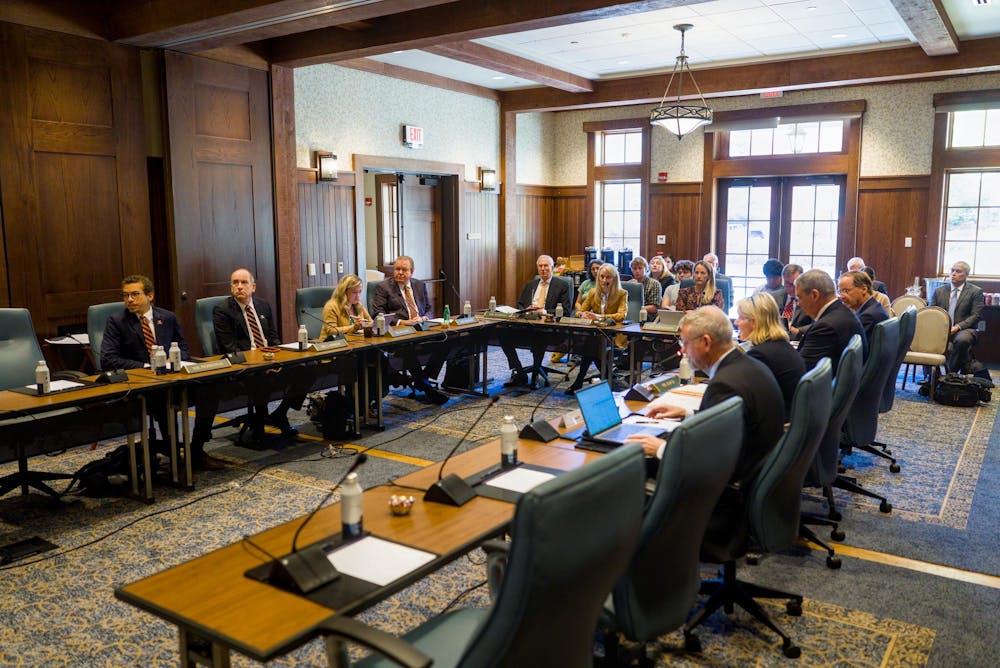
The University Board of Visitors will convene at Boar’s Head Resort for all of its December meetings, instead of traditionally having the majority of meetings on Grounds in the Rotunda. The venue change — which is now about a 10 minute drive from Central Grounds — has sparked concern from a legal expert about accessibility and full compliance with Virginia’s Freedom of Information Act.
In past Board sessions, a few of the meetings have been held off-Grounds, such as the Health System Board which met at Boar’s Head during the September Board meetings. However, this time, the Board will hold all meetings off-Grounds. There is no University or Charlottesville bus route that goes directly to the venue.
In a statement to The Cavalier Daily, University Spokesperson Bethanie Glover said that the venue change was made to “minimize disruption” to the Lawn and the Rotunda during stage preparations for Lighting of the Lawn. Access to the Lawn and the Rotunda will be restricted to only Lawn and Range residents and event staff between 5-6 p.m. with the event beginning at 7 p.m.
“In considering logistics and security for the December Board of Visitors meeting, the University noted the event's overlap with the Lighting of the Lawn,” Glover said. “In order to efficiently manage meeting traffic and security … the meeting was scheduled to be held at Boar's Head Resort.”
The Virginia Freedom of Information Act says that all public meetings and documents must be presumed open, unless there is a specific exemption invoked. Glover said that to further accommodate members of the public, the meetings’ open sessions will be livestreamed, as usual, “allowing for expanded accessibility.”
However, Kevin Martingayle, partner at Bischoff Martingayle in Virginia Beach and Class of 1991 Law alumnus, said that a livestream may not be enough to fully comply with FOIA law.
Martingayle said that attending meetings in-person gives unique insight that one might not be able to observe online — such as the facial expressions and interactions among Board members that may be off-camera on a livestream.
“The essence of it is that being in the room is superior to watching it on a computer screen or a television screen,” Martingayle said. “Being in the room itself gives you an opportunity to observe lots of stuff that a camera may not be telling you if [the camera] may be trained on the speaker.”
Questioning why the University did not choose to use another facility on Grounds, Martingayle suggested options such as the Caplin Auditorium in the School of Law or a room in the Darden School of Business.
“I don't understand why they picked Boar’s Head — there's nothing wrong with it, it's a nice place — but it's not as convenient to the public as doing it right there in one of the on-campus facilities, and it seems like they've got plenty of options on-campus,” Martingayle said.
Martingayle also emphasized the overall importance of public officials understanding FOIA law, citing the statute of the Code of Virginia which requires that public officials elected or appointed to an office become familiar with the Code’s chapter on FOIA. He said that even if it is not perfectly clear whether FOIA law has been violated by holding the meeting at Boar’s Head, the venue change still provokes questions about the motivation behind the move.
“If [the venue change] doesn't violate the letter of the law to pick a place that is inconvenient … and that is hard to attend, it certainly violates the spirit of a law,” Martingayle said. “Anybody who is doing something that is deliberately designed to thwart the purposes of the Freedom of Information Act probably shouldn't be in a decision-making role. It's really that easy.”
Martingayle cited a 2023 case involving a member of the public and the media who was denied entry to a Suffolk school board meeting — in which Martingayle represented the individual denied entry. On the day of the meeting, the individual was told that members of the public were not permitted in the meeting room and could only view a livestream from another room in the building. The Virginia Supreme Court ultimately ruled that the school board violated FOIA law by denying her entry.
The Board room in the Rotunda has a capacity of up to 60 people — including Board members — according to a representative from Facilities Management. Glover said that at Boar’s Head, 50 seats will be made available to presenters, administration, staff, media and public attending the open sessions of the meetings — excluding Board members.
This is not the first time that the Board’s venue choices have provoked concern among University community members. At the full Board’s meeting in September, dozens of protestors lined up outside the Board room, attempting to enter the Rotunda. However, most were unable to do so because of room capacity limits. Several of these protesters were part of The United Campus Workers of Virginia U.Va. chapter.
Similar to their protest at the September Board meeting, UCW-VA plans to march this Friday during the full Board meeting, beginning at noon at Bryan Hall. From there, participants will march to Madison Hall and then board buses and travel to Boar’s Head. UCWVA hopes to “pack” the full Board’s open session meeting.
Specifically in its protest, UCW-VA is demanding the resignation of Rector Rachel Sheridan and Vice Rector Porter Wilkinson from the Board, the cease of the presidential search process until there is a legitimate makeup of Board members and that support for collective bargaining — the process of negotiation between employers and groups of employees to establish provisions for wages, benefits and working conditions — be a “core qualification” of any presidential candidate.
In addition to the venue change, the University implemented a new clear bag policy for the meetings, as noted on the Board’s website. Glover said that the University instituted this policy to ensure the safety of all Board members and attendees.
“The clear bag policy is an added precaution for the safety of all meeting attendees,” Glover said. “Bag checks at entry have been common practice for the past several meetings and the clear bag policy aligns with safety precautions for many other U.Va. events.”
A concern regarding the Board meeting venue was brought to court in a 2013 case. The opinion by the Virginia Freedom of Information Advisory Council found that the Board violated FOIA law by denying students entry into the Board room because there was not enough capacity. While FOIA law does not specify any logistics of the size of the room under the definition of a public meeting, the opinion said that the best practice would be to ensure a meeting room is large enough.
“While FOIA is silent regarding the logistics involved in holding public meetings, because the University is now aware of the increased interest in its meetings, the best practice is to ensure a meeting location large enough to accommodate all,” then-FOIA council executive director Maria Everett wrote in the opinion.
Glover said that the University and the Board make sure to consider accessibility for students and media when planning venues for Board meetings. She also noted that the meeting room at Boar's Head will accommodate more members of the public and the media than the typical Board meeting room in the Rotunda.
“The University and the Board of Visitors take compliance with Virginia law seriously, and keep compliance and accessibility for the media and public, including students, in mind when planning and advertising Board of Visitors meeting locations,” Glover said.
Livestreams of all the Board’s open sessions are available on the Board’s website.
Nina Broderick is Managing Editor for the 137th term. She previously served as senior associate editor on the news desk. Nina is a third-year student from Richmond, Va. and is majoring in Public Policy & Leadership in the Batten School with a double minor in Government and Spanish.
Read More

With midterm elections approaching, Miller Center experts share foresight
By Reilly Auld and Luca Bailey | 5 hours agoThese midterm Congressional elections are generally viewed as an opportunity for voters to evaluate the incumbent President’s performance in their first two years in office.

Honor Committee continues to debate changing appeals process
By Michael Racz and Bryan Dean | 5 hours agoThe proposed change, if voted into effect, would alter the way students are able to appeal either their hearing or sanctioning panel decisions, should they feel there has been a violation of a granted right or there is new evidence to introduce to the case.

University Medical Center nears top safety grade, looks to improve in November
By Michael Racz | YesterdayIn the spring 2026 Leapfrog Hospital Safety Grades, the University Medical Center received a “B” grade — the second-highest grade awarded by The Leapfrog Group — with a numerical score of 3.18, just 0.02 points below the threshold for an “A.”