
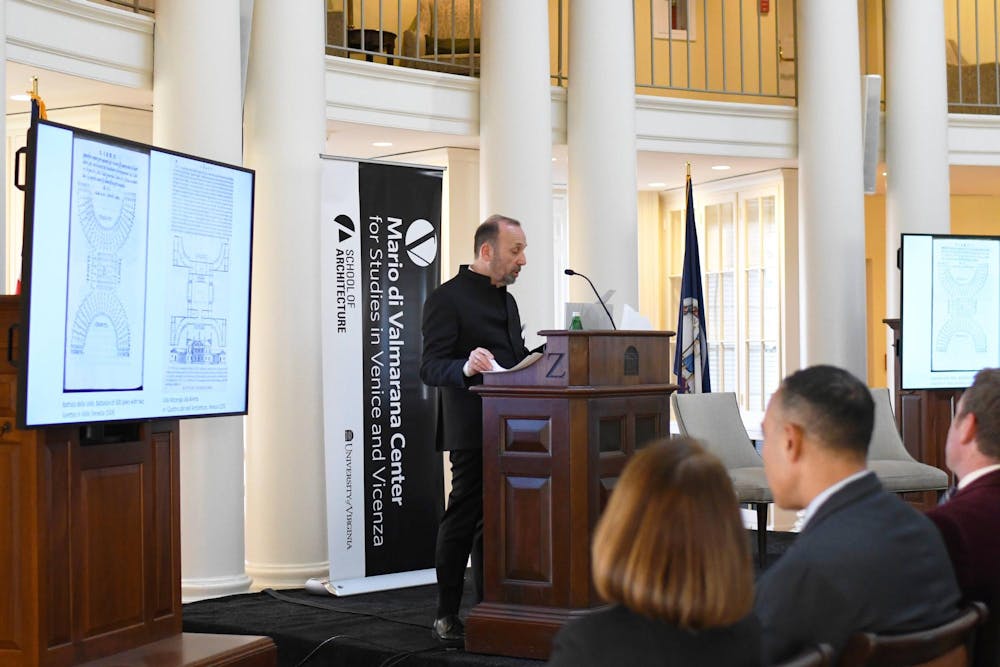
The School of Architecture hosted a symposium to celebrate and reflect on 50 years of study in Italy’s Veneto region, with its programs in Vicenza and Venice. The symposium also honored the opening of the Mario di Valmarana Center for Studies in Vicenza and Venice, a center built with the goal of expanding education opportunities abroad for architecture students. The symposium was held Friday and Saturday and included two days of presentations, celebrations and alumni reflections.
The new Mario di Valmarana Center is the University's first academic center abroad, with its 15,000 square-foot campus consisting of classrooms, studios, meeting rooms, exhibition spaces and lodging for students and faculty. Housed within the former Bishop’s Palace, it functions as a place for students to live, learn and experience the culture of Vicenza. The center intends to provide students with new opportunities for education and research and will engage with faculty across the University and with scholars from the area.
The theme of the symposium was “Creating a Global Laboratory,” according to Bill Sherman, Mario di Valmarana architecture professor and director of the Mario di Valmarana Center for Studies.
Sherman said he wanted attendees to learn about how the work being done in Venice and Vicenza is central to the missions of both the University and the School of Architecture.
“[Studying abroad] brings architecture alive. It's not something that they're just designing, and they're just drawing in their sketch books,” Sherman said. “[The students] are completely immersed in a culture.”
Saturday morning panelists included Andrew Johnston, director of the U.Va. program in historical preservation and associate professor of architecture and architectural history, Alexandra Valmarana, architect and consultant for Peregrine Bryant Architects, Pantheon Ventures partner Francesco Valmarana, Assistant Professor of Architecture Ali Fard and Ludovico Centis, architect and founder of The Empire, who all touched on ideas of cultural importance of architecture.
When abroad at the Center, students will work with historical architecture as a tool for research and data collection. Johnston detailed how students will use ground-level scans and aerial drone shots of Italian buildings, and through the use of photogrammetry, turn 2D images into a 3D model of the buildings.
Students will then be able to use the data to construct a complete model of the surrounding landscape. Johnston discussed how advancements in technology have allowed students to create more detailed records of the architecture.
“We were able to use a new technology called SLAM — simultaneous localization and mapping — using structured light,” Johnston said. “[SLAM] is a fabulous technology for being able to do this work.”
Valmarana explained how students in the Venice and Vicenza programs learn not just about the composition of the buildings, but also the buildings’ cultural significance. She said students learn that these buildings are not just objects but representations of historical systems of ideas.
“[Students] don’t just sit and look at the buildings,” Valmarana said. “We look at the people who inhabit them, coming in and out of those buildings and in those places, and seeing how people interact on the square, town hall and … villa and in those spaces, and we watch and we learn.”
Valmarana also spoke on relevant architectural challenges students explore in the abroad programs, including creating climate-resilient buildings made with sustainable materials. Valmarana emphasized that using technology can be helpful in achieving this goal, but that history should also be used to influence modern architecture.
“Technology alone is not enough,” Valmarana said. “What matters most … is the curiosity, the willingness to observe, the patience to draw and the humility to learn from those who came before us five centuries ago.
Architecture students looking to study abroad in Vicenza or Venice can do so either in the summer between their third and fourth year or in the fall of their third or fourth year. This upcoming summer, students will spend a month in Vicenza, learning about the area's history, culture and architecture while partaking in intense drawing practice. Fourth-year Architecture students who wish to study in Venice can do so this upcoming fall — applications were due March 1 for the fall program.
Ruby Budetti is a staff writer on the news desk. She also works as a staffer for The Cavalier Daily social media team. She is a second-year student on the pre-Batten track and hopes to major in public policy and leadership.
Read More

U.Va. and United Way of Greater Charlottesville launch ‘Give Where You Live’ donation partnership
By Vrinda Vashisht | 4 hours agoThe program is set to run through Dec. 18, and its start date coincided with United Way’s 35th annual Laurence E. Richardson Day of Caring.

Student Council passes bill to create ad hoc committee to review UBE proceedings
By Edward Christopher and Anna Ivanov | 5 hours agoThe Commission will craft a report on the University Board of Elections’ current structure and governance practices, putting forth proposals for corrective action based on its findings.

Board of Visitors discusses the implementation of AI in research and academics
By Jaylynn Perez | 14 hours agoThe Board also received an orientation on changes to NCAA athletics, completed its annual Atlantic Coast Conference certification, heard a report from Aaron Bloomfield, Faculty Senate chair and engineering professor, and discussed the University’s ongoing searches for a provost and several deans.


