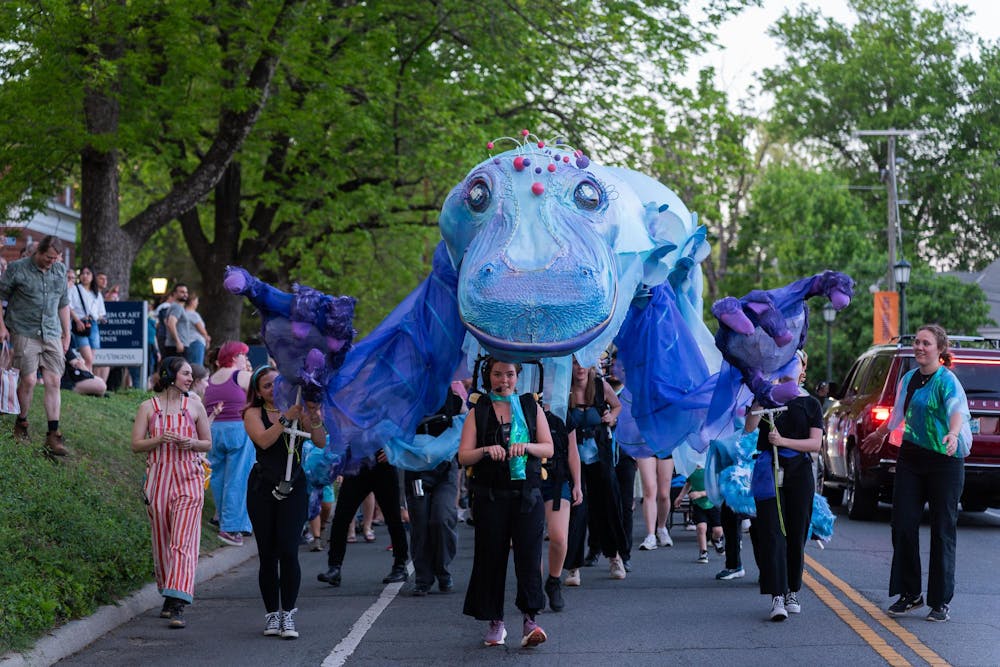
Massive whimsical creatures took over Arts Grounds and the Rotunda Thursday evening as a celebration of students’ semester-long work. The Stan Winston and Steve Warner Festival of the Moving Creature was first hosted at the University in 2013 before its revival in 2024 — and has since dazzled crowds annually with puppets large and small. This year’s creatures were brought to life Thursday as student puppeteers gave out high-fives to children and onlookers.
The creatures, all created and puppeteered by students, are made in two classes at the University, ARCH 5384, “Art of the Moving Creature” and DRAM 1220, “Art of the Creature.” Taught by Melissa Goldman, a fabrication lab manager at the School of Architecture, and Annie Temmink, a lecturer in the drama department, these two classes worked to make the otherworldly festival a reality.
Seven of the course’s carefully curated beasts marched down Rugby Road at the festival, from Arts Grounds to the Thomas Jefferson Statue in front of the Rotunda. Many families, Charlottesville community members and students came out to enjoy the festival and watch the creations in awe.
The event began at 7 p.m. with the initial creature, a jester-like weevil puppeteered by three students, blasting its trumpet as it walked out of the Drama Building towards the center of the excited crowd to announce that Prince Reginald and his court had arrived. Prince Reginald, a large pink bird puppeteered by six students, soon followed, bowing to the children who swarmed around him to get a closer look. The other creatures in Prince Reginald’s court gathered on the grass next to the Drama Building, playfully interacting with the audience around them. Bubba, a large blue hippopotamus, was on the rear end of the parade as the newest inductee to the court.
Once the creatures arrived at the Rotunda, they all lit up with embedded lights as the sun set and the sky darkened, making the event feel even more magical to the audience. Graduate Arts & Sciences student Niamh Clarke was impressed by the skill that the puppeteers needed to maneuver and create the puppets, and said she enjoyed seeing them walk across Grounds and interact with children who came to the festival.
“It is so impressive — the artistry and mechanics that some of these puppets have,” Clarke said. “A lot of the puppets are giving the kids a really good show … they were eating things out of the kids' hands, which is really fun.”
Other attendees echoed their appreciation of the festival’s interactivity, including Francesca Sawaya, mother to one of the puppeteers. Sawaya said she liked seeing the puppets mingling with spectators, especially the children.
“I love the way they're having the creatures interact with all the kids on the route, but also with all the adults, too,” Sawaya said. “I also love that they're on the Rotunda with Thomas Jefferson watching.”
Ahead of the performance, students learned from various professional puppet makers in Hollywood through the Stan Winston School of Character Arts — an online platform integrated within the two courses. Stan Winston, was a Class of 1968 alumnus and is known for his work in creating the puppets for movies such as “Jurassic Park” and “Alien.” Passing away in 2008, his legacy lives on through his continually appreciated professional works, as well as the school that was founded in his name.
Goldman said she enjoyed seeing the students work through a trial-and-error process and use what they learned to first create a puppet before understanding how to control it.
“We teach how to make models, how to make shapes out of cardboard, how to make mechanisms … [Then there’s] something we called creature Jenga, and we smash them all together and we see what works,” Goldman said. “There was a lot of creative input and energy to be like, ‘Oh, that's working.’ And that sort of feedback of, ‘Why don't you try moving this way?’”
Throughout their creative cycles, students in the course said they honed their collaboration skills as well. Fourth-year College student Reese Robers, who worked on and manned the jester puppet, said this project made her think about teamwork in a new way.
“That's the fun part about it, is you can't do it by yourself, you’re the head, you're the middle of the body … you all have to come together to make him the creature,” Robers said. “It's like a type of teamwork that I don't think you get anywhere else, because you have to learn to move as a unit and then make those units move along with each other … I think it's just an interesting way to work together and bring some joy into the world.”
Robers brought up the tail end of the jester who led the parade in front of Prince Reginald. During the parade, Robers played the trumpet from within the puppet to create a feeling akin to a true court jester leading the way for his prince. The festival came to an end around 9 p.m., just after a dance party at the Rotunda featuring the creatures grooving to the “Cupid Shuffle” by Cupid. Onlookers delighted in the silliness, and children danced alongside the puppets.
Thanks to the student puppeteers’ meticulous work, the annual festival brought joy to many children, students and community members as the puppeteers brought these fantastical creatures to life.
“[The puppets], they're alive. We know that they're being puppeted by people. We know that they're designed by students, but they're alive,” Goldman said.
Read More
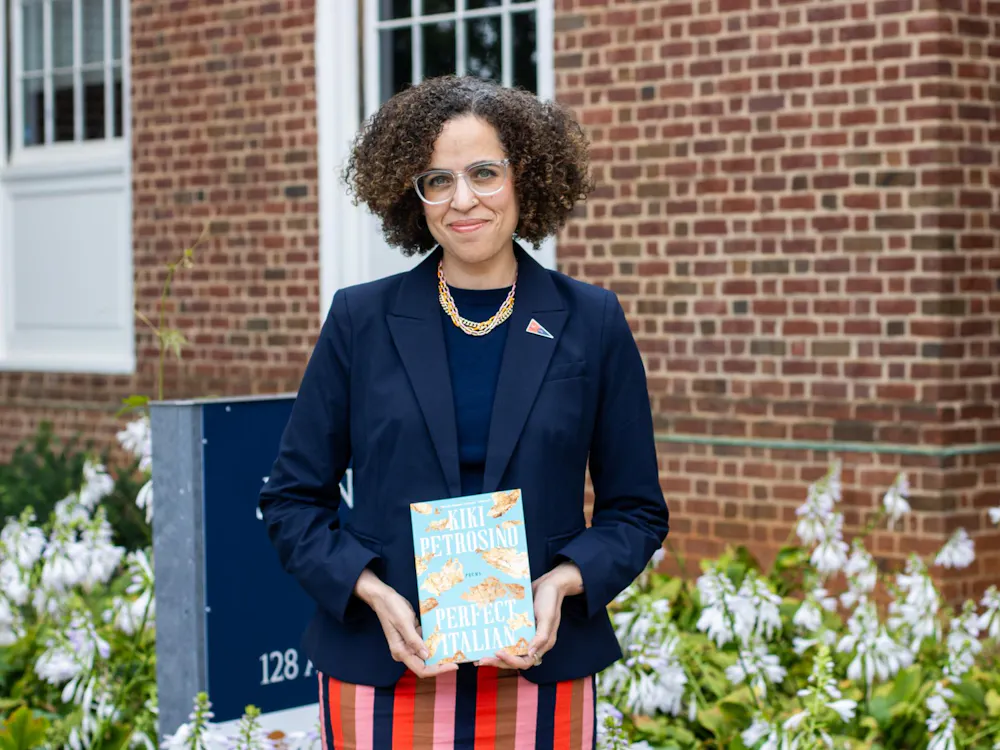
Professor Kiki Petrosino explores heritage, belonging and family in ‘Perfect Italian’
By Carly Smith | 2 days agoIn this work, Petrosino examines her own heritage and identity, using engaging yet deeply personal language, vivid imagery and carefully crafted syntax as ways to express her connection, and lack thereof, to her family’s history.

U.Va. Arts Welcome Picnic showcased the many ways to engage with art on Grounds
By Cece Sherman | 2 days agoUniversity creatives, student-led Contracted Independent Organizations and local organizations were welcomed by U.Va. Arts to the Betsy and John Casteen Arts Grounds Sunday for the annual Arts Welcome Picnic.

How generative AI is — and is not — affecting arts education
By Alena Touve | 2 days agoAs University arts professors begin teaching in the new semester, the industry-wide debate about AI’s role in art will frame how professors approach class discussions, assignments and preparing students for what awaits after graduation.