
Saturday afternoon, Barrio Fiesta returned to the Martin Luther King Jr. Performing Arts Center, blending humor, vulnerability and tradition into something much deeper than a typical showcase. The 33rd annual Barrio Fiesta — hosted by the Organization of Young Filipino Americans — centered this year’s theme on legacy. Established in 1988, OYFA — a Contracted Independent Organization — connects students at the University with Filipino culture through dedicated events and community-building, with the Barrio showcase being a staple artistic event of theirs each spring.
Through a dramedy skit, traditional dances and modern performances, the show explored what it means to carry culture forward while navigating identity in the present. The show began shortly after 2 p.m. with its central skit “Pamana: Legacy,” directed by three OYFA members — fourth-year College student Danella Romera, fourth-year Engineering student Argie Cunanan and second-year Nursing student Caitlyn Lee.
“Pamana: Legacy” followed protagonist Alon De Los Reyes, played by Elijeron Bonga, OYFA member and second-year Architecture student. De Los Reyes — a high school senior determined to make the varsity basketball team and disconnected from his Filipino identity — meets two key figures who prompt him to rethink his sense of belonging and identity.
De Los Reyes was mentored by Manong B, a retired basketball trainer turned dance instructor, and grew close to a peer named Maricel, the two portrayed by fourth-year College student Eric Yeatts and second-year College student Ciara Gilbert respectively. As De Los Reyes struggled with the pressures to assimilate to American culture, the story pushed him to confront both internal resistance and external expectations. Third-year College student Mayna Malhotra said the skit’s message about identity resonated with her.
“I liked how the skit was intended to make people feel comfortable with their identity … I really appreciated their dedication to making the [Filipino] community feel seen,” Malhotra said. “I was surprised at how transparent the actors were … It felt like it was really authentic.”
That authenticity extended into the script, with dialogue reflecting familiar family dynamics — including lines about parents blaming “that phone” for everything — drawing bursts of laughter. The actor’s delivery, often imbued with Filipino accents, reinforced a shared recognition of experiences many in the audience had encountered in their own families. Combined with moments of reflection and tension, the skit read less like a staged production and more like a lived experience unfolding in real time.
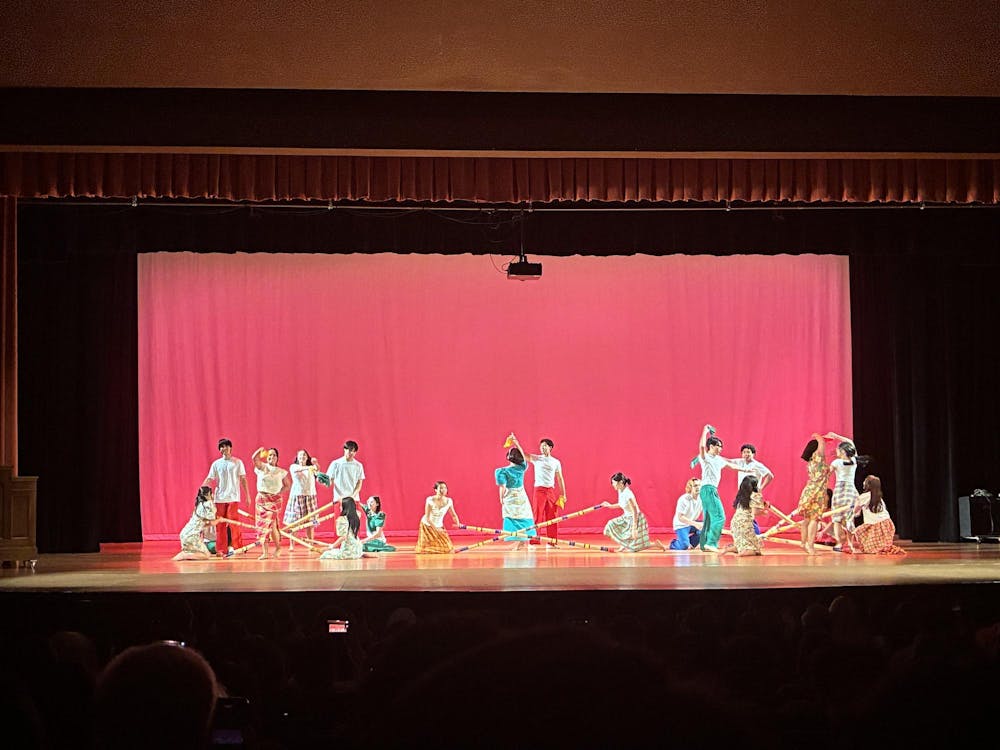
Beyond theatrical storytelling, Barrio Fiesta showcased Filipino culture through both traditional and modern dances. The show featured a range of traditional Filipino dances — including Sakuting, Dinaklisan, Carinosa and Singkil — put on by University students. In one especially memorable moment, dancers performed Tinikling — a traditional Filipino folk dance — blindfolded, skilfully stepping between moving bamboo poles as the audience watched in awe.
Other dances, such as Maglalatik, the Filipino folk dance featuring coconut shell percussion, brought high energy and precision to the stage as dancers moved in sync and maintained intricate timing. Nikita Pantow, OYFA member and fourth-year College student, reflected on her preparation process ahead of her group dances.
"It's definitely been a challenge … practicing from day and night,” Pantow said. “But it's really rewarding seeing it unfold at the end.”
The afternoon marked the culmination of months of preparation, and according to Reyna Eberhardt, OYFA member and fourth-year Nursing student who performed Saturday, the dance put on by fourth-years was kept secret from younger OYFA members until just before the final show.
“It’s just so awesome to see everything come together after hours and hours,” Eberhardt said. "Everyone [is] so hype and excited… especially for fourth years, because we don't show anything until the night before to anyone, so it’s all a secret.”
Throughout its high-energy performances and polished choreography, Barrio Fiesta anchored itself in the feeling of community — alumni, current students, friends and families filled the auditorium to support performing OYFA members, creating an environment that felt both celebratory and deeply personal. Class of 2025 alumnus Lorenzo Romulo — who previously performed in Barrio Fiesta — noted the growth of the production.
“It just got everyone together,” said Romulo. “Their dances were very good, and it felt a little more professional … The skit was a lot better this year.”
Romulo added that the event brought back memories of his own time in the organization, noting that he edited his Class’s montage video — an annual tradition that reflects on graduating fourth-year’s journeys in OYFA. The montage Saturday left few dry eyes in the room, underscoring the event's emphasis on memory and legacy.
The show’s sense of legacy exuded beyond the barriers of the stage, as the event honored the families who helped shape the performers and their culture as well. Through character portrayals and traditional dances, performers highlighted Filipino American experiences and cultural values, creating moments of recognition and gratitude. In the audience, families watched as those stories came to life, gaining a rare glimpse into how their children interpret and carry forward the culture they were raised in.
Barrio Fiesta’s reach went beyond performance as its storytelling and traditional dance also brought together different generations of the community. Pantow pointed to the Filipino community and their shared experiences as what makes Barrio Fiesta stand out.
“There's not one word that can describe [Barrio],” Pantow said. “It’s definitely a magical thing … You get to have fun with your friends, and even along the way, you meet new people.”
As the show came to an end around 6 p.m., that sense of magic lingered in the celebration of Filipino culture and the connections formed among performers, families and audience members on and off stage. In every rhythmic step and theatric moment, Barrio Fiesta showed that legacy is not just inherited — it is lived.
Read More

Le Marché du Soleil stitches together a community, rain or shine
By Nritho Halima | YesterdayThe event marked the fourth collaboration between Le Marché du Soleil, a vintage and secondhand pop-up shop and Cou Cou Rachou, a Charlottesville bakery known for its close-knit local following.
The Southern’s showcase reintroduced student bands on the right note
By Kelsey McIntyre | 2 days agoThe Southern’s concert presented a moment for bands to come together and perform in front of an audience of dedicated music lovers.

Hoo’s Watching: Fall films to embrace the autumn spirit
By Bridget Baile | 4 days agoHere are three essential watches for any reader as they prepare to witness the leaves outside their windows change from green to orange.


