
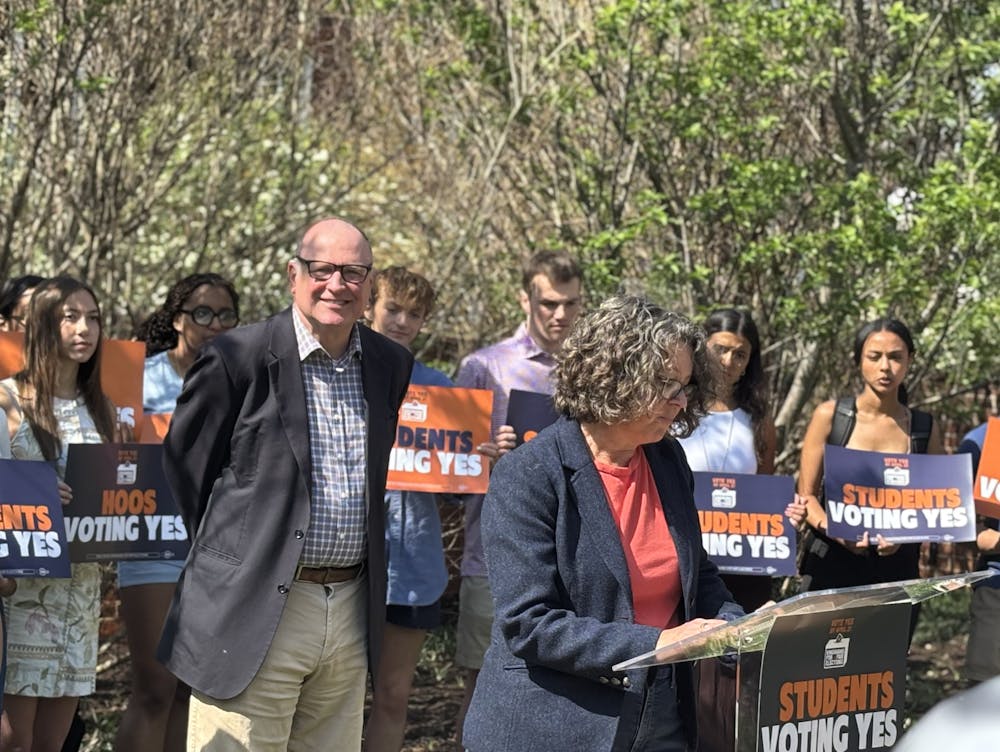
Just over two weeks before voting ends in Virginia’s contentious April redistricting referendum — where voters will decide whether to amend the Constitution of Virginia allowing Democratic legislators to pass a 10-1 congressional map in favor of their party — University Democrats gathered in Garden IX of the Rotunda for a press conference Friday encouraging students to vote for the proposal.
UDems — a Contracted Independent Organization at the University that advocates for the Democratic Party’s policies on Grounds — has been mobilizing in support of the redistricting amendment since February. Members carried signs Friday that read “Students voting yes” and “Hoos voting yes” as members of their Executive Board, Sen. Creigh Deeds (D-11) and Del. Amy Laufer (D-55) delivered remarks to the press. Speakers said that voting for the amendment is important to “level the playing field” in response to Republican mid-decade redistricting in other states at the urging of President Donald Trump.
By contrast, College Republicans, a student group that supports the Republican Party on Grounds, have been organizing in opposition to the amendment. According to a March Instagram post, they argue that, because Virginia voters overwhelmingly approved the Commission in a 2020 referendum, this is a sign that voters already support independent redistricting in the Commonwealth and the current process should remain in place.
April’s ballot question asks voters whether they support amending the Commonwealth’s Constitution to temporarily bypass the independent Virginia Redistricting Commission. The Commission places an even number of Democrat-backed and Republican-backed legislators and Virginians on a special committee to draw congressional and General Assembly lines every decade. If voters adopt the amendment, the Commission will remain in place, but through October 2030, the General Assembly would have the power to pass new congressional maps of its own, after which the Commission would resume control in 2031. This would allow Democrats to implement a 10-1 congressional map in their party’s favor.
In response to the Trump administration’s push, Republican-controlled state legislators have passed congressional maps favoring their party in Texas, North Carolina and Missouri. Laufer encouraged students Friday to vote “yes” to place a “check” on the Trump administration’s efforts and to make their voices heard as voters.
“We're facing an unprecedented push to redraw the rules and the maps across our country,” Laufer said. “Virginia has the power to stand up and push back and help lead this nation forward. And the students here are the voters. They have the power to make this happen. Their voice matters … I just want to encourage everybody to vote ‘yes.’”
Deeds also noted that in Virginia, unlike in other states, voters will have the final say on the new map’s adoption — a required step for legislators to amend the Commonwealth’s Constitution. In most states engaging in mid-decade redistricting, legislators already have the sole authority to draw new maps, requiring no changes to their state constitutions to do so. Voters in Virginia and California, however, first needed to vote to amend their constitutions to override their existing redistricting commissions, requiring approval from members of the public.
“[Democratic legislators] don’t think it’s fair to [pass a map] without the people having a voice,” Deeds said. “I voted ‘Yes’ [and] I’m encouraging all my friends to.”
UDems tables to encourage students to vote “Yes” on the South Lawn every week on Tuesdays and Thursdays from 11 a.m. to 1 p.m. and Fridays from noon to 2 p.m. UDems has also engaged in phone banking efforts for the broader Charlottesville community and plans to engage in canvassing closer to Election Day, according to Stephen Dalil, UDems campaign chair and third-year College student.
Semony Shah, UDems president and third-year Commerce student, and Addison Buck, UDems vice president and second-year Engineering student, joined legislators to speak in favor of the proposal.
Shah said that the vote carries unique weight for the University community, which has been at the forefront of efforts from the Trump administration to increase oversight into University affairs. Between April and June of 2025, the Justice Department sent seven letters to the University alleging noncompliance with Trump’s executive order to end diversity, equity and inclusion initiatives on college campuses. Two of these investigations were closed in September while five were suspended in exchange for the University’s continued, demonstrated compliance with the Justice Department’s interpretation of civil rights law.
Shah pointed to the Justice Department’s investigations and cuts to federal research funds as signs of federal overreach in University affairs. She said another example of federal overreach included the vote by the Board of Visitors — whose members, at the time, were appointed by former Gov. Glenn Youngkin (R) — to dissolve the Office of Diversity, Equity, Inclusion and Community Partnerships. Shah argued that by voting to pass the new maps, University students can voice their discontent with this federal pressure.
“These actions were taken without student voices being considered,” Shah said. “This referendum is a way to take back the power to ensure that student voices are heard and to prevent more permanent federal overreach from happening.”
On the topic of tangible benefits passing the amendment could have for students, Buck said that UDems is passionate about passing a new map because she said it will affect the political landscape of the Commonwealth as students graduate and enter the workforce. Buck said she believes that a “Yes” vote is an investment in that future, but also explained that the maps will only be in effect until the 2030 census. In October 2030, according to the amendment’s text, the General Assembly will no longer have the power to pass new maps, which will again leave the Commission solely responsible for redistricting.
When asked why UDems called the press conference Friday, Shah said that it was meant to publicize their efforts as one of the few organizations mobilizing on Grounds roughly halfway through the campaign. Shah also said she was grateful for UDems’ voices to be amplified by Laufer and Deeds, who have been outspoken in favor of redistricting the Commonwealth. Deeds said that the press conference marks a voter mobilization effort.
“There’s no time like the present,” Deeds said. “If you want your voice to be heard, show up and vote. We need as many ‘Yes’ votes as we can get.”
Voters have until April 18 to cast an early vote, at which point all other votes must be cast on the date of the special election, April 21. There is no deadline to register and same-day registration is available, but those who register after April 14 must cast a provisional ballot.

Luca Bailey is a third-year Politics student from Free Union, Va. As a staffer on the news and video desks, he has covered topics ranging from the General Assembly and state elections to local politics and University governance. He is also The Cavalier Daily’s beat writer for the Charlottesville City Council.
Read More

Student Council considers creating an ad hoc committee to review UBE proceedings
By Lucia Gambacini | 11 hours agoConsideration of the bill was postponed until the next general body meeting.

Health System Board Finance Working Group passes remote participation policy
By Lily Kostro | 11 hours agoThe policy states that a member of HSB may participate remotely in meetings not open to the public, provided the member notifies the rector that they are unable to attend in-person due to an emergency, personal matters or a disability.

Less than three months out — what’s on the ballot this November in Virginia?
By Abigail Larkin | 11 hours agoHere is a closer look at what is on the ballot this November in Virginia’s elections for the U.S. Senate, U.S. House of Representatives and amendments to the Virginia Constitution.


