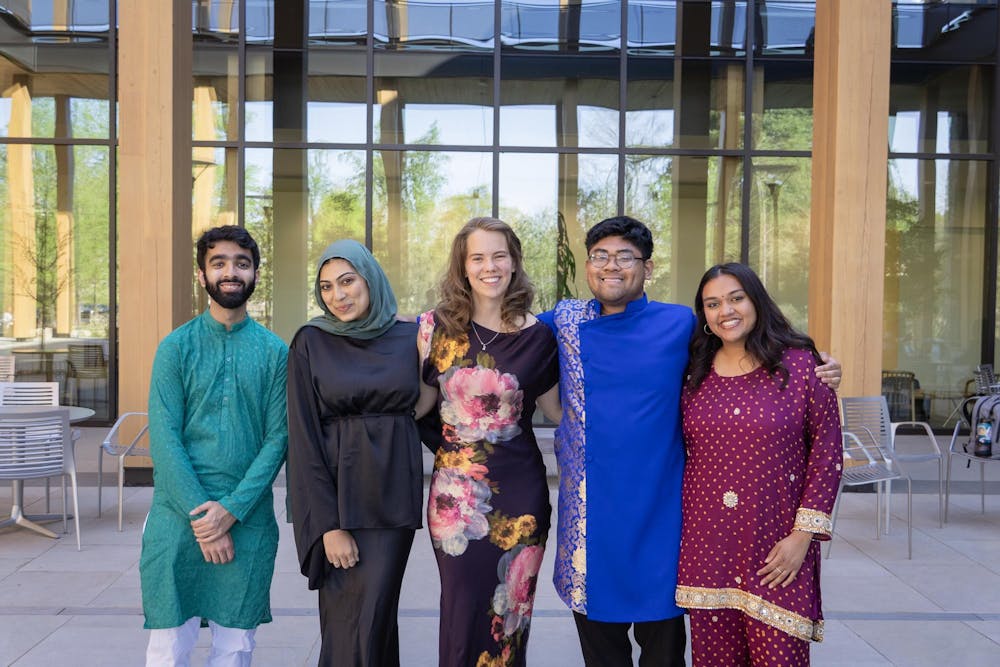
Early Friday night, with the sun setting through the windows of the Contemplative Commons Studio 1B, the Virginia Interfaith Coalition brought together over 100 people of various faiths and backgrounds for a night of food, music and conversation. With keynote speaker Reverend Doctor LaKeisha Cook, executive director of the Virginia Interfaith Center for Public Policy, the event covered a wide range of topics, including faith, politics and community.
Established at the University in 2016, VIC is a Contracted Independent Organization that facilitates events and encourages spaces where various faith groups can come together and find common ground. Sheryl Loden, VIC co-president and fourth-year Engineering student, delivered the opening remarks on VIC’s values with Niki Patel, VIC co-president and fourth-year College student.
“VIC is a CIO on Grounds that strives to connect the religious community through advocacy and education. We advocate for religious students by meeting with University administration, promoting other faith-based CIOs and forming partnerships with relevant groups on Grounds,” Loden said. “We are also equally committed to education, as we believe that understanding each other leads to connection.”
This was the second annual Interfaith Dinner Night after VIC was inactive from 2019-2023 due to the COVID-19 pandemic. VIC was restarted last year in order to promote cross-cultural communities. For Patel, VIC does just that, fostering spaces of open dialogue in a religious climate that can feel overwhelming.
“I'm from South Asia, South Asia is notoriously known for being one of the most diverse places on Earth … I grew up with my neighbor being Muslim, and [the person next to them] being Christian … we would all go to the temple together,” Patel said. “But I think [community] gets overcasted or ignored when the louder voices are talking about religious tension ... I wanted to specifically be in a space where I could have interfaith dialogue and learn, as Sheryl would say, ‘from my neighbor.’”
The dinner was supported by the Interfaith Students Center, the Honor Committee, the Division for Community Engagement and Equal Opportunity, the Contemplative Sciences Center and U.Va. Dine. U.Va. Dine, through the Virginia Catering Company, provided a plated dinner with various accommodations for different religious and personal dietary restrictions.
Delaney Couri, interfaith program coordinator with the Interfaith Student Center and unofficial advisor of the VIC, was instrumental in connecting the organizers with people of faith throughout the community, according to Patel. For Couri, they hoped the dinner brought new insight and impact to the attendees as individuals.
“I hope the event brings catharsis. I hope it brings good conversation, and with all the folks that I've seen here tonight, I am pretty assured that it will,” Couri said.
Before the meal began at 6 p.m., the outdoor space of the Contemplative Commons was filled with artwork by students of different faiths. There were paintings, statues and a playlist of instrumental music from different religions set softly behind it all. Karen Marsh, executive director of Theological Horizons — a Charlottesville-based non-profit Christian ministry — found the art to be an enjoyable tool to explore faith.
“People who are spiritually curious have a lot to talk about and a lot to share, a lot to learn from each other … I just find it so delightful to get to know how people express their faith in the world.” Marsh said.
As the music slowed and attendees were called inside, John Thach, VIC event chair and fourth-year College student, called for a series of prayers from different traditions.
“Each tradition represented here has a long history, and with this interfaith prayer we want to give voice to these traditions, and to share a space of goodwill and mutual respect,” Thach said. “As we hear from each representative of their respective faiths, I want to invite you to appreciate their words and their prayers with openness and quiet reflection of our shared humanity.”
Some of the prayers presented were from Christianity, Hinduism, Buddhism, Islam, Bahá'í and Judaism. Asst. Religious Studies Prof. Sam Shuman sang ‘Di Tsukunft,’ a Yiddish song written by Morris Winchevsky, a Jewish, socialist leader, dating from the early 1900s.
After the prayers were finished and a land acknowledgement was made in remembrance of the tragedy of the Monacan peoples’ removal from this land, dinner commenced. To make religious discourse as accessible as possible to all attendees, the VIC executive team created discussion prompts on cards and placed them at each table.
Some discussion prompts included, “How does religion and/or spirituality play a role in your life?,” “What, if anything, would you like to see change in religious life at U.Va.?,” and “What, if anything, is the biggest barrier to you engaging in interfaith conversations with others?” Annie Weinberg, executive director of the Brody Jewish Center and Class of 2019 alumna, found these exercises helpful for such a diverse group of individuals.
“It's hard to find one Jewish person who believes and feels the same way about everything, or has the same rituals on a holiday, or has the same life experience as the next person,” Weinberg said. “I think it's more [about] coming in with curiosity and meeting each person as an individual.”
The meal itself was delicious and light, with a variety of entree options made for various faiths. Based on a pre-set menu curated from the RSVPs of the attendees, it opened on a small salad, then moved on to the main course. U.Va. Dine worked to accommodate all preferences, and each plate was made specifically for its recipient.
When the meal was finished, Cook delivered her speech, detailing the motivations behind her work with the VICPP. The organization has over 25,000 members, making it the largest faith-based advocacy organization in the state, and has been active for 43 years. Cook became involved in 2020, pushing faith-based advocacy against the death penalty, advocacy which led to its abolition in the state in 2021. Since succeeding in that mission, the VICPP has continued to advocate for economic, social and religious justice across Virginia.
“A guiding principle that I hold for my life and my work is called Ubuntu. Ubuntu means I am, because we are ... Because it should never be enough for you just to have an individual win,” Cook said. “It's about the collective win of the community … I am because we are … We fight for justice, not just for ourselves, but we fight for justice for everyone.”
Once Cook wrapped up, attendees began gathering their belongings and finding friends — but the conversation continued to burn strong. Second-year College student Annika Bhatia shared how the evening was valuable to members of the University community.
“Talk to people who aren't the same as you,” Bhatia said. “The active engagement with others and trying to be there and trying to have these conversations is really important … I think that encouraging that concept … to people who are open to it, would be beneficial for the student body.”
Read More

Hoo Needs a Hug brings parents, treats and joy to Grounds
By Ingrid Gay and Luke Smiley | 6 hours agoAptly named Hoo Needs a Hug, this once-a-semester pop-up event from University parents aims to help provide emotional support during stressful times for students.

Feeling the burn with Pilates Reformer at North Grounds Recreation Center
By Lily Notter | 20 hours agoReformer Pilates is a full-body, low-impact workout that focuses on strength, flexibility, mindfulness and stabilization.

The world kept scrolling
By Aditi Burra | 4 days agoI began to find a sense of peace in not knowing. I felt so much more at ease with myself and my life, all because I deleted a few apps on my phone.