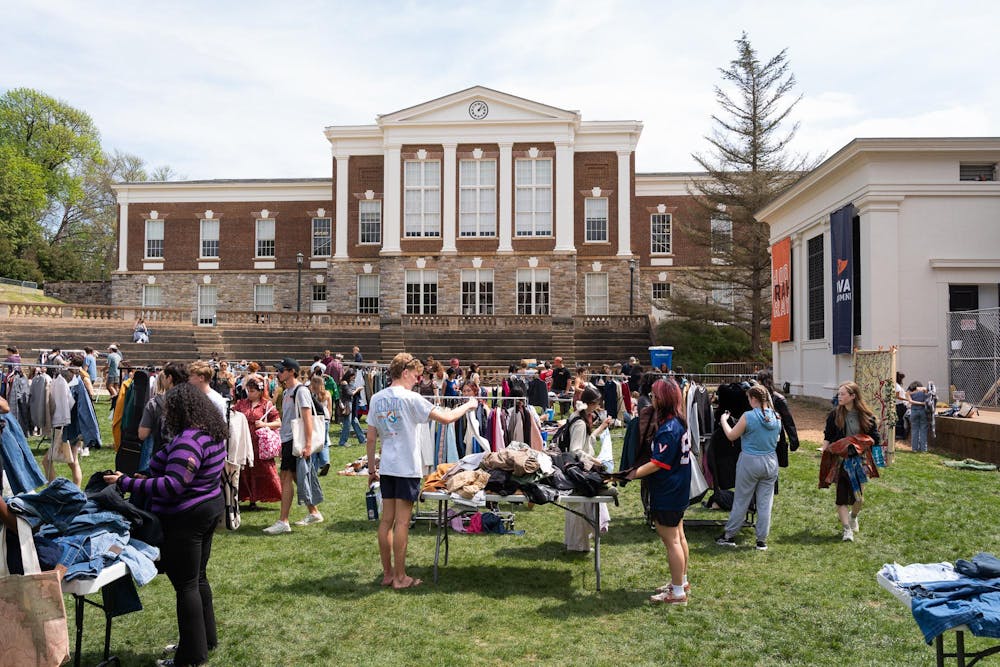
Sunday, racks of secondhand clothing lined the Amphitheater as students and community members came together to sift through garments in search of their next closet staple. From 1-3 p.m., live music and animated conversation filled the air at “Ye Olde BIG SWAP.” Embracing a medieval-inspired theme, the event was hosted by the Contracted Independent Organization SWAP, which is an acronym for Sustainability, Wearing confidence, Accessibility and Promoting community. The event reimagined the traditional clothing exchange as a Renaissance-faire-like experience — aptly dubbed a “RenaisSWAP faire.”
This event is one of the many listed on the University’s Earth Month calendar, a series of activities, celebrations and opportunities for involvement hosted by various organizations in an effort to promote sustainability on and beyond Grounds.
SWAP received CIO status in 2023 and has been hosting BIG SWAP events once per semester since then, welcoming students and community members to exchange clothing, shoes and other accessories. Alongside its usual mix of live music and secondhand clothing, this semester the organization expanded the event to include vendors selling handmade items, clothing and baked goods.
The rules of BIG SWAP are intentionally straightforward. Students and members of the broader Charlottesville community trade in gently used clothing items or accessories in exchange for tickets — tracked digitally by organizers — which can then be redeemed for other donated items.
In the days leading up to the event, organizers host donation drives to build the event’s inventory. Even on the day itself, attendees are encouraged to arrive with items in hand, adding to the available selection and allowing them to take part in the swap.
Planning for BIG SWAP begins early in the semester, as SWAP’s executive board works in tandem with its roughly 400 general body members to coordinate the many moving parts of the event. In the weeks leading up to the swap, members collect donations and secure materials such as tables and clothing racks to display items on the day of the event, relying heavily on other CIOs and local organizations for many of these resources.
For this semester’s BIG SWAP, organizers collaborated with the student band Mona Lisa to provide live music, as well as vendors from both the University and the broader Charlottesville communities, including Stepmom LLC, Matchas for Mexico City and more.
The scale of the event’s impact is reflected in the sheer volume of garments donated and exchanged — according to Christian Wright, SWAP co-president and fourth-year Engineering student, this year saw roughly 2,300 donations. Besides facilitating the exchange of thousands of items, he shared that rather than allowing any leftover clothes after the event to go to waste, SWAP makes a deliberate effort to give them a second life.
“We always end up with leftover clothes, because some people will donate 50 or 60 items and only take one or two things,” Wright said. “So from the last SWAP, [we had] over 2000 clothes exchanged and had a few hundred left over.”
Wright said that the organization first prioritizes redistribution within the University community, partnering with initiatives such as Student Council’s Cavalier Career Closet to expand students' access to professional attire.
From there, SWAP extends its efforts into the broader Charlottesville community, working with local organizations such as ASPCA to distribute clothing. According to Jace Bernard, SWAP’s fashion chair and second-year College student, rising clothing prices make the organization’s sustainability efforts especially important.
“Clothes, especially now, are getting so much more expensive … thrift stores are starting to have … mall prices for just a plain white t-shirt. It's pathetic. It's an excuse for people to price gouge you out of things when you can't afford items,” Bernard said. “[As a] club, we're teaching people how to not only wear clothes sustainably, but how to live sustainably.”
This concern extends beyond rising costs to larger issues within the fashion industry. Both Bernard and Wright noted how fast fashion prioritizes speed and trend cycles at the expense of quality and sustainability.
“Fast fashion [does] not [use] the best materials … it's a quick trend that's just automatically over,” Wright said. “Noticing how unsustainable fashion is, that's [SWAP’s] goal, to try to mitigate some of that, and start a more [of] a circular economy when it comes to clothes.”
Though BIG SWAP is perhaps SWAP’s most recognizable event, it constitutes only one part of the organization’s broader mission. According to Bernard, the event functions less as a standalone attraction and more as an entry point into its wider sustainability efforts.
“At the event, we see people coming by [who] they might ask questions about what SWAP does outside of [the event],” Bernard said. “We always tell them [that] this is one event we do each semester, but it is not the only event we do each semester. We really try to hone in to the fact that this is one single, minute thing in our broader mission of sustainability efforts.”
Outside of BIG SWAP, the CIO also hosts Corner Cleanups, sustainable zine-making workshops and group thrift outings. Still, BIG SWAP plays an important role in promoting SWAP’s four pillars. For Wright, the event itself offers more than just a chance to refresh one’s wardrobe — it gives attendees the opportunity to contribute to greater sustainability efforts.
“The biggest thing [attendees] learn is that clothes never belong in the trash. They never belong in the dumpster,” Wright said. “Because there's always something that you can do with it. We wholeheartedly believe in the old saying ‘one man's trash is another man's treasure.’”
For attendees, bringing the thrift store concept to Grounds is part of what distinguishes the event from more traditional forms of secondhand shopping. William Niermann, BIG SWAP attendee and second-year College student, noted that the event reaches a broader audience by bringing the exchange to Grounds.
“Thrift stores are pretty self-selective because people that go thrifting already care about sustainability,” Niermann said. “But, SWAP is different because it reaches out to the whole U.Va. community. It comes to Grounds, unlike thrift stores.”
Beyond sustainability, the event also fostered a sense of community among participants. Stephanie Dinh, SWAP member and volunteer and first-year College student, noted the spirit fostered by the event.
“I've been seeing friends split up to different tables and find items that they think their friends are gonna like and then lifting it up and shouting to their friend, ‘I think this would look great on you,’” Dinh said. “Having that moment of coordination, that moment of ‘I see you in this item.’ [It’s that] shared spirit of making sure everyone has something that they're happy with at the end of the day.”
From the perspectives of both Bernard and Wright, BIG SWAP appears to be about more than just clothing, instead reflecting an effort to reshape how students think about consumption and self-expression. By creating a space that is both accessible and mission-driven, SWAP encourages participants to view fashion not as disposable, but as something meant to be reused and shared between members of the community.
“One thing that [we’ve] definitely been trying to make sure that people know is that regardless of how you dress, it doesn't matter — you have a place in SWAP,” Bernard said. “You have a place in the conversation about sustainability and you have a place in the conversation about going against fast fashion and recognizing how immoral it is.”
Read More

ROUNDTABLE: The ins and outs of sexual health on Grounds
By Ingrid Gay , Madigan Wirkus and Summer Hoffman | 2 days agoThree sex and relationship beat writers from The Cavalier Daily’s Life desk discuss their approaches to navigating sexual health on Grounds and beyond.

Fall Activities Fair marks new beginnings for students
By Ingrid Gay and Claire McGinn | 2 days agoOrganized by Student Council, students browsed over 550 Contracted Independent Organizations, Special Status Organizations and other student-oriented organizations to learn about the plethora of avenues for involvement around Grounds.
Opening Convocation welcomes new students to Grounds
By Astrid Cheng | 3 days agoThe ceremony formally welcomed the University community's newest members, bringing together around 4,000 first-year and transfer students.