Editor’s note: This article is a humor column.
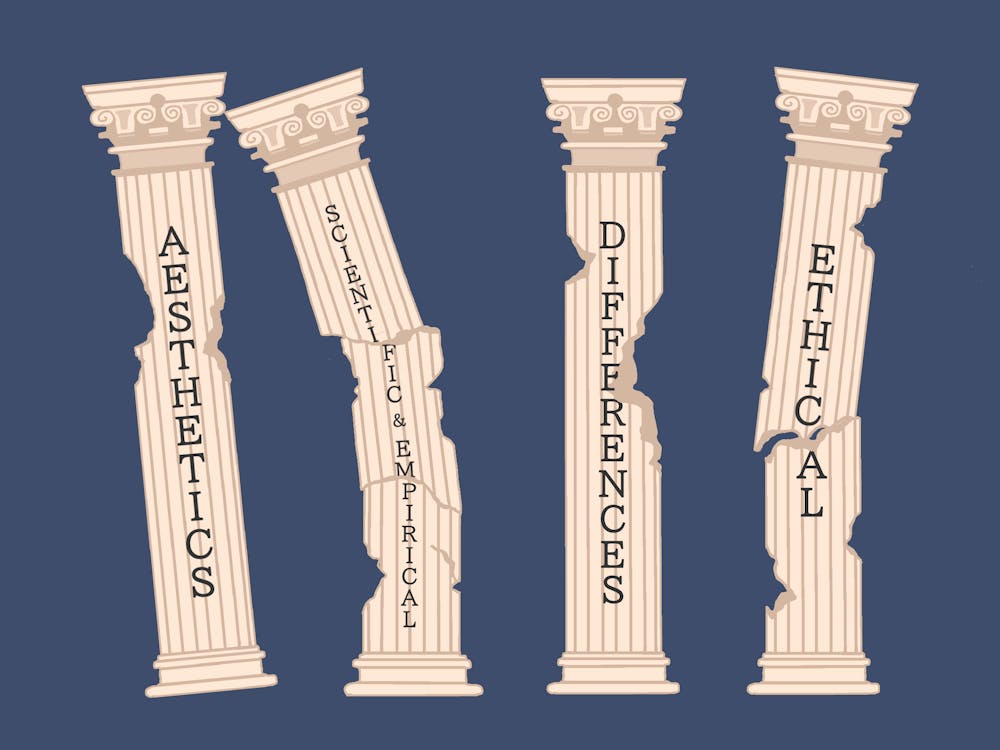
The Engagements, which were first introduced on Grounds as an "experiment," have quickly evolved into the central trauma of the first-year experience. As first-years attempt to craft the "perfect schedule" with classes like ECON 2010 or CHEM 1410, they must also navigate the outright panic of trying to enroll in an Engagements class. While first-years at other universities are trying to balance choosing the right major with picking the right career, University students are busy trying to achieve the perfect balance of Empirical and Scientific, Ethical, Aesthetics, and Differences.
Forest Barkley, rising second-year College student and chemistry major, recalled his first-year experience, specifically regarding enrolling in his Engagements courses.
“It’s a brutal process,” Barkley said. “In my first semester, I was waitlisted for EGMT 1520, “History of Dirt” class, which fulfills the Empirical and Scientific pillar, so I had to take EGMT 1520, “History of ‘Would You Rather’” instead. It messed up my entire schedule. My advisor said I needed CHEM 1410 for my degree, but I dropped it because these Engagements seemed way more relevant to my future career in engaging.”
In an effort to preserve the University’s global standings amidst the administrative changes of 2025, University leaders have announced a new yearlong Engagements cohort for the 2026-27 school year. This cohort, a special group of 25 students who will uniquely be allowed to take only these classes, will move away from the confines of things like "facts" or "grades," to instead focus on the random and bizarre areas of our world.
The four pillars of this new cohort are designed to tackle the "Big Questions" with the depth and sophistication of a Yik Yak post. The curricula include “How to Survive a Post-Truth World,” “The Science of Whether Everything is a Simulation,” “Fact or Fiction: Violence is Never the Answer” and “How to Form Your Own Opinion.” These courses will teach students about national ideals of strength, power and unity by ignoring all divisive concerns and focusing on nuanced issues — problems that aren’t actually problems.
In a move inspired by a "No Homework" movement, the University is ditching the traditional grading scale within the cohort and instead opting for a general Vibe-Check meter. There is no homework, as the administration has deemed stress to be a violation of a student's inalienable right to chill. Instead, a student’s transcript will simply reflect their vibes in the class. This cohort will also reduce students’ uncertainty about the difficulty of their Engagements classes, which have historically varied quarter to quarter. In the past, students have even viewed particular Engagements courses as harder than their major-relevant courses. Apparently, certain professors take the two credit courses they teach too seriously, treating the Engagements like their primary job.
For example, extreme head-nodding and hand-raising will result in a GVO — Good Vibes Only — grade. However, asking the professors to explain why they graded a certain way will result in a VK — Vibe Killer —- status. University administrators are optimistic about this new scale and are eager to carry out another successful experiment to once again “improve” student experience.
Dr. Nunya Besnes, History professor in the College, is credited as the lead curriculum designer and main point-person for this new cohort. Dr. Besnes has shared what leading this initiative has meant for her.
“I was certain I was going to be fired after my department lead noticed I stopped giving exams, but I explained how I grade based on feeling,” Dr. Besnes said. “I was shocked to be given this responsibility, but the dean told me my teaching style was intellectually unstimulating, which I think is a fancy way of saying very effective.”
The University expects there to be an overwhelming amount of interest in this cohort, so they have required a formal application for it. The application consists of several essays where there is no prompt or direction — you simply have to find a way to impress them. There is also a mandatory video component that needs to showcase a student’s overall vibes. In the words of the cohort teaching staff, only the most "lit" and "aura" students will be accepted, ensuring the collective energy remains at a peak level.
Ultimately, this new cohort program marks a shift in the educational direction of the University, proving that in a world of complex global issues, the most useful thing a student can do is catch a vibe.
Read More

Scott Stadium set to implement DoorList for entry following student ticketing backlash
By Nafeesa Naz | 2 days agoDue to the controversial decision to require student tickets for entry to football games, the department has chosen to require DoorList to enter.

U.Va. to host first annual Club Rejection Fair
By Nikitha Prabhu | 6 days agoThe University announced that it will host its inaugural Club Rejection Fair following another competitive fall recruitment cycle.

I still have no idea what my CIO does, and that’s okay
By Owen Andrews | October 2, 2026Upon reflection, I’ve decided that it doesn’t matter if I don’t know what my CIO does.