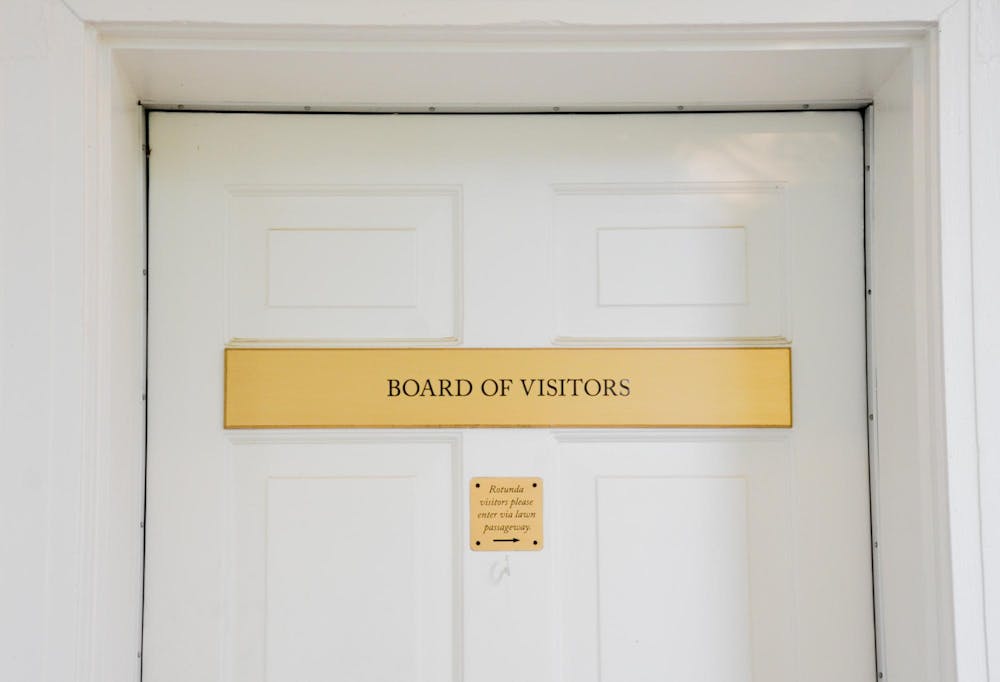
The University's Board of Visitors looks far different today than it did even two years ago. In the past year alone, it was reshaped twice — the first time by former Gov. Glenn Youngkin (R), and then by current Gov. Abigail Spanberger (D). The individuals appointed to the Board through these makeovers have had a significant impact on University governance, including the presidential resignation of Jim Ryan, Law professor and former University president, and the upheaval of University policies such as diversity, equity and inclusion programming.
But the changes do not only stem from the governor appointments — the backgrounds of Board members are evolving as well. Once composed of statesmen and planters during the University’s founding in 1819, the Board is now dominated by lawyers, business executives and financiers.
The modern Board's shape is set by state law. The Code of Virginia provides for 17 voting members appointed by the governor and confirmed by the General Assembly, requiring that at least 12 be Virginia residents, at least 12 be University alumni and one be a physician with experience in an academic medical center. However, the Board can conduct business given a quorum of five members is satisfied.
Further, the Board is composed of the Executive Committee and eight standing committees — the Academic and Student Life Committee, Advancement Committee, Audit, Compliance and Risk Committee, Buildings and Grounds Committee, Executive Compensation Committee, Finance Committee, Health System Board and the Committee on the College at Wise.
In sum, the Board oversees long-term planning of the University, sets the annual University budget and holds power to hire or fire the University president. Authorizing the establishment of centers and schools when it sees necessary, creating or discontinuing degree programs, determining salary ranges for faculty ranks and setting tuition rates are among some of the Board’s duties as well.
Members serve four-year terms and may be reappointed for a total of two consecutive terms. They may serve for more than two terms over a lifetime after at least four years have passed since the end of their second consecutive term. Since each seat is filled by gubernatorial appointment, the Board’s composition can change substantially when a new governor takes office or as members’ terms expire. On the current Board, 10 members are Spanberger appointees — whom she appointed in January — six are Youngkin appointees and one was appointed by Youngkin and reappointed by Spanberger in June.
Over the past two years, both the partisan balance of the Board and the professional backgrounds of its members have shifted.
Michael Kennedy, 2024-25 faculty representative to the Board and Education professor, said that he had previously grown accustomed to the Board working quietly alongside University administration. That changed as Youngkin filled seats across his term, Kennedy said.
By the end of Kennedy’s year on the Board, 13 of its 17 voting members were Younkin appointees — a supermajority with the votes to pass resolutions and direct University policy on its own. Around the time of Ryan’s resignation, the Board had only 12 voting members, and all were Youngkin appointees.
Kennedy pointed out that while he nor Ryan shared all the same beliefs as the majority of the Board members, Kennedy said he thinks a diversity of opinions on the Board is a good thing.
"Where things boiled over was when things were pushed through because the [Youngkin appointed] supermajority was in place without proper deliberation, and when things happened in smoke filled rooms," Kennedy said. "Then ultimately you read about it in the New York Times, and the president of the University has resigned."
Tracing back the leadership of the University to its first president in 1904, the demographics and backgrounds of Board members have substantially changed, and the current Board is working to regain trust in the University community following an eventful year.
The history of the Board, which begins with landowners
When Thomas Jefferson founded the University, he built its governance without a president, vesting authority in a Board led by a rector, while a rotating chairman of the faculty handled academic affairs — an arrangement that reflected his distrust of concentrated executive power. The University operated without a president until the early 20th century, when it named Edwin Alderman as its first in 1904.
According to Founders Online — a free archive of historical documents from the University of Virginia Press and the US National Archives — the early Board was drawn from Virginia’s politically powerful landowners. Jefferson was named the University’s first rector in 1819, and the early Board seated former presidents and statesmen — among them James Madison, elected rector in 1826 — alongside planters, generals and legislators such as James Breckenridge, Joseph C. Cabell and John Hartwell Cocke.
The leaders of the University were of an agrarian, slaveholding society, and, when the University opened and held its first classes in 1825 — six years after the completion of the University’s first building — the children of many of these leaders became the first students.
Today, the backgrounds of Board members have shifted more towards business, law and finance. The Board’s rector and vice rector, Carlos Brown and Victoria Harker, respectively, are described as business and civic leaders — Brown is the executive vice president, chief administrative and projects officer and corporate secretary of Dominion Energy, and Harker is a corporate executive who serves on the Boards of Huntington Ingalls, Xylem Inc. and Philip Morris International. Recent members have included a beverage-company chief executive and a partner at a major corporate law firm.
The University’s drift from the political to corporate elite on the Board mirrors a national pattern. Business has been the most common occupation among university trustees since the 1980s, according to a 2020 survey by the Association of Governing Boards of Universities and Colleges, which has tracked the composition and demographics of college and university boards since the late 1960s.
The increase in lawyers and businessmen as Board members in the present-day
The trend identified by AGB that “business” is the most common occupation nationally accounts for both public and private sectors since 1985. Surveyed boards by AGB have also remained, over the decades, predominantly older white men.
This shift to business and professional services has slowly increased for decades. AGB’s tracking of public boards shows the share of members from the business profession rising from 36.5 percent in 1997 to 40.8 percent in 2020, while the share from education professions slipped from 14.1 percent to 10.7 percent in the same period. The shift is more pronounced on private institutions’ boards nationwide, also according to AGB, where business representation climbed steadily from 47.9 percent in 1997 to 56.6 percent in 2020, while the public boards have increased representation from 36.5 percent to 40.8 percent in the same time frame.
Jeri Seidman, faculty representative to the Board, former Faculty Senate chair and associate professor of commerce, said that since 2019 — when she joined the Faculty Senate — the Board has been largely made up of business people. She said she wishes the Board’s membership better reflected the University’s academic strengths. She pointed to its English department and the doctoral graduates who go on to faculty posts at universities such as Stanford University and the Massachusetts Institute of Technology.
"I do wish that the [Board] picks could better reflect U.Va.’s strengths," Seidman said. "It'd be great to have [individuals with a background in higher education] on the Board … I would personally love that — even as a business person."
Seidman noted that the majority of universities across the nation have business people and lawyers in their governing bodies in similar proportions to the University’s Board.
Kennedy, who participated in a year of Board meetings in 2024-25, offered his view on the current Board’s composition. A Board member’s profession, he said, mattered less than a Board member's connection to the present-day University. The longest-serving members, he said, were sometimes nostalgic for an earlier version of the school — the University of the 1970s and 1980s. Therefore, according to Kennedy, some current members are less attuned to how much the University has changed, including its demographic changes.
"[Older Board members] remember a U.Va. of the 1970s [and] the 1980s that they loved and still love — the University was a very different place than [today]," Kennedy said. "The College dominated … far more than it does today. The professional schools … weren't nearly as influential and essential in research and revenue generation as they are now.”
By contrast, Kennedy said, Board members with children currently enrolled experienced the University anew — a connection that, in his telling, cut across professional and political lines. He pointed to David Webb, a conservative businessman on the Board with a daughter at the University, as an example of how that parental lens could matter more than a Board member’s background.
"[Webb is] somebody with whom I don't agree on a lot of policy issues, but we had positive dialogue,” Kennedy said. “We had very positive interactions around, 'Hey, how's your daughter doing? … Is there anything that faculty need to know or be on our radar?’"
Of the current Board’s 17 voting members, four are women and the rest are men — of the 13 men, eight are white. Regarding current members’ professions, nine are corporate leaders. These members include Brown, Harker, Board member Michael Bisceglia, who is the president and co-founder of the Stauer Watch and Jewelry Company and more. Additionally, two Board members are lawyers, and at least four others currently have or previously held careers in the law.
The politics of Board appointments and legislators’ push for more representation
When asked whether the recent changes to the Board's composition have caused the Board to become more political, Kennedy expressed caution. The events of the past year, he argued, owed less to the Board's composition than to the extraordinary federal pressures on universities across the country.
Over the last year, beginning with Ryan’s resignation, the University rejected the Trump administration’s “Compact for Academic Excellence in Higher Education,” signed an agreement with the Department of Justice to comply with civil rights guidance and saw the recomposition of the Board by Spanberger. Kennedy characterized the federal pressure on universities nationwide over the last year as without precedent in U.S. history.
"The interference from Washington — via the Justice Department and others — on American universities, in the way that happened beginning in January of 2025, catalyzed so many of the things that transpired here," Kennedy said. "So much of what happened last year, and trickled into this past academic term, was driven by the absolute unique set of circumstances unfolding in Washington, D.C."
In Kennedy’s career, he said the Board had drawn faculty notice only once before when they had voted to remove then-University President Teresa Sullivan. For most of his time at the University, he said, he could not have named a single member. According to Kennedy, a Board functioning as it should is largely invisible to the people it governs.
"If the Board's doing what they're supposed to do, it doesn't really touch University life in a whole lot of specific and tangible ways," Kennedy said. "They're working hand in glove with the President's office [and] the Provost's office to administer the University in ways that are invisible and allow the high-quality faculty, staff and top-caliber students to do their best work."
Kennedy ultimately expressed that a trusted Board is not scrutinized by the University community, and does not require constant oversight. Beyond actions of the Board, the conversation of who sits on the Board — specifically regarding faculty and student representation — has also drawn repeated legislative scrutiny over the past couple of years.
In the 2025 Virginia legislative session, Del. Amy Laufer (D-55) sponsored House Bill 1621, which would have required all public colleges and universities in the Commonwealth to elect nonvoting faculty and staff representatives to their governing Boards — making mandatory what most institutions, including the University, already do. Youngkin vetoed the bill, noting in his veto statement that such representatives would not be subject to General Assembly confirmation or his removal authority.
The push broadened in 2026 with House Bill 1385 and its Senate counterpart, Senate Bill 494, which would have required every board a part of a public university in the Commonwealth to adopt formal shared-governance policies and raise board members' terms from four to six years. After the General Assembly rejected Spanberger's recommended amendments, she vetoed the bills in May.
Youngkin’s recomposition of the Board, followed by Spanberger’s recomposition
According to Kennedy, he could pinpoint the moment the balance shifted in the Board when Youngkin-appointed members began in their roles July 1, 2024. In Kennedy’s year on the Board, 13 of the 17 voting members had been appointed by Youngkin with only four holdovers from former Governor Ralph Northam (D) — among them then-Rector Robert Hardie and then-Vice Rector Brown.
"When July 1 … hit, and the Youngkin-appointed members had the supermajority, I think that moment was a guarantee that there were going to be some changes," Kennedy said. "Because ultimately the Board has statutory authority to make any changes [to the University] they see fit."
The changes came in the form of resolutions passed by the Board that lacked precedent, according to Kennedy, such as the vote to dissolve the Office of Diversity, Equity and Community Partnerships in March 2025.
"Resolutions that would have a major impact on the University were not common coming out of the Board [before the instatement of Youngkin’s supermajority],” Kennedy said. “It was a big change, and there was a lot of tension between — from my vantage point — Carr’s Hill and members of the Board that were pushing these ideas that were quite different [from] the direction the University had been pursuing. And that is not necessarily a bad thing … boards of any organization exist to bring their ideas, bring their expertise, and offer those as … a way to collaborate."
Since then, Board membership has shifted again, with Spanberger requesting five resignations and appointing 10 new members to the Board in January.
The Board is rebuilding trust with the University community
Both Seidman and Kennedy have displayed optimism in the increasing stability of the Board following the turbulent events of the past year. Seidman, who attended the Board's recent retreat to Morven Farm, the University-owned estate — where she said the first agenda item was to discuss governance and accountability — described a warmer relationship with the new leadership.
"The new rector and vice rector have been incredibly welcoming," Seidman said. "They understand that trust has been broken, and there is a desire from the faculty and Faculty Senate to have contact in order to rebuild that trust, and they have responded really positively."
The Board’s retreat to Morven Farm took place June 6 and over the course of the day, the Board discussed priorities that Brown outlined in the March meeting of the full Board.
She further noted that, in her year in the faculty representative seat, she hopes for a return to normalcy, in which community members trust the Board’s governance.
"I would hope at the end of this year that nobody else has the Board meetings on their calendar," Seidman said. "[I hope that there is not] a large group sitting, watching and worrying about what might come out of a Board meeting."
Kennedy, now a year removed from the faculty representative seat, said he wishes for a similar sense of shared respect and collaboration. He pointed to the governance and accountability Board meeting held in June as a special meeting for the Board and a hopeful sign that the Board is “thinking about their duties in a high-quality way.”
Both Seidman and Kennedy described success in similar terms — a Board that operates quietly enough that the University community does not need to watch its every move. For Kennedy, the ultimate measure of a Board doing its job well is that no one notices it at all.
"I am hopeful that we are in and moving forward into a period of peacetime, where we return to a Board, still to this day, comprised of appointees from two governors working together collaboratively," Kennedy said. "Whatever it is they do or don't do won't be making front-page news… because it's just business as usual — and that is my sincerest hope, that the Board meetings are very boring."
Komal Reddymachu is a second-year student in the College majoring in Government and English. He is a staff writer on the news desk and has been writing for The Cavalier Daily since his first semester at U.Va. Komal enjoys writing about all topics, but he especially enjoys covering events around Charlottesville.
Read More
Allergy Clinic to close following accreditation review of Student Health and Wellness
By Ruby Budetti | 2 days agoThe decision follows a review of SHW by the Accreditation Association for Ambulatory Health Care.
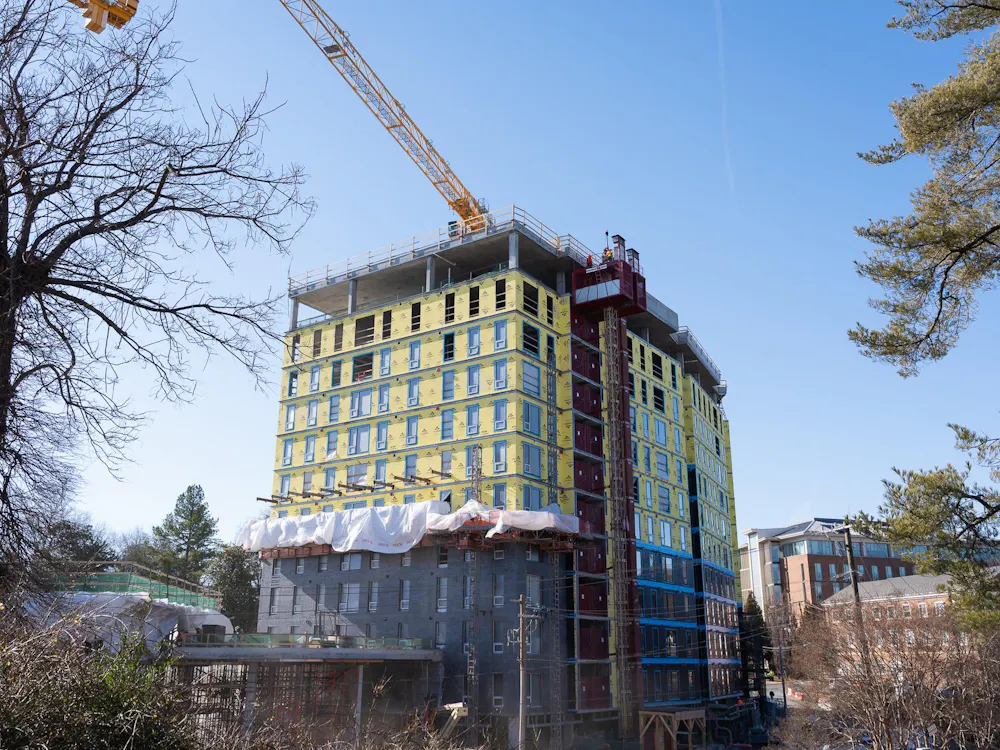
VERVE apartment set to bring 1,332 beds to Charlottesville market in summer 2027
By Edward Christopher | 2 days agoThe building is replacing nine residential buildings in the area, which is adjacent to Grounds and 0.6 miles from U.Va. Health.
Lecture hosted by Rare Book School reframes the newspaper as an industrial product
By Vrinda Vashisht | 3 days agoStamm argued that the 20th century newspaper was not only a vehicle for journalism, but also a manufactured product of industrial capitalism.