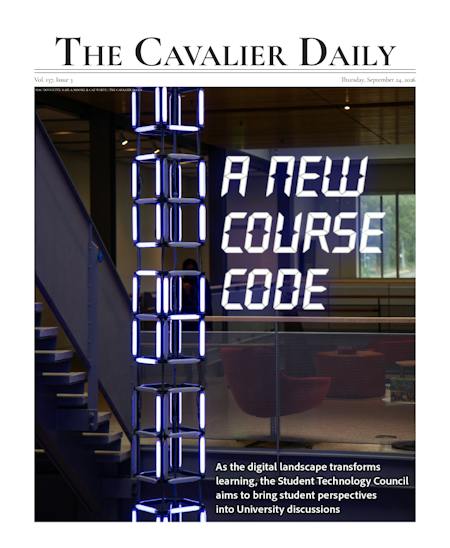
The Board of Visitors’ Academic and Student Life Committee convened Thursday afternoon to hear updates from Brie Gertler, interim executive vice president and provost, and the Partnership for Leaders in Education program. They also heard a presentation on student experiences at the University and voted on the discontinuation of two degree programs and the approval of two new graduate programs.
The Academic and Student Life Committee oversees University operations connected to student affairs, including athletics, safety, residential life and dining. The Committee also guides policies related to academics and research, including degree offerings and faculty recruitment and retention.
In her remarks, Gertler provided an extensive update on major academic events and research funding since the Committee’s September meeting, highlighting both accomplishments and ongoing challenges stemming from the fall semester’s federal shutdown.
The Karsh Institute of Democracy hosted its Democracy 360 conference in October — a three-day series with nine public sessions and five work sessions that brought policymakers, students and community members together. The 2025 Virginia Film Festival, which screened 131 films, welcomed more than 140 industry guests with nearly 24,000 attendees and sold out 47 events. The School of Data Science held its annual Datapalooza conference Nov. 14 on truth and accountability in the age of AI, attracting more than 350 in-person attendees and over 100 virtual participants.
Gertler noted new partnerships and program expansions within the academic schools. The School of Engineering recently secured a $4.5 million partnership with Capital One, which will fund an artificial intelligence research center in the future Whitehead Road engineering building and support AI-focused doctoral fellowships. She also highlighted the $16 million Department of Energy grant awarded to Xinfeng Gao, mechanical and aerospace engineering professor.
In her update on research funding, Gertler reported that the University has received $249.6 million in sponsored awards this fiscal year. She noted that this represents a strong showing despite the 43-day federal shutdown earlier this fall, in which no new awards could be issued.
She explained that the University received a notice of 46 federal grant terminations — eight of which have been fully reinstated and one partially reinstated. Approximately $60 million in expected funding remains lost, especially from two awarded grants from the U.S. Environmental Protection Agency that had not yet begun.
“We are in a better position than we had feared that we would be,” Gertler said. “Any dollar that we lose is terrible, but it’s better to not have begun than to have to pull back from work that is already deeply underway.”
Admission trends were another highlight of Gertler’s remarks. As of Dec. 3, the University has received 66,431 first-year applications — a 36 percent increase from last year. She credited the Office of Undergraduate Admission for outreach efforts across the Commonwealth, noting a 29 percent rise in applications from Southwest Virginia.
The Committee also received an in-depth presentation on the Partnership for Leaders in Education — a collaboration between the Darden School of Business and the School of Education and Human Development. The presentation focused on its work with school districts nationwide to strengthen leadership and improve K-12 learning outcomes.
William Robinson, executive director for the partnership, reported partnerships with more than 200 districts and 900 schools, serving over 4 million students. He said that the goal of the program is to allow schools to utilize and spread their leadership and educational tools to address issues district-wide.
“We’re starting with a set of schools that help them differentiate and innovate,” Robinson said. “The goal is to learn lessons that spread across the entire system … because we agree that systems change will be more enduring.”
Fourth-year College student Gregory Perryman, who currently serves as the student representative on the Board, commented on the presentation and recounted meeting a group of school officials during a flight cancellation who spoke “glowingly” about their experiences at the University. He commended PLE for its national reach and noted the impact of the University far beyond Grounds.
“It’s one of those reputational and kind of service impact that we, even in this room, couldn’t know the measure of,” Perryman said. “The impacts of these programs are being whispered throughout rooms and in places across the country.”
The meeting also included a student panel featuring fourth-year College student Boris Nakashyan, fourth-year College student Kate Johnson and Lia Davila, third-year Batten and College student. During the panel, Committee members asked questions about their academic paths, involvement across Grounds and moments that have shaped their experiences.
Nakashyan described how creating learning activities modeled by escape rooms has shaped his time at the University. He explained that his first proposal of a 300-person escape room for his psychology course was after discovering how much active learning was built into the class. He highlighted the role of creating these puzzles as a way to form bonds within his community.
Johnson reflected on how athletics have defined her experience. As a two-year captain on the women’s volleyball team, Johnson said that connecting with young fans in the Charlottesville community has been the most cherished part of her career. She added that living on the Lawn has also helped her grow beyond the “athlete bubble” and learn from her community.
Davila shared how stepping outside her usual coursework led to one of her most memorable academic experiences. In her first semester as a transfer student, she took an introductory astronomy course — a class removed from her policy work in the Batten School — and said it shifted her perspective.
“As a public policy student and someone who’s always been really interested in politics, it’s easy to get really bogged down with the current issues of the world,” Davila said. “It was a nice reminder that we live on a floating rock, and there’s so much out there in this universe.”
The Committee approved the discontinuation of two degree programs — the Bachelor of Professional Studies in Health Sciences Management in the School of Continuing and Professional Studies and the Doctor of Education in Counselor Education in the School of Education and Human Development. After comprehensive reviews, the Committee found that neither program could sustain sufficient enrollment and lacked student interest.
Members also approved two graduate degrees — the Master of Science in Public Policy and Data in the Batten School and the Master of Change Management in the School of Continuing and Professional Studies. According to Gertler, the programs are designed to meet rising workforce demand in data-informed policy and organizational changes. Both programs will now require approval from the Virginia State Council of Higher Education after receiving approval from the Board.
The Committee also approved two new academic positions to honor distinguished scholarship. The Donald Black Professorship in the Social Sciences will focus on sociology and provide undergraduate access to the Donald Black collection. The Kinder Foundation Distinguished Chair of Landscape Architecture will support scholars in the School of Architecture and promote design innovation in design. Both resolutions were unanimously approved.
The Academics and Student Life Committee will meet at the next meeting of the Board March 5 and 6.

Jaylynn Perez is a third-year College student from Chesapeake, Va., majoring in government and Public Policy and Leadership. She currently serves as a news senior writer and video staffer, after previously serving as senior associate editor for the news desk. She enjoys covering topics such as University governance and local politics.
Read More
Provost search committee seeks Faculty Senate’s Executive Council input on qualities for next provost
By Jaylynn Perez and Cassidy Hazel | 17 hours agoBrie Gertler, interim executive vice president and provost, also provided updates on the University’s developing approach to artificial intelligence.

U.Va.’s Larry Sabato weighs in on midterms, issues warnings for Democrats ahead of 2028
By Luca Bailey | 17 hours agoSabato shared his insights into how the country’s 2026 midterm elections are unfolding heading into the final weeks of the campaign.
Parking on Grounds — what has changed this semester?
By Charlotte Gabriel | YesterdayAccording to University students interviewed by The Cavalier Daily, several expressed frustration with high parking prices on Grounds, as well as the difficulty in finding available parking in general.