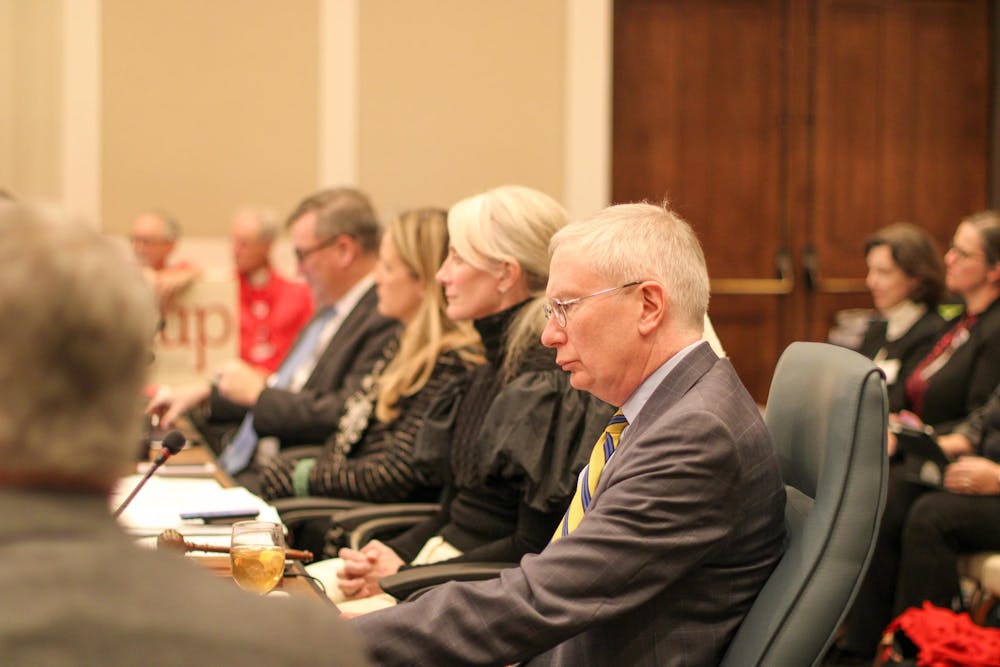
The Board of Visitors Buildings and Grounds Committee met Thursday to approve an addition to the Major Capital Plan — the Steele Wing Renovation in the West Complex following interior flooding in April. The Committee also heard about historical preservation efforts on Grounds.
The Major Capital Plan includes construction, renovation or infrastructure projects with a budget of $5 million or more, and the Building and Grounds Committee determines whether a project should be added to the plan. The addition of the Steele Wing Renovation project has an estimated cost range of $25 to $30 million, and the Committee approved the project without objection.
According to Lois Stanley, senior vice president for operations, the project came about after serious flooding to the West Complex building in April. Stanley said the Steele Wing is over 100 years old, and the chilled water piping sprung a leak on the top floor, resulting in what Stanley described as a “scene out of a season’s finale for Grey’s Anatomy.” The building has been vacant since.
Stanley said that the project would include upgrades, such as a redesigned floor plan for flexibility and efficiency. The Committee passed the motion to add the project to the Facilities Master Plan.
Stanley provided an update on the University’s annual capital planning process, and she said that her team recommends revisions to the Major Capital Plan each year based on proposals that are submitted by sponsors. Once plan updates get approved, the Office of the Architect for the University can move forward with project development. Stanley specified the different points of involvement of the Buildings and Grounds and Finance Committees throughout the approval process.
Jim Lambert, faculty representative to the Board, asked Stanley what the University is doing to learn from other institutions and their capital development projects. Stanley said that at previous institutions she has worked for, capital planning was a relatively new initiative, and many schools do not have major capital planning programs. J.J. Davis, executive vice president and chief operating officer, said the University sets a standard for other institutions to follow.
“We're the gold standard, but we're always willing to learn from others,” Davis said. “We’re always sharing ideas and learning, but based on awards, we’re hitting it out of the park.”
John L. Nau III, Board member and chair of the Buildings and Grounds Committee, said he visited two major projects Wednesday — University Avenue Park and the Central Energy Plant. Nau said he appreciated the opportunity to visit the energy plant and encouraged other Committee members to visit it.
“The staff was amazing, [and] we are lucky to have a state of the art facility,” Nau said. “You can't just call it a power plant … it is amazing.”
Of the approved projects, Stanley highlighted Fontaine Research Park and the projects it encompasses as a success. According to Davis, the Central Energy Plant uses geothermal energy to serve the energy needs of Fontaine Research Park and is carbon neutral.
The Committee also heard about the shared historic preservation efforts between the OAU and Facilities Management. Recently, the Historic Preservation Framework Plan — a project developed as part of the Getty Foundation’s Campus Heritage program for preservation planning on college campuses — has been updated, and Senior Historic Preservation Planner Brian Hogg and Sarita Herman, assistant director of project management and historic preservation, presented updates to the Committee. University Architect Alice Raucher introduced the presentation, prefacing with the University's responsibility to preserve history in its architectural decisions.
“In addition to advising you on the growth of our Grounds, one of [OAU’s] primary responsibilities is stewardship of our historic rounds for future generations,” Raucher said. “[Our team knows] exactly what to do and how to align our historic structures with contemporary needs.”
Hogg presented to the Committee the Framework Plan that evaluates all of the buildings on Grounds over 40 years old for historic significance. The plan aimed to inform decisions around buildings to honor the University’s history.
“The hope was that we would be creating a tool that would help to inform planning and design decisions regarding these buildings as we move forward — which buildings mattered, which ones didn't,” Hogg said.
According to Hogg, over 250 buildings and 27 landscapes have been evaluated for significance to the school, beauty and general upkeep. Within the evaluation, buildings and landscapes were ranked by categories of significance, and eligible properties were identified by the Commonwealth’s Environmental Impact Review process.
Once a project is chosen, the Committee then conducts research and physically investigates the current building, according to Hogg, as was done for construction to now-Shannon Library, the Rotunda and the old dorms. Hogg said the Committee creates historic structure reports to identify conditions in need of repair or where interventions can be made, such as adding air conditioning or bathrooms.
Herman walked the Committee through construction that the University Chapel has undergone that demonstrates effort to honor the building’s history. Historic carpenters, painters and preservationists have done work on the building to restore aspects of the building that reflect its history, according to Herman.
Hogg also presented the example of the Gilmer Hall renovations to the Committee that aim to put science on display with windows looking out onto Alderman Road, and Herman presented ongoing Lawn renovations to the Pavilions. Herman said two future projects that she hopes will find funding include McCormick Observatory and Lambeth Field Colonnade.
The Buildings and Grounds Committee will meet at the next meeting of the Board March 5 and 6.
Grace Little is a news editor for the 137th term. She is a third-year student from Dallas, Texas majoring in Neuroscience and the Interdisciplinary Major in Public Policy, Politics and Media Studies. She enjoys writing about the shifting landscape of higher education.
Read More
U.Va. Health first in Virginia to use a temporary heart pump in a pediatric patient
By Isabela Delgado | 7 hours agoAccording to the National Institutes of Health, the Impella device is a miniature catheter-based device, in which a long tube is “placed in the left ventricle across the aortic valve" to pump blood and maintain a systemic circulation.

Student Council considers reduced 2026-27 academic year budget
By Lucia Gambacini | YesterdayRepresentatives ultimately adopted an amendment to the proposed budget, but tabled consideration of the legislation to this Tuesday’s meeting.

Students pay University Mandatory Fees — what do they cover?
By Isabela Delgado | 3 days agoThe amount a student pays in fees is dependent on several factors, such as a students’ residence in- or out-of-state and their school of enrollment.