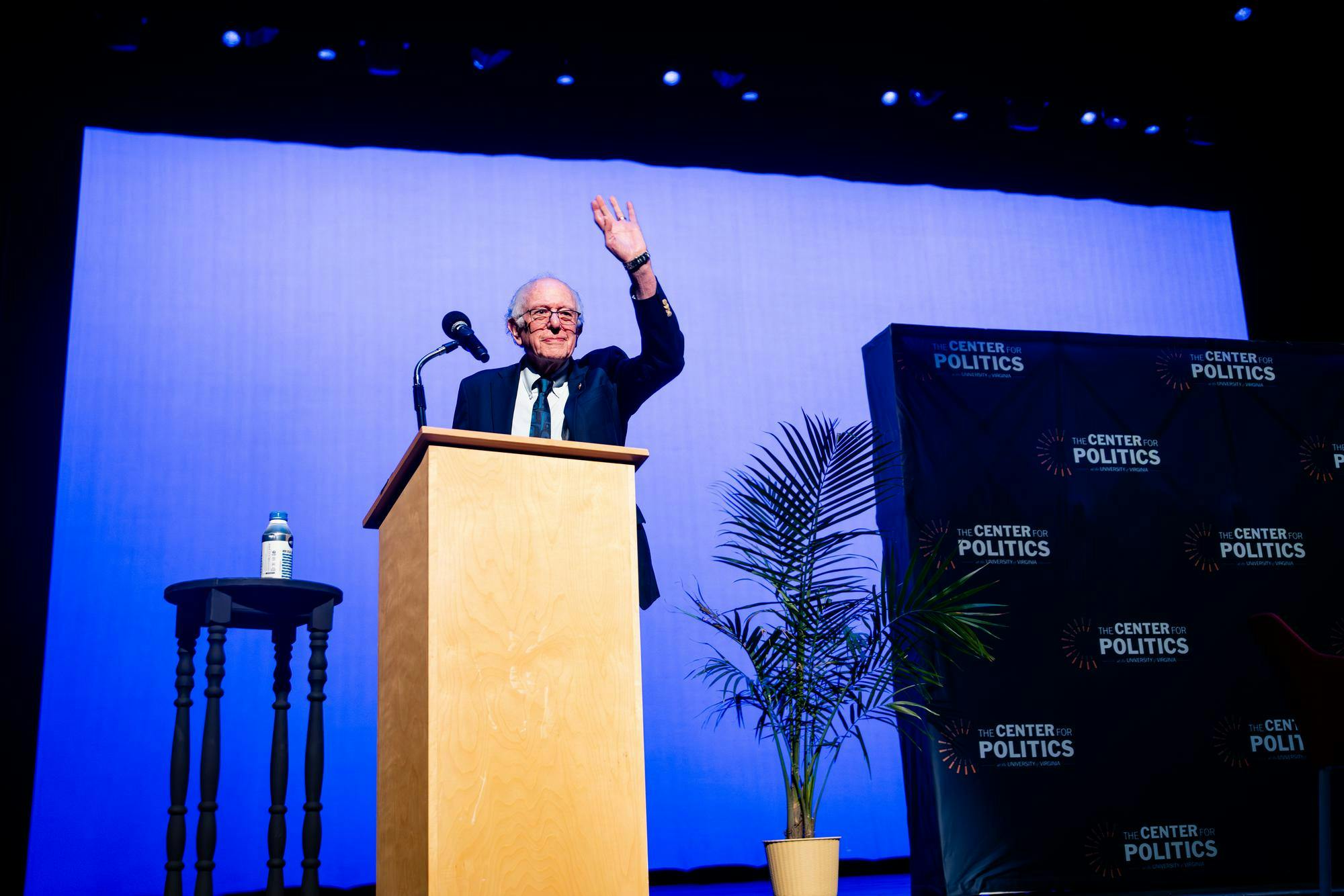
The Center for Politics welcomed U.S. Senator Bernie Sanders (I-Vt.) Thursday evening for a sold-out conversation at the Culbreth Theatre, moderated by Robert Costa, CBS News correspondent and scholar at the Center for Politics. The event — with over 520 attendees — centered on Sanders’ book, “Fight Oligarchy,” on wealth inequality, artificial intelligence and the state of democracy.
Sanders is now serving his fourth Senate term, marking nearly two decades of consecutive service. According to Costa, Sanders has earned his reputation as an advocate for income inequality, workers’ rights and progressive policies. To open the event, Sanders assessed the country’s current trajectory, arguing that unprecedented levels of income and economic inequality lead to concentrated power within the government and unfairness among Americans.
“We live in a time of more income and wealth inequality than we have ever had in the history of this country,” Sanders said. “When you have the top 1 percent owning more wealth than the bottom 93 percent, it’s not just an issue of fairness. It is also an issue of power.”
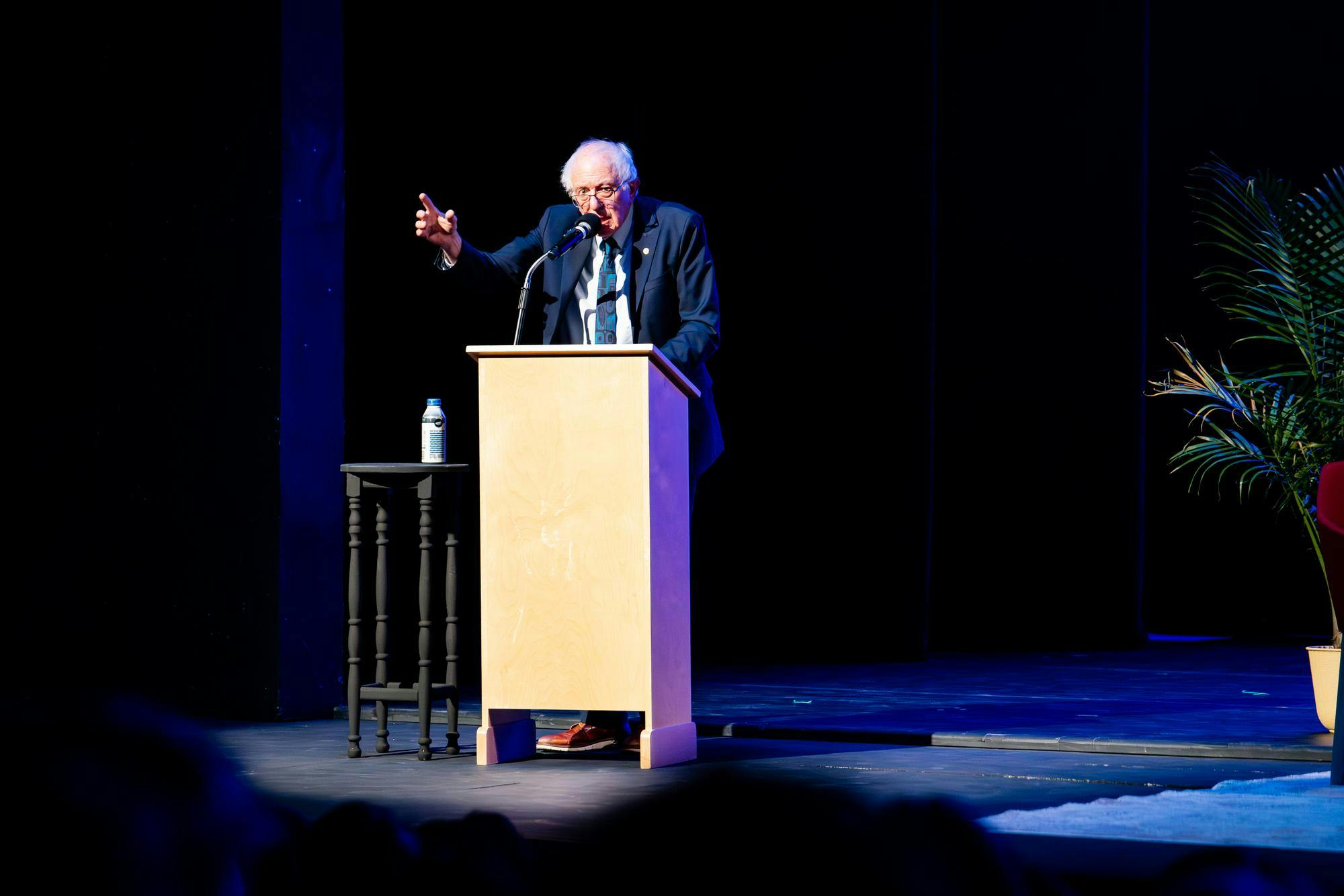
According to Sanders, a small fraction of billionaires shape the economy, influence the American political system and control the media, creating an imbalance of power. He described this concentration of influence as an oligarchy — a government where a small group holds all power.
Throughout the conversation, Sanders highlighted the role of the labor unions in addressing economic and political challenges. He referenced his recent participation in strikes — including joining Starbucks workers on a picket line in Brooklyn Monday as they protested low wages and frustrating work schedules.
Second-year College student Sam Carey attended the event and said he was not surprised by the strong turnout of students, faculty and community members. He discussed Sanders’ approach to politics and what makes him stand out from other politicians.
“Bernie is one of the few politicians that I actually can get excited about listening to because I think that he’s unconventional,” Carey said. “He goes against the grain.”
During the event, Sanders also addressed perceptions of Mayor-elect Zohran Mamdani’s political platform, saying that some people view Mamdani as socialist and overly radical. Sanders noted that Mamdani’s campaign policies — stabilizing rent, free childcare and the expansion of free bus services — were far from radical. Instead, he said true radicalism lies in the fact that the top 1 percent of billionaires hold more wealth than 52 percent of the working-class population.
“What is radical is that you are living in the only major country on Earth that doesn’t guarantee health care for every man, woman and child. That’s really radical,” Sanders said. “There is no rational reason why everybody in this country should not have higher quality health care as a human right … [and] have the best public education system.”
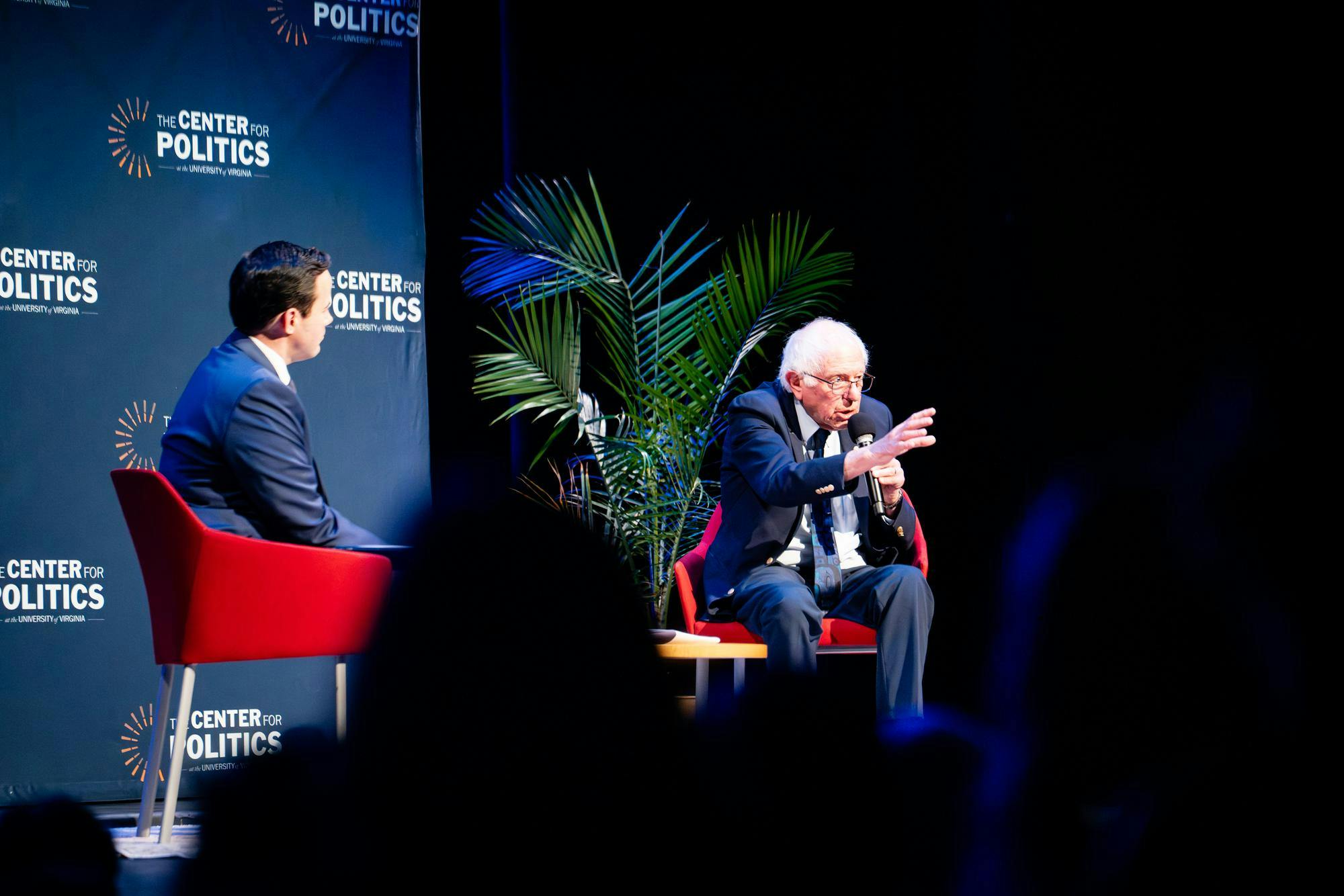
Turning to the future of artificial intelligence, Sanders asked audience members if they were worried that it poses a negative impact on the working-class population — the vast majority raised their hands. He highlighted how the growing use of AI and robotics has led to higher unemployment among college graduates and reliance on chatbots for emotional support.
“[AI] is transformative. It’s going to have an unbelievable impact on every aspect of our lives,” Sanders said. “The enormity of this issue and how it’s going to impact every life and our kids' lives has not gotten the discussion that it needs.”
Sanders connected these emotional pressures to democratic instability, noting that working-class Americans face immense stress from housing, healthcare and basic living expenses. He argued that the stress not only reduces life expectancy but also fuels political frustration when the government fails to meet citizens’ needs. For Sanders, these challenges make active civic engagement at all levels essential.
Third-year College student Kessler Kreutner-Eady said Sanders’ remarks on labor unions and workers’ rights resonated with her, noting that collective bargaining in unions helps improve working conditions. She added that his concerns about the impact of AI on the workforce mirror her own, especially regarding entry-level jobs and recent graduates, and said she appreciated his acknowledgment of the challenges currently facing Americans.
“Our generation faces a lot of problems that are fundamental, and I think not a lot of politicians acknowledge these concerns,” Kreutner-Eady said. “He did a really good job at listening to U.Va. students’ concerns about having children, getting married [and] having a life in America.”
Sanders concluded by reflecting on his decades of political activism, spanning long-term movements for racial justice, women’s rights and labor protections. He emphasized that these accomplishments were not instantaneous and that lasting change demands persistence and collective action. Recognizing the challenges that young people face today — such as climate change, political polarization and economic security — he encouraged them not to withdraw.
“You cannot live in despair. You cannot hide under the covers. These problems are, in fact, solvable,” Sanders said. “Fight for a vision as to where you would like to see this country go and be prepared to stand up and make it happen.”
The event was also made accessible through a livestream on YouTube. The full conversation can be found on the Center for Politics’ official channel.

Jaylynn Perez is a third-year College student from Chesapeake, Va., majoring in government and Public Policy and Leadership. She currently serves as a news senior writer and video staffer, after previously serving as senior associate editor for the news desk. She enjoys covering topics such as University governance and local politics.
Read More

Tao Tan discusses financial future of U.Va., rising college tuition trend nationwide
By Lily Kostro | 17 hours agoTan explained how tuition costs will shape the future of academic institutions such as the University.

U.Va. Health cuts scribe hours as AI documentation tools expand across Health System
By Vrinda Vashisht | 17 hours agoScribes in the undergraduate medical scribe program said in interviews with The Cavalier Daily that a new emergency department schedule that began Sept. 15 has reduced or eliminated certain scribe shifts and has decreased scribe availability to clinicians in the Emergency Department.

How does the Honor Committee manage its endowment?
By Isabela Delgado | YesterdayThe Honor Committee manages an endowment upwards of $200,000, and for its 2026-27 academic term, it has budgeted $204,500 — just over its available endowment.