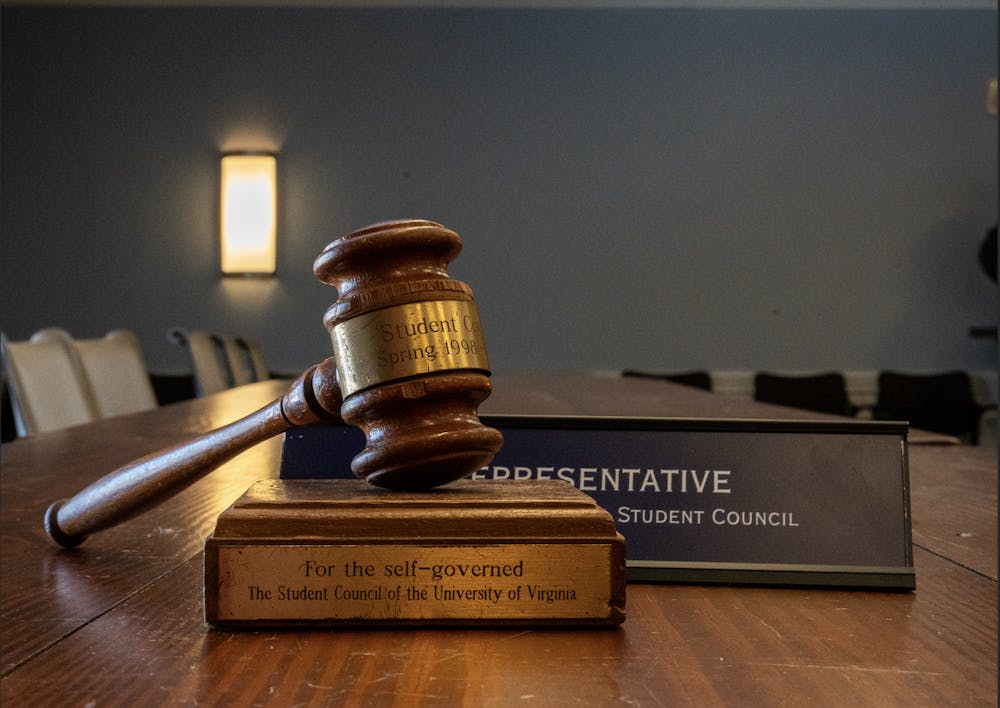
Something is rotten in the state of the University Board of Elections. A Special Status Organization tasked with monitoring and tabulating student self-governance elections, UBE’s operational blunders and institutional defensiveness rears its head almost every year to the detriment of the student body. This semester, the crown jewel of inefficacy has been UBE’s handling of allegations following the Student Council presidential election — the labyrinthine combination of poorly worded UBE bylaws and serious allegations of bribery and electoral malpractice on behalf of the Inter-Fraternity Council. Now, forced into an institutional gridlock with a yet to be confirmed election, Student Council has indefinitely postponed the transition of its new Executive Board into office — yet another egregious ramification to student self-governance due to UBE’s inefficacy.
Micah Andrews, former Student Council presidential candidate and third-year College student, identified several irregularities in this year’s presidential election, pointing towards improper endorsement procedures and election outcomes. An appeal made by Andrews about these claims to UBE was denied, until they were appealed to the Judicial Review Board. With this consequential appeal remanded from the JRB back to UBE due to its incomplete and hurried investigation, the organization is ironically tasked with digging itself out of the hole it has itself dug. Only through ameliorating its internal culture of defensiveness can UBE begin to work past the consequences that these faulty proceedings placed against the value of student self-governance.
In its capacity, UBE hosts one election per semester to elect myriad student-governed positions and allow students to vote on referenda. Therefore, UBE sits right at the core of student self-governance — student government only works if students trust the system that puts leaders in power, making it the gatekeeper of multiple institutions’ legitimacy. It is responsible for ensuring that student elections are fair through a careful process of oversight and accountability. However, recent events call into question UBE’s honest commitment to these values, trading accountability for ambiguity and internal preservation.
Internal preservation of UBE’s functions can be beneficially combined with internal improvement in UBE’s rules reports, published to the University community after each election season to summarize all complaints of election violations. The communication of these complaints and violations provides a unique opportunity for refinement — the ability for UBE to publicly analyze common miscommunications, loopholes or violations which can inform stronger bylaws and policies. In effect, rules reports are the intersection between external transparency with the student community and internal acknowledgement of UBE’s oversights. While these reports hold immense potential, UBE relegates these reports to the status of a chore requiring no earnest engagement following any violations. For example, almost every violation detailed this semester stated that “no further action was taken” to establish precedent for these issues or adjust impactful bylaws. Certainly, the Student Council presidential election fiasco reveals UBE’s hostility to internal reflection — an incapacity to look inwards at institutional weaknesses such as contradictory bylaws, rising to a far greater level of consequence for the student body.
The ongoing saga with the Student Council presidential election exposes serious impracticalities within UBE’s bylaws that exacerbate the uncertainty surrounding proper and improper election behavior. Beyond the intricacies of sidewalk chalking to advertise campaigns, UBE’s bylaws include outdated or contradictory information about its process, in addition to little information about accountability structures. For example, UBE’s own bylaws misidentify their one serious check on power, the JRB, as an arm of the UJC — this is blatantly incorrect. While bylaws exist as an important, living document for many student self-governed organizations to critically engage with their own mission, UBE seems to ignore this vital document, epitomizing a culture of insincere and detached governance.
Furthermore, by failing to engage with these bylaws on a progressive basis, UBE places itself in a reactive role — closing their eyes and hoping no challenge from the JRB or any other institution arises. Take the former example — UBE’s handling of the complaint against the Student Council presidential election drew the JRB’s ire because of its serious discrepancies in the investigation’s collection and analysis of evidence. Jill Rockwell, JRB chair and senior assistant dean of career advancement and alumni engagement in the Frank Batten School of Leadership and Public Policy, penned a justifiably searing decision that detailed each and every piece of evidence that an underprepared and defensive UBE failed to evaluate in Andrews’ complaint. While Rockwell’s remand gave UBE a second chance, the indignation and ineptitude at UBE raises concern that the organization will squander this opportunity. Indeed, it would be in the best interest of UBE to recognize the gravity of this situation and act effectively following serious challenges to its legitimacy.
UBE should not be a mysterious figure creeping in and out of students’ inboxes, sending ballots with little further engagement over the year. Rather, it should be a cornerstone of our University, ensuring students can have a role in every part of shared governance on Grounds. If UBE cannot realize its mission, consequences will continue to reveal themselves for student self-governance on Grounds. Beyond a Student Council president not being officially named, inefficiency will negatively impact whether students submit a ballot in the future. No student-governed organization is perfect, but for one that acts as the one and only avenue to electing our student leaders, UBE should surely try to be.
In the spirit of its need for community trust, UBE must publish a final, comprehensive decision on the Student Council presidential election with sincere consideration paid to all available evidence — as this was clearly lacking from UBE’s first hearing. At the same time, it must also initiate a thorough internal review which investigates past failures, answers critical questions about its role as a student organization and establishes transparent, accountable mechanisms for its governance. While the long-lasting consequences of a yet to be confirmed Student Council presidential election cannot be erased, there is a method in the madness of UBE endlessly pursuing perfection — the long-term sustainability of a vital arm for student self-governance.
The Cavalier Daily Editorial Board is composed of the Executive Editor, the Editor-in-Chief, the two Opinion Editors, the two Senior Associates and an Opinion Columnist. The board can be reached at eb@cavalierdaily.com.
Read More
ANDERSON: Why I am ‘dark woke’ — and you should be too
By Beckett Anderson | 22 hours agoArising from an internet meme, dark wokeism offers Democrats a youth-powered way out of the hole they find themselves in.

HASNAIN: The mental health taboo and its many adverse effects
By Zehra Hasnain | YesterdayYet, I write this not to propose some novel solution on finding inner peace and instead hope to push students to capitalize on existing reliable resources.
EDITORIAL: Prevent drug overdose tragedy from repeating itself
By Editorial Board | 3 days agoThe combination of these realities at Ole Miss — unsafe drug use leading to overdose and death, coupled with specious social media speculation — represents a microcosm that we must be cognizant of at our University, where drug use is common and drug education is not sufficiently provided.